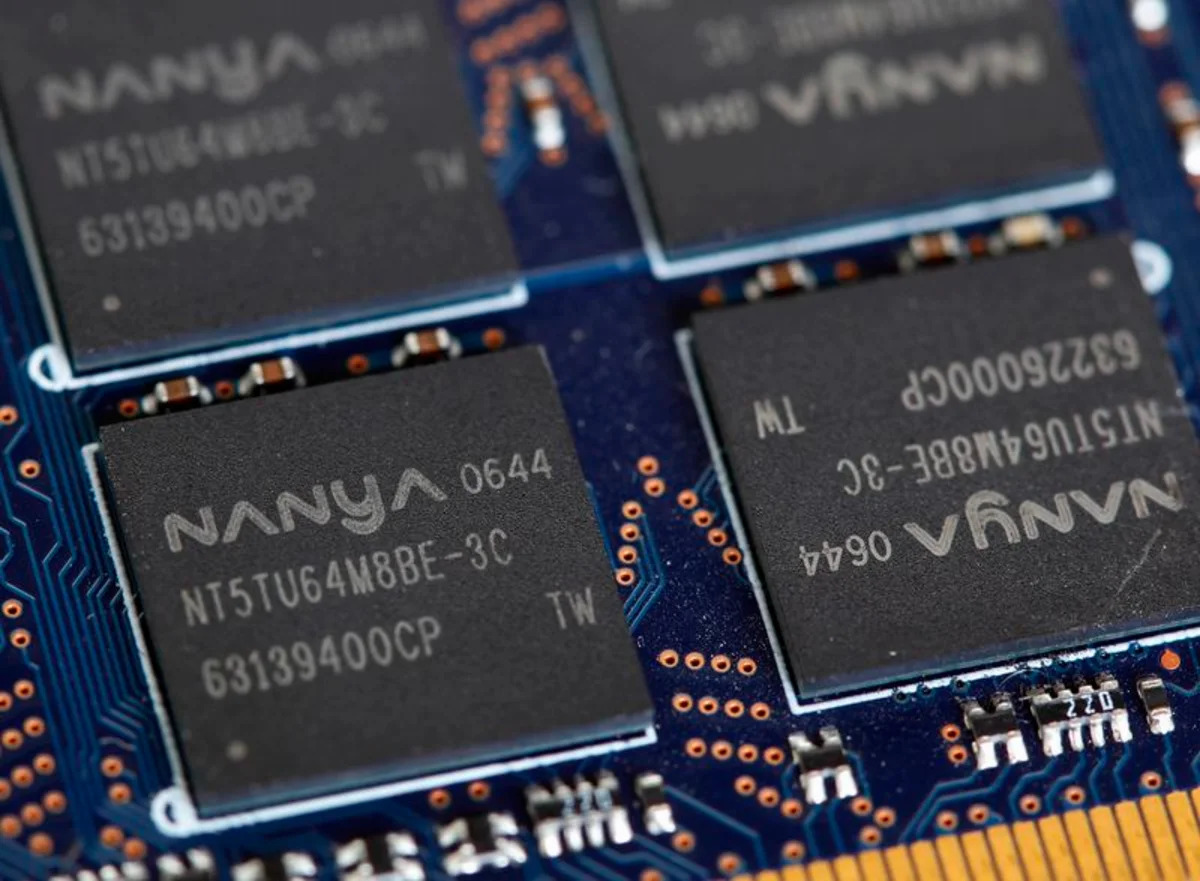
Nanya Technology, a Taiwanese memory chipmaker serving Nvidia, Qualcomm, and Google, announced plans to spend more than $6.2 billion(約9900億円) on capital investment in 2027—four times its 2026 spending—as AI-driven demand for memory chips soars. The company's second-quarter earnings surged dramatically, with revenue up 684% and net income up 1,324% year-over-year, reflecting a structural shift in the industry driven by artificial intelligence.
Summaries like this, in your inbox every morning.
Sign up free →What happened
Taiwanese memory chipmaker Nanya announced capital spending plans of more than T$200 billion(約32兆円) ($6.2 billion(約9900億円)) for 2027, roughly four times this year's figure. The company reported unaudited second-quarter revenue of T$82.55 billion(約13兆円), up 684% year-over-year, with net income surging 1,324% to T$50.19 billion(約8兆円).
Why it matters
The spending surge reflects soaring demand for memory chips driven by artificial intelligence. Nanya's gross margin improved dramatically to 79.5% from a negative 20.6% a year earlier, signaling strong profitability in the sector. The company expects the current supply shortage to persist for several more quarters, supporting continued investment.
What to watch
The new plant's first phase is scheduled to reach 30,000 wafers per month in 2028, eventually expanding to 45,000 wafers per month. Total investment in the new plant will reach about T$480 billion(約77兆円) at full production capacity. The spending plan has yet to receive board approval.
Nanya's aggressive spending plan reflects a fundamental shift in memory chip demand driven by artificial intelligence. The company's dramatic second-quarter earnings—revenue up 684% and net income up 1,324% year-over-year—signal that the AI boom is translating into real, measurable market strength. By committing more than T$200 billion(約32兆円) to capital spending in 2027, Nanya is betting that this demand will sustain beyond the immediate cycle, supported by what President Pei-Ing Lee described as "structural changes driven by artificial intelligence."
The memory industry faces a genuine supply constraint. Nanya expects the shortage to persist for several more quarters, a dynamic that justifies the heavy investment. Peers like Samsung Electronics and SK Hynix are also ramping up investment to meet the same surge in AI-driven demand. The planned new facility, which will ultimately cost about T$480 billion(約77兆円) at full production capacity, positions Nanya to capture market share as capacity comes online in 2028 and beyond. This timing aligns with the company's view that the AI-driven structural shift will support a stronger long-term outlook for the entire memory industry.
No discussion yet for this article
Get curated AI news from 200+ sources delivered daily to your inbox. Free to use.
Get Started FreeFree · takes 30 seconds · unsubscribe anytime
1 minute a day. The AI essentials.
200+ sources · Email / LINE / Slack
