What happened
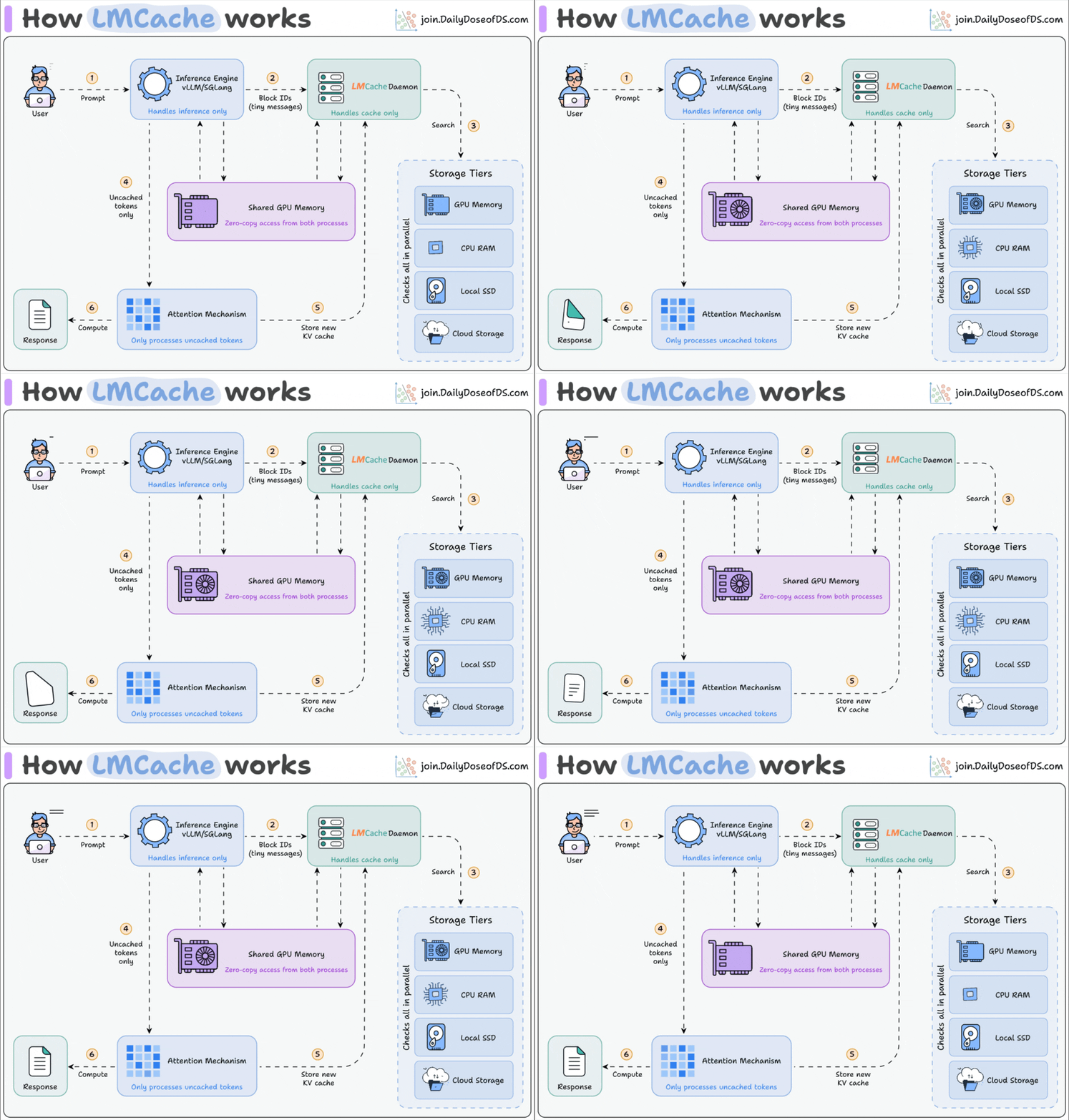
LMCache, an open-source project, separates KV cache management (the data structures AI models use to remember token relationships) from the inference engine itself, running it as a standalone process on shared GPU memory. On H200 GPUs with the Qwen3-235B model and 50 concurrent users, this architecture delivers 14× faster time-to-first-token and 4× faster decoding compared to traditional in-process caching, with startup time dropping from over 3 minutes to about 30 seconds.
Why it matters
AI agent workflows currently consume 5 to 30× more tokens per task than standard chatbot queries because ~62% of tokens sent are repeated content (system prompts, tool definitions, documents) re-sent with each step. Even as per-token prices fell 80% between 2023 and 2026, total AI costs are rising because volume outran savings. Gartner forecasts 40% of AI agent projects will be cancelled by 2027 due to cost overruns alone. LMCache addresses this by eliminating resource contention—cache I/O no longer blocks inference—and enabling multi-tier parallel loading from GPU, CPU, and storage simultaneously.
What to watch
LMCache integrates with all major inference engines (vLLM, SGLang, TensorRT-LLM) and supports both NVIDIA and AMD GPUs, making it immediately adoptable across most production setups. The project has 10k+ GitHub stars and is open-source.
Summaries like this, in your inbox every morning.
The core problem LMCache solves is a resource contention that traditional inference engines face: cache management and inference computation are fundamentally different workloads. Cache operations are I/O-heavy (moving large tensors between GPU, CPU, and storage), while inference is compute-heavy (matrix multiplications on GPU). When both run inside the same process, they cannot execute simultaneously, causing bottlenecks. Google's TurboQuant, a recent KV cache quantization technique, demonstrates this effect—it compresses cache with zero accuracy loss but causes 20%+ inference slowdown when running inside the engine.
LMCache separates these workloads entirely. The inference engine simply tells LMCache which cache block IDs it needs via tiny messages, and all tensor movement happens in LMCache's own process. This unlocks three specific benefits: no resource contention, zero-copy sharing across GPUs (eliminating multiple memory copies), and multi-tier parallel loading that checks GPU memory, CPU RAM, local SSD, and remote storage simultaneously rather than sequentially.
The timing of this release is significant within the broader cost crisis in AI deployment. Per-token prices dropped 80% between 2023 and 2026 (GPT-4 class models fell from $30/M to $0.40/M tokens), but agentic workflows consume 5 to 30× more tokens per task than standard queries because ~62% of tokens are repeated system prompts, tool definitions, and documents. This means total costs have risen despite unit price collapses. Gartner now forecasts that 40% of AI agent projects will be cancelled by 2027 due to cost overruns. LMCache targets precisely this inefficiency—not by making tokens cheaper, but by ensuring unnecessary tokens do not get sent in the first place.
Pick your industry and the AI tools you use, and get news related to your work every day.
Free · 30 seconds with Google · unsubscribe anytimeWhat is AIToday? →
Ask AI anything about this article. The AI reads this article, earlier AIToday articles, and Wikipedia, and cites its sources. Q&As are published on this page for other readers too.

