
A single cosmic ray striking a crucial bit in an LLM's weights can destroy its ability to solve even simple math problems.
The model tested—Qwen2.5-Coder-3B—dropped from 85% accuracy to total failure after only six random bit flips.
Space data centers planned by companies like those led by Elon Musk will face far more radiation than ground systems, making this vulnerability urgent to address.
What happened
A researcher tested Qwen2.5-Coder-3B (a 3-billion-parameter coding LLM) by randomly flipping individual bits in its weights to simulate cosmic ray damage. After just six random bit flips, the model collapsed from solving 139 out of 164 HumanEval problems to producing only nonsense output; the fatal flip targeted bit 14 (the most significant bit of the exponent) in a single weight in layer 27, changing its value from 0.021 to 1352.
Why it matters
LLMs running in space data centers—which Elon Musk and others plan to deploy—face much higher rates of bit-flips from cosmic rays and ambient radiation than ground-level systems. This experiment shows that even unshielded AI models can fail catastrophically from a single well-placed radiation strike; when the vulnerable exponent MSB was protected, models survived 79,000 to 490,000 random bit flips before collapse, but protection is not automatic.
What to watch
The model's behavior after fatal bit flips often included token loops (the model endlessly repeating the same output), as seen when one flip affected the embedding weight for the Thai token แฟ. Standard error-correction (ECC) memory can protect against bit-flips, but the experiment did not test whether deployed space systems will use it or what other safeguards may be needed.
Ask the AI about this article →
The experiment emerged from a practical concern: as companies including those led by Elon Musk plan to place data centers in space, the radiation environment there—dominated by cosmic rays and stronger ambient radiation—will cause bit-flips far more frequently than at sea level. Standard protections like error-correcting code (ECC) memory exist, but the author's findings reveal how naked an unshielded LLM is: a single stray particle hitting the wrong bit can instantly render a 49-billion-parameter model useless.
The vulnerability concentrates in the exponent's most significant bit (MSB) of FP16 (16-bit floating point) weights. Flipping this bit can change a weight's magnitude by orders of magnitude—in the observed case, from 0.021 to 1352—disrupting the model's entire computation. The author's bisection-search approach efficiently found these critical bits by corrupting large blocks and narrowing down the fatal flip, avoiding the need to test millions of individual flips one at a time.
When the exponent MSB was artificially protected, the model's resilience improved dramatically, surviving tens of thousands to hundreds of thousands of flips before failure. However, the collapse was never graceful; the model typically entered loops where it would repeat the same tokens endlessly, occasionally triggered by damage to specific weights like token embeddings. The experiment did not test real ECC hardware or particle physics, only uniformly random bit flips as a simplified model, so the real-world severity depends on the exact radiation environment and shielding choices made by space data center operators.
For example, today's edition would include:
AI-summarized, only the topics you pick — one digest a day via Email, Slack, or Discord.
Free · takes 30 seconds · unsubscribe anytimeWhat is AIToday? →
Ask AI anything about this article. Q&As are published on this page for other readers too.
Israeli startup DataAgent Ltd

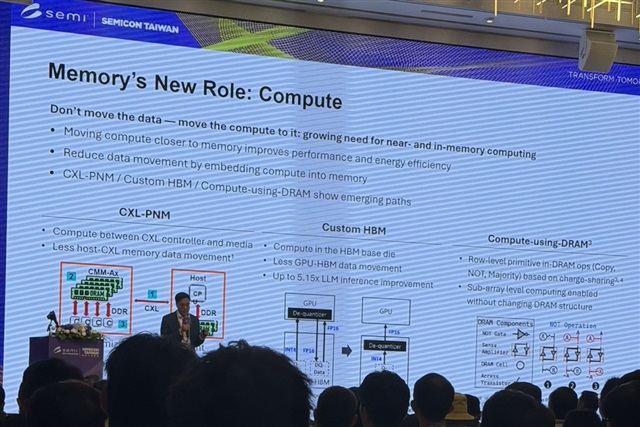
SK Hynix presented a custom HBM concept at SEMICON Taiwan 2026, where compute functions are placed in the base…
The U.S. Department of Defense announced on August 31 that it has deployed ChatGPT Mil, a customized version o…

Nvidia reported earnings that were both remarkable and boring, reflecting its focus on avoiding a consolidated…

Anthropic has agreed to a $35bn cloud-computing contract with Lambda, a Nvidia-backed cloud provider

The Supreme Court of Japan has included about ¥60 million in its fiscal 2027 budget request for AI-related exp…