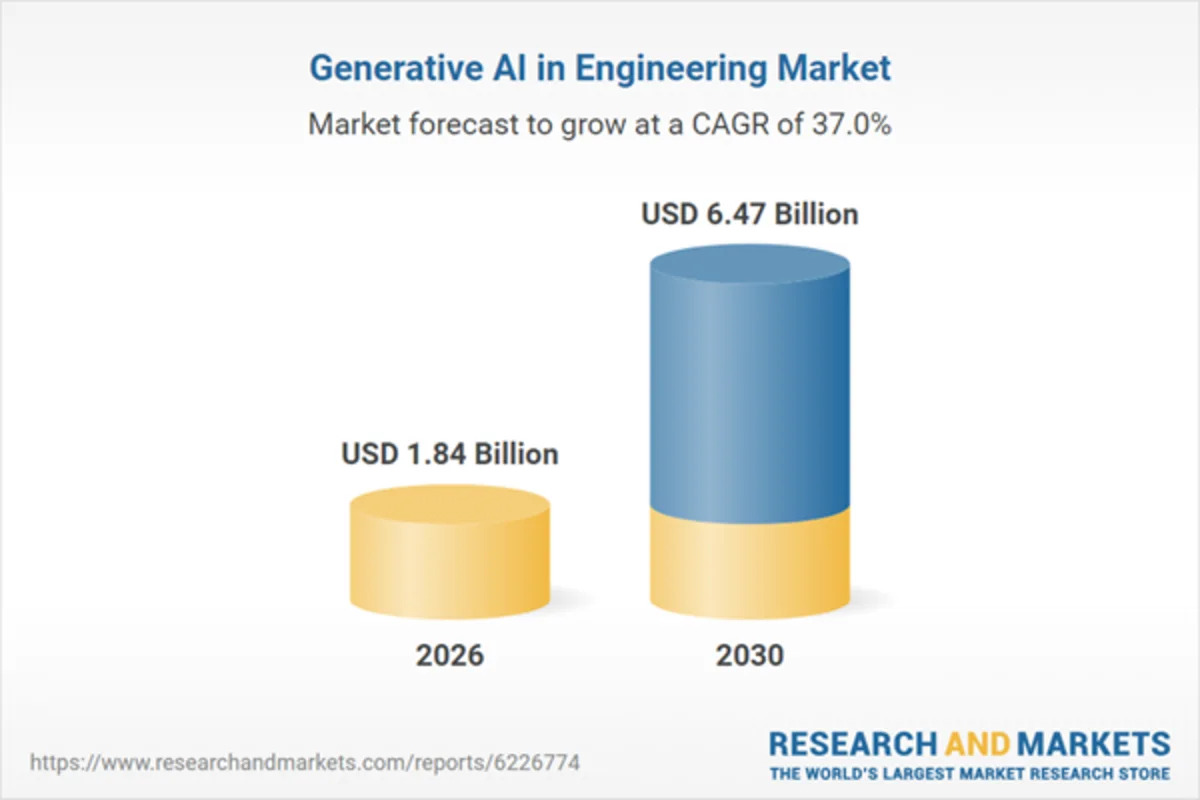
The generative AI in engineering market is expected to more than triple from $1.33 billion(約2100億円) in 2025 to $6.47 billion(約1兆円) by 2030, driven by rising adoption of design automation tools and digital twin technologies. Major companies like Cognizant and Ernst & Young are investing heavily in AI-powered platforms to help clients streamline engineering and design processes, though tariffs are beginning to affect computing costs and project budgets.
Summaries like this, in your inbox every morning.
Sign up free →What happened
The generative AI in engineering market is projected to grow from $1.33 billion(約2100億円) in 2025 to $1.84 billion(約2900億円) in 2026, with a CAGR of 37.7%, and then reach $6.47 billion(約1兆円) by 2030 at a steady CAGR of 37%. Growth is being driven by adoption of CAD and simulation tools, generative design tools, digital twin technologies, and increased demand for swift product development.
Why it matters
Automation is emerging as a primary driver, leveraging advanced technologies to enhance efficiency, reduce costs, and ensure quality in engineering processes. Companies like Cognizant Technology Solutions Corporation and Ernst & Young Global Limited are launching AI-powered platforms and acquiring talent to help businesses transform their engineering and design workflows, signaling that generative AI integration in engineering is now a competitive priority for major firms.
What to watch
North America led the market in 2025, though tariffs are shaping market trends by affecting costs for imported computing systems and influencing project budgeting and technology upgrades. Key players include Google LLC, General Electric Company, IBM, Honeywell International Inc., and NVIDIA Corporation.
The generative AI in engineering market is entering a phase of sustained high growth, with the 37–37.7% CAGR projected through 2030 reflecting broad demand for automation and efficiency gains across the engineering sector. The drivers cited—CAD tools, design optimization, digital twins, and swift product development cycles—point to a shift in how companies approach complex engineering challenges, with AI becoming integral to competitive product design and cost management rather than a peripheral tool.
Major enterprise vendors are responding by building or acquiring capabilities in this space. Cognizant's 2024 launch of Flowsource and Ernst & Young's acquisition of Nuvalence both signal that established consulting and technology firms see generative AI in engineering as a core business opportunity, not a speculative bet. These moves suggest the market is moving beyond proof-of-concept into scaled deployment within large organizations. At the same time, tariff pressures on imported computing systems introduce a cost variable that may reshape project economics and regional investment patterns, particularly affecting regions reliant on overseas hardware.
No discussion yet for this article
Get curated AI news from 200+ sources delivered daily to your inbox. Free to use.
Get Started FreeFree · takes 30 seconds · unsubscribe anytime
1 minute a day. The AI essentials.
200+ sources · Email / LINE / Slack
