AIToday

Kimi release sparks China AI fears; Nasdaq drops 1%

TechCrunch AI7h ago
Kimi release sparks China AI fears; Nasdaq drops 1%

Key takeaway

Chinese company Moonshot AI released Kimi K3, an open-source AI model that matched the performance of leading proprietary models and triggered a 1% Nasdaq sell-off. The release reignited U.S. concerns about Chinese AI competition and prompted senior Trump administration figures to warn that American regulations are hampering domestic AI development and leaving the country vulnerable to losing the AI race to China.

Summaries like this, in your inbox every morning.

Sign up free →

3 Key Points

  • What happened

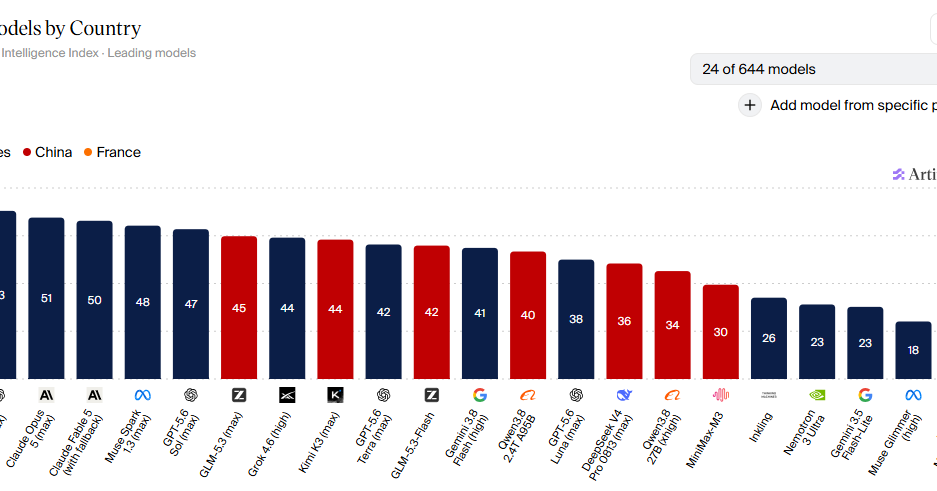
    Chinese company Moonshot AI released Kimi K3, an open-source model that Moonshot says demonstrated frontier-level performance across its evaluation suite and outperformed other tested models, though it trails Claude Fable 5 and GPT 5.6 Sol. Independent analyses from Arena.ai and Vals AI suggested Kimi is competitive with flagship frontier models. The announcement coincided with a speech from Chinese president Xi Jinping at the World AI Conference in Shanghai.

  • Why it matters

    The release triggered a 1% Nasdaq drop on Friday as investors sold chip stocks like Nvidia, reigniting debates about Chinese AI competition similar to the January 2025 DeepSeek R1 controversy. The timing and performance have alarmed U.S. officials and tech leaders amid Trump administration tariff tensions and national security concerns. OpenAI's Dean Ball warned that open-weight models could lead to "full AI communism," while David Sacks (Trump's former AI czar) said U.S. regulations are "tying itself in knots" and causing America to lose the AI race.

  • What to watch

    The Trump administration may respond by creating regulatory barriers around open-source Chinese models, according to Ball's prediction. However, Shakeel Hashim (editor of Transformer) argues that worry may be overblown because Kimi likely lacks dangerous cyber capabilities and China will face similar incentives to restrict such models once they develop those capabilities.

In Depth

Moonshot AI, a Chinese company, released Kimi K3 this week, claiming it achieved frontier-level performance across its evaluation suite and consistently outperformed other tested models. The company acknowledged that Kimi K3 still trails the most powerful proprietary models, Claude Fable 5 and GPT 5.6 Sol, but independent analyses from Arena.ai and Vals AI suggested the model is competitive with flagship frontier models overall. The announcement coincided with a speech from Chinese president Xi Jinping at the World AI Conference in Shanghai.

Wall Street responded with visible anxiety. The Nasdaq dropped about 1% on Friday as investors sold off stocks in chip companies like Nvidia, a pattern that echoes the market turbulence following DeepSeek's release of its open-source R1 model in January 2025. However, current tensions feel sharper: the Trump administration is engaged in a tariff war with China, the tech sector is debating national security risks from companies like Anthropic, and major AI firms prepare for their initial public offerings.

Tech industry leaders and administration officials offered starkly different takes. David Sacks, Trump's former AI czar and now co-chair of the President's Council of Advisors on Science and Technology, seized on Kimi's progress to criticize U.S. policy. He argued that America is "tying itself in knots: politicians and bureaucrats are banning new data centers, piling on state regulations, and pushing for new federal agencies to pre-approve frontier models. This is how you lose the AI race." Sacks also criticized Claude as a "woke lobotomized model." Travis Kalanick, the former Uber CEO, complained that the Chinese are "distilling off" (training on the outputs of) American AI models, warning that if distillation enforcement is not applied symmetrically, American models would be placed at a disadvantage—though he acknowledged that American models have also been built on top of Chinese ones, specifically Kimi.

OpenAI's Dean Ball offered a more systemic critique. He called Kimi "a very good model" whose performance cannot be easily explained by distillation alone, and expressed personal surprise that "the Chinese state continues to allow the open sourcing of models this good, given potential risks." Ball then made a provocative prediction: that "the probable outcome of an open-weight-model-dominant world is full AI communism," where AI is treated as "a 'public good' which will ultimately be provided by the state as a kind of 'digital public infrastructure.'" He called this future a "dystopian hellscape" and suggested the Trump administration will eventually "create large amounts of regulatory risk around the use of open-weight Chinese models." Ball proposed that rather than banning open source, the administration could "direct every agency to issue soft law that creates FUD [fear, uncertainty, and doubt]," using regulatory uncertainty to discourage regulated enterprises from using open Chinese models.

Not all voices echoed this alarm. Shakeel Hashim, editor of the AI-focused publication Transformer, argued that much of the worry is overblown. He noted that Kimi likely does not have dangerous cyber capabilities and predicted that the Chinese government will face "extremely similar incentives" to restrict open Chinese models once they develop those capabilities—suggesting both nations will eventually police dangerous models in parallel ways.

Context & Analysis

The release of Kimi K3 has revived anxieties about Chinese AI progress that surfaced after DeepSeek's January 2025 R1 launch, but the stakes now feel higher. The Trump administration faces mounting pressure on multiple fronts: tariff tensions with China, debates over AI national security (including internal criticism of Anthropic), and imminent public offerings from major AI companies. The timing of Moonshot's announcement alongside President Xi Jinping's speech at Shanghai's World AI Conference amplified the perceived threat, triggering immediate market reaction.

The discourse reveals a sharp split in how U.S. tech leaders and officials interpret the threat. David Sacks and OpenAI's Dean Ball view open-source Chinese models as either evidence of regulatory failure (Sacks's argument) or an existential risk to American economic hegemony (Ball's "full AI communism" framing). In contrast, Shakeel Hashim contends that much of the worry overshoots the actual danger—Kimi likely does not possess dangerous cyber capabilities, and the Chinese government will eventually face the same incentives to restrict dangerous open models that U.S. policymakers now face. The debate thus hinges on whether Chinese competitive progress represents a genuine national security threat or a market-driven outcome that both countries will eventually police in similar ways.

FAQ

How does Kimi K3 compare to other leading AI models?
Moonshot said Kimi K3 trails Claude Fable 5 and GPT 5.6 Sol but demonstrated frontier-level performance across its evaluation suite and consistently outperformed other tested models. Independent analyses from Arena.ai and Vals AI also suggested Kimi is competitive with flagship frontier models.
Why did the stock market react negatively to Kimi's release?
The Nasdaq dropped about 1% on Friday as investors sold off stocks in chip companies like Nvidia, spooked by Moonshot's announcement and the apparent progress of a Chinese open-source AI model.
What are U.S. officials saying about the risks?
OpenAI's Dean Ball said Kimi is "a very good model" and expressed surprise the Chinese government allows open-sourcing of models this good. He warned that an open-weight-model-dominant world could lead to "full AI communism." David Sacks argued that U.S. regulations are "tying itself in knots" and causing America to lose the AI race.

Get AI news like this every morning

AI-summarized, only the topics you pick — one digest a day via Email, Slack, or Discord.

Free · takes 30 seconds · unsubscribe anytime

Discussion

No discussion yet for this article

Stay ahead with AI news

Get curated AI news from 200+ sources delivered daily to your inbox. Free to use.

Get Started Free

Free · takes 30 seconds · unsubscribe anytime

1 minute a day. The AI essentials.

200+ sources · Email / LINE / Slack

Get it free →