What happened
Meta launched two things yesterday: a state-of-the-art model called Muse Spark and a new two-tier pricing system for foundation models. The Standard Tier (muse-spark-1.3) costs $1.25/m input tokens and $4.25/m output tokens, while the Contributor Tier (muse-spark-1.3-contributor) costs $0.10/m input and $0.20/m output tokens. In exchange for that discount, Meta retains the right to train future models on your data.
Why it matters
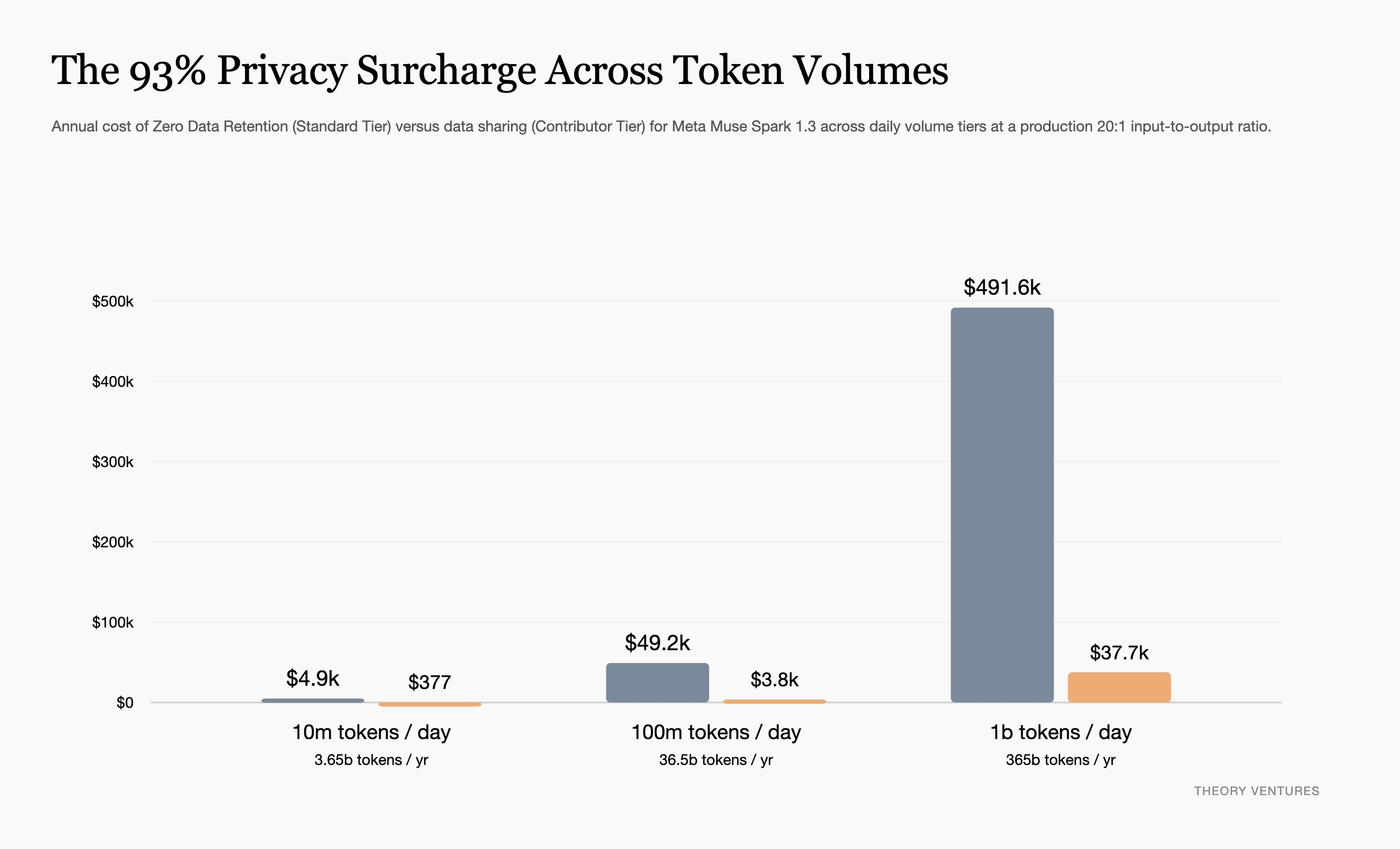
This is the first time a foundation model provider has offered such an explicit barter on its API. The 92% discount on input and 95% on output tokens reveal how Meta values incoming customer data: $1.24/m tokens. For an enterprise processing 1b tokens per day, opting into Zero Data Retention (ZDR) would cost an extra $454,000 per year.
What to watch
Meta is effectively vertically integrating the AI data supply chain, bypassing the market for training data and human labeling, which is estimated at $10b in annual revenue. The pricing model turns its inference network into a self-funding data flywheel, and might solve the business model for American open source.
Summaries like this, in your inbox every morning.
Meta's move marks a significant shift in how AI companies monetize their models, blending the consumer internet's data-for-service trade with enterprise pricing. By charging drastically different rates based on data usage rights, Meta explicitly prices the value of customer data, a concept previously implicit in many consumer products. This approach can be seen as a vertical integration of the AI data supply chain, similar to how platforms like Google and Facebook vertically integrated digital advertising. Instead of buying training data from external vendors, Meta is acquiring organic reasoning traces directly from its users at a fraction of the cost, while undercutting closed models on inference price. However, this strategy raises questions about data privacy and the long-term implications for businesses that may unknowingly subsidize Meta's future models in exchange for lower costs. The economics of AI inference are now intertwined with data acquisition, creating a new paradigm where compute is not just an infrastructure utility but a currency for data.
Pick your industry and the AI tools you use, and get news related to your work every day.
Free · 30 seconds with Google · unsubscribe anytimeWhat is AIToday? →
Ask AI anything about this article. The AI reads this article, earlier AIToday articles, and Wikipedia, and cites its sources. Q&As are published on this page for other readers too.
Infineon Technologies said on October 21 it is expanding work with Nvidia on 800-volt direct current power arc…
BloFin Research outlined three defensive moves for a potential 2027 AI correction: shift some S&P 500 exposure…

Shares fell 6.9% Thursday, extending the drop from the June 2 peak to 50%, with market capitalization at about…
Schneider Electric, Nvidia and HPE formed a strategic collaboration to launch Industrial AI Agents at the Edge…

Anthropic released Claude Duet, built on Claude Opus 5.5

Inception launched Mercury 3 on October 19, a diffusion model it says generates 1,068 output tokens per second…