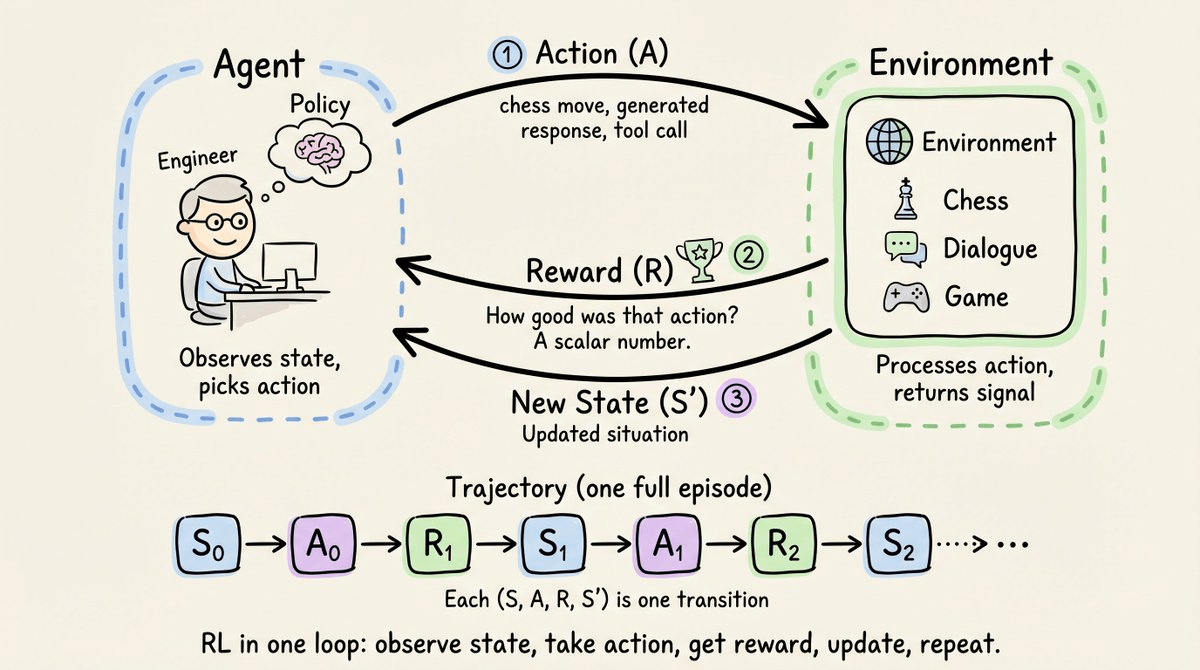
In January 2025, DeepSeek released R1 using RLVR (Reinforcement Learning with Verifiable Rewards) instead of the human-preference training pipeline. For math problems, the verifier checked if the model's answer matched the known solution; for code, a compiler ran the output and returned pass or fail (binary rewards: 1 for correct, 0 for wrong).
DeepSeek's approach uses GRPO (Group Relative Policy Optimization), which removes the critic model and learned reward model entirely. Instead of four full-size models in memory (policy, reference policy, reward model, critic), the system requires just two (the policy being trained and a reference copy for KL regularization), cutting memory demands substantially.
DeepSeek R1-Zero, trained with GRPO and verifiable rewards with no supervised fine-tuning, went from 15.6% to 77.9% on AIME 2024 math problems; with majority voting, it hit 86.7%, matching OpenAI's o1. The model developed self-verification, reflection, and chain-of-thought reasoning purely from the binary signal.
Ask the AI about this article →
For example, today's edition would include:
AI-summarized, only the topics you pick — one digest a day via Email, Slack, or Discord.
Free · takes 30 seconds · unsubscribe anytimeWhat is AIToday? →
Ask AI anything about this article. Q&As are published on this page for other readers too.

