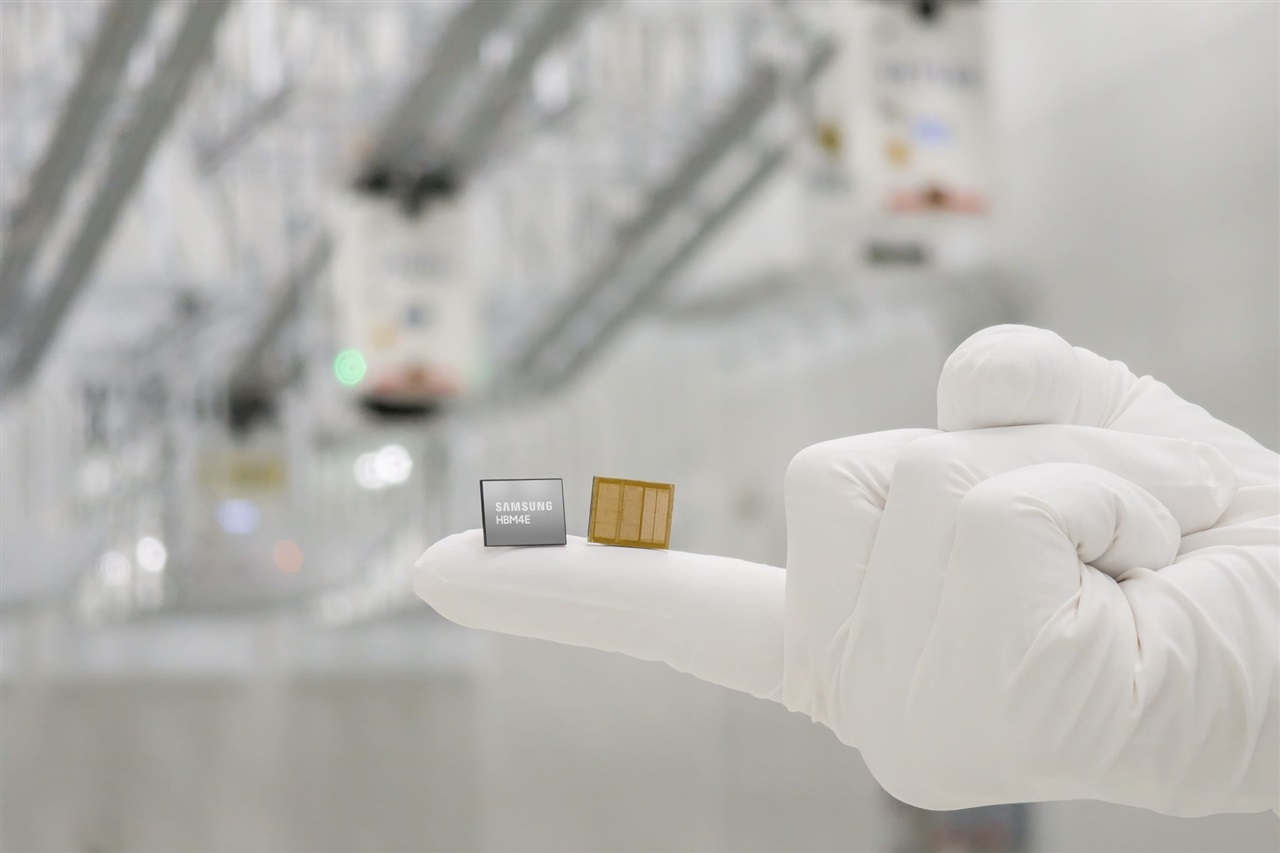
Samsung Electronics has not yet secured a volume-production order from Nvidia for HBM4 memory chips, relying only on paid evaluation samples so far. This gap highlights the uncertain status of Samsung's HBM4 capabilities and its competition to win Nvidia's high-volume business as AI infrastructure demand grows.
Summaries like this, in your inbox every morning.
Sign up free →What happened
Samsung Electronics has not yet received a volume-production order from Nvidia for HBM4 chips (high-bandwidth memory used in AI systems). The company's HBM revenue from Nvidia remains limited to paid evaluation samples, according to semiconductor industry sources cited by Dealsite.
Why it matters
HBM4 represents a critical next-generation memory component for AI accelerators. Without a volume order from Nvidia—a dominant AI chip buyer—Samsung's ability to scale HBM4 manufacturing and compete in the AI infrastructure supply chain remains uncertain.
What to watch
The status of Samsung's HBM4 relationship with Nvidia signals broader dynamics in AI memory supply. Confirmation of a volume order would indicate Samsung's advancement in the HBM4 qualification process and its readiness to serve Nvidia's production ramp.
Samsung Electronics has not yet received a volume-production order from Nvidia for HBM4 chips, according to semiconductor industry sources cited by Dealsite. The South Korean memory chipmaker's relationship with Nvidia currently centers on paid evaluation samples—a limited revenue stream far short of the full production volumes needed to build a meaningful HBM4 business. HBM4 represents the next generation of high-bandwidth memory, a critical component in AI accelerators and data center systems where memory bandwidth and thermal performance are paramount. Nvidia, as the leading designer of AI chips and a major buyer of memory components, is evaluating whether Samsung's HBM4 meets its production specifications and performance requirements. The absence of a volume order—despite Samsung's public ambitions in the HBM space—indicates that Samsung's HBM4 qualification process with Nvidia remains incomplete. This status contrasts with the scale and urgency of AI infrastructure buildout globally. For Samsung, the stakes are high: a confirmed Nvidia volume order would validate the company's engineering roadmap, open access to one of the semiconductor industry's largest and most dynamic customers, and position Samsung to compete directly with rivals like SK Hynix and Micron for AI memory market share. The reliance on evaluation samples alone underscores that Samsung has yet to cross the threshold from validation to production commitment.
Samsung's lack of a Nvidia HBM4 volume order points to a critical juncture in the company's AI memory strategy. Evaluation samples represent an early-stage relationship—Nvidia is testing Samsung's HBM4 quality and capability, but has not yet committed to production volumes. The reported absence of such a commitment suggests either that Samsung's HBM4 does not yet meet Nvidia's full requirements, or that Nvidia is evaluating competing suppliers (such as SK Hynix or Micron). For Samsung, winning a volume order would be transformational: it would unlock scale production, establish a revenue stream in one of the fastest-growing AI infrastructure segments, and cement the company's role in the next generation of AI chip supply chains. The paid evaluation model also shows Nvidia's rigor in qualification—samples are not free samples for endorsement, but paid trials meant to validate performance under real-world conditions.
No discussion yet for this article
Get curated AI news from 200+ sources delivered daily to your inbox. Free to use.
Get Started FreeFree · takes 30 seconds · unsubscribe anytime
1 minute a day. The AI essentials.
200+ sources · Email / LINE / Slack
