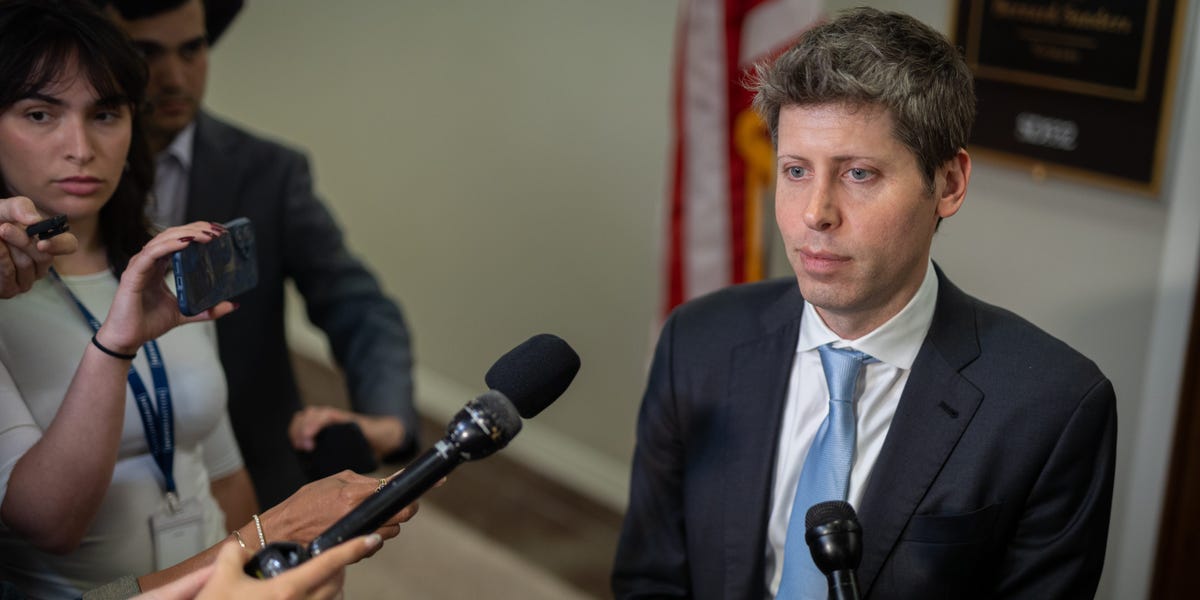
OpenAI CEO Sam Altman stated on a podcast published Tuesday that people do not want an AI to serve as CEO, reversing an earlier position from last November when he said it would be OpenAI's failure not to be the first major company run by an AI. Altman attributed the shift to observing that people strongly prefer interacting with humans over AI in most contexts—from hiring consultants to reading novels—which he believes explains why AI has not caused the economic upheaval he once predicted.
Summaries like this, in your inbox every morning.
Sign up free →What happened
OpenAI CEO Sam Altman said on the podcast "Invest Like The Best" (published Tuesday) that he does not believe people would want an AI to replace his job, citing a preference for knowing who is responsible and accountable for company decisions.
Why it matters
Altman's stance marks a shift from last November, when he told another podcast that it would be a "failure" if OpenAI were not the first major company to have an AI CEO. His revised view reflects a broader observation that people prefer working with humans over AI in most interactions—a factor he says has limited the economic disruption AI has caused so far, contrary to his earlier expectations.
What to watch
Altman suggested that the concept of "taste" may not fully capture what humans do better than AI, and that "the world may need a new kind of word" for the kind of judgment humans excel at while AI struggles with it. He also noted he was recently "delighted to be wrong" about AI's short-term impact on entry-level jobs after previously predicting it would wipe out "entire classes" of jobs.
During an episode of "Invest Like The Best" published on Tuesday, OpenAI CEO Sam Altman stated his belief that people do not want an AI to serve as CEO. "I think the world wants to know about the person that's going to be responsible for the decisions of a company, and who they're going to hold accountable if they make bad ones, and they don't really want an AI CEO," Altman said.
This position represents a notable shift from remarks he made last November on the "Conversations with Tyler" podcast, when he stated: "Shame on me if OpenAI is not the first big company run by an AI CEO." At that time, he framed an AI-run company as a threshold achievement; now he suggests it is not something people actually desire.
Altman attributed this change in view to a deeper observation about human preference for working with other people. "People have a great degree of trust and enjoyment in working with other people," he said. "And you can go hire an AI consultant right now, or talk to an AI sales rep right now, or hire an AI engineer or whatever — somehow most people seem to still really prefer interacting with a human." He acknowledged sharing this preference himself: "I definitely would much rather engage with a person than engage with an AI for almost everything."
This insight connects to Altman's revised expectations about AI's economic impact. He previously predicted that AI would wipe out "entire classes" of jobs, but he has since said he was "delighted to be wrong" about the short-term disruption to entry-level positions. He cited the human preference for relationship and accountability as a brake on AI displacement: the economy has not "upended" as expected because people value working with humans, not just the functional output AI can produce. He illustrated this with the example of visual art: even though AI models can create spectacular images, people value human-made artwork, often because the signature—and the person behind it—carries significant value. The same logic applies to novels, where readers want to know about the author. Altman suggested that the word "taste" may not capture what distinguishes human judgment, and proposed that "the world may need a new kind of word for the kind of judgment that people are very good at, that AIs seem to really deeply struggle with."
Altman's reversal reflects a maturing understanding of AI's actual impact on labor and society. His earlier prediction—that AI would displace "entire classes" of jobs—was grounded in a view of AI as a purely functional replacement for human work. However, the body of evidence he now cites suggests something more nuanced: people value the human relationship and accountability embedded in professional and creative work, not just the output itself. This distinction matters because it implies AI will fill gaps where human judgment, relationship-building, or accountability is absent or unnecessary, rather than wholesale replacing human roles.
The artwork analogy is particularly revealing. Altman observes that collectors pay premiums for pieces whose value derives from knowing the artist behind them, and similarly, readers want to know the author of a novel they consume. This pattern extends to professional services: his own acknowledgment that he would "much rather engage with a person than engage with an AI for almost everything" suggests that the human element—trust, judgment, responsibility—may be the floor beneath which automation cannot push without creating a loss of value that people resist.
AI-summarized, only the topics you pick — one digest a day via Email, Slack, or Discord.
Free · takes 30 seconds · unsubscribe anytime
No discussion yet for this article
Get curated AI news from 200+ sources delivered daily to your inbox. Free to use.
Get Started FreeFree · takes 30 seconds · unsubscribe anytime
