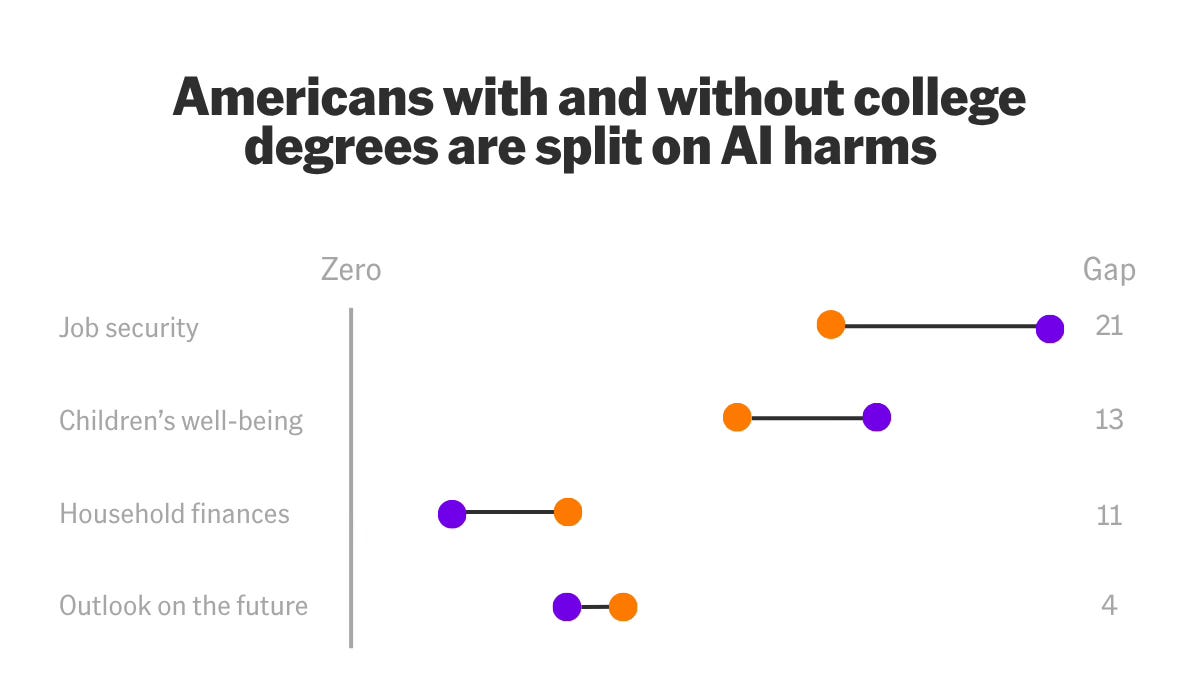
A U.S. survey of nearly 2,900 adults shows that while 66% of Americans worry about AI overall, college graduates and those with less education fear different harms: grads worry most about jobs and children, while those with a high school degree or less are more concerned about household financial impacts. The divergence reflects a broader political "diploma divide" and suggests that policy debates focused on jobs and kids may neglect the financial anxieties of less-educated Americans.
Summaries like this, in your inbox every morning.
Sign up free →What happened
A survey of 2,869 U.S. adults (pooled from June 25–30 and July 9–13) found that 66% of Americans express concern about AI, but the specific worries split sharply by education level. College graduates are more likely to cite job and child safety impacts, while those with a high school degree or less are relatively more concerned about effects on household finances.
Why it matters
The education divide in AI perception mirrors a broader "diploma divide" that has reshaped U.S. political coalitions. Public debate on AI has focused heavily on jobs and children—issues that resonate most with college-educated voters—while largely overlooking household financial concerns that weigh more heavily on less-educated Americans. This imbalance risks leaving policymakers out of step with the full range of public anxiety.
What to watch
College graduates are more optimistic overall—31% are excited about AI's role in society (vs. 22% of those with a high school degree or less), and 74% expect scientific or medical breakthroughs (vs. 58%). Meanwhile, 54–59% of college graduates say government isn't doing enough on AI impacts, compared to 33–35% of those with a high school education or less.
Athena Insights released new polling data on July 9–13, 2026, examining how Americans perceive AI's impacts across education levels. The survey, combined with an earlier wave conducted June 25–30, pooled responses from 2,869 U.S. adults and found a striking pattern: while concern about AI is high across the board—66% overall—the specific harms people fear depend heavily on their level of education.
College graduates emerge as both more worried about some impacts and more optimistic than those with a high school degree or less. Among the college-educated, 31% say they are excited about AI's role in society, compared to 22% of those without a college degree. On the flip side, college graduates are more likely to report negative impacts on jobs and children. However, the starkest disparity concerns financial security: Americans with a high school degree or less are relatively more likely to say AI is negatively impacting household finances, a concern that ranks lower for college-educated respondents.
The data also reveals differences in perception and expectation. Fifty-seven percent of college graduates say they are already seeing people save time because of AI, versus 39% of those with a high school degree or less. Seventy-four percent of college-educated Americans believe AI will lead to scientific or medical breakthroughs, compared to 58% of high school-educated respondents. College graduates are also more attuned to potential risks: 36% say AI is already behaving in ways its developers didn't intend, versus 24% of high school-educated Americans.
On the question of government responsibility, a stark gap opens. Between 54% and 59% of college-educated Americans say the government is not doing enough to address AI's impacts on the environment, children, and workers. That figure drops to 33–35% among Americans with a high school degree or less. Colin Bortner, head of research at Athena Insights, framed the implication: much recent debate has centered on jobs and children, areas where concern spans all education levels but is strongest among college graduates. "Household finances, on the other hand, are less of a concern among college-educated Americans than among Americans with a high-school education or less," Bortner noted. He cautioned that focusing the AI debate narrowly on jobs and kids while neglecting pocketbook issues risks sidelining the concerns of less-educated Americans.
The survey employed NORC at the University of Chicago's AmeriSpeak panel, a probability-based sample designed to represent the U.S. household population. The most recent wave (July 9–13, 2026) sampled 1,055 adults with a margin of error of ±4.2 percentage points; the pooled result carried a margin of ±2.6 points. The methodology was weighted to U.S. population benchmarks.
The survey reveals that AI concern in America is not monolithic but stratified by education. While 66% of the public expresses worry about AI broadly, the sources of that worry diverge sharply. College graduates, who are more likely to track tech developments and engage with debates about artificial intelligence, concentrate their concerns on job displacement and child safety—issues that dominate recent policy discourse. Conversely, Americans with a high school education or less report proportionally greater anxiety about household finances, a concern less prominent in mainstream media coverage and political debate.
This "diploma divide" is not new; it has been a defining feature of American political realignment for decades, shaping voter coalitions and policy priorities. The research suggests that the AI debate risks replicating this pattern: by focusing on jobs and children, policymakers and media may be amplifying the concerns of college-educated, politically engaged Americans while sidelining the bread-and-butter anxieties of other constituencies. Colin Bortner, Athena Insights' head of research, warns that this focus "risks over-indexing on the concerns of college graduates and ignoring other important American constituencies." The asymmetry is underscored by parallel findings: college grads are more optimistic (31% excited vs. 22% for high school or less) and more confident in AI's potential for scientific breakthroughs (74% vs. 58%), suggesting they see both greater peril and greater promise in the technology.
AI-summarized, only the topics you pick — one digest a day via Email, Slack, or Discord.
Free · takes 30 seconds · unsubscribe anytime
No discussion yet for this article
Get curated AI news from 200+ sources delivered daily to your inbox. Free to use.
Get Started FreeFree · takes 30 seconds · unsubscribe anytime
1 minute a day. The AI essentials.
200+ sources · Email / LINE / Slack
