What happened
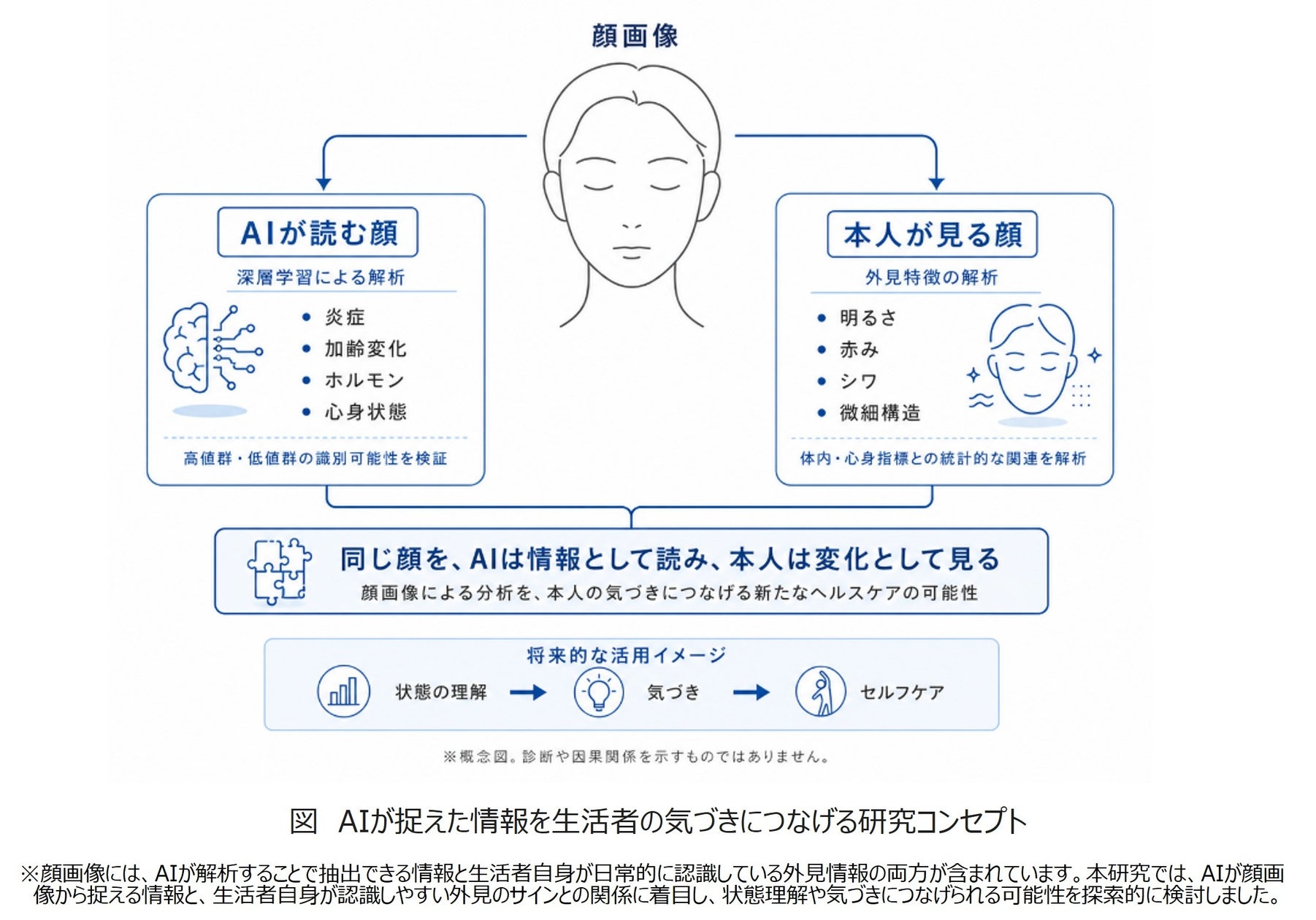
Daiichi Sankyo Healthcare studied face images from 310 healthy adults and ran deep-learning analysis and statistical checks, reporting possible links between visible features and internal or mind-body indicators.
Why it matters
The company says the findings point to a new use for face images — turning them into self-awareness of one's own condition, since test values and scores alone are hard for people to feel.
What to watch
The results were presented as possibilities, not proven diagnostics, so the test is whether larger samples and more advanced analysis methods improve accuracy. Watch for the stated next steps on expanding participants and refining the method.
WHO IT HITSThis lands on consumer health and skincare product teams — the company frames the work as groundwork for self-care solutions — and potentially on people tracking their own condition outside clinics, though the results are described only as possibilities.
Ask the AI about this article →
Summaries like this, in your inbox every morning.
The starting point for this work is a practical gap the company describes: blood tests, questionnaires, and wearables have advanced, but test values and scores alone are hard for people to feel as their own condition, so they do not necessarily lead to self-care or behavior change. At the same time, research estimating internal and mind-body states from face images has been progressing, but it was not sufficiently clear whether the information AI captures can be understood and owned by the people themselves.
Daiichi Sankyo Healthcare's approach was to treat the face not only as an object of AI analysis but also as everyday visible information the person sees in the mirror. The study combined two methods: deep learning that tested whether high and low groups for indicators such as inflammation, aging changes, oxidation, hormones, stress, fatigue, and insomnia could be distinguished, and statistical analysis linking eight extracted visible features — skin brightness, cheek redness, yellowing, under-eye shadows, eye-corner wrinkles, fine lines at the eye corners, fine skin texture, and nasolabial fold depth — to blood test values and mind-body data. When the two sets of results were cross-checked, some of the indicators flagged by deep learning also showed associations with visible features.
The stakes hinge on whether larger participant numbers and more advanced analysis methods actually improve the accuracy of what face images can yield, and on whether the company can build features people find easy to understand. The framing is self-care support rather than diagnosis, so the near-term value is likely to be judged by how well these signals translate into awareness and action for ordinary users, not by clinical claims.
For example, today's edition would include:
AI-summarized, only the topics you pick — one digest a day via Email, Slack, or Discord.
Free · 30 seconds with Google · unsubscribe anytimeWhat is AIToday? →
Ask AI anything about this article. Q&As are published on this page for other readers too.
Anthropic launched a new Claude tool aimed at financial advisors, and the offering includes integrations with…

Vertiv agreed to buy UtilityInnovation Group for about $1.45 billion, and Broadcom's fiscal Q3 2026 AI semicon…

CrowdStrike rose 12% to $232.08, Zscaler 12% to $183.97, and Palo Alto Networks 11% to $366.40 in midday Monda…

Seagate posted Q4 revenue of $3.63B, up 48.5% YoY, and is shipping Mozaic 4 HAMR drives up to 44 terabytes to…
Charles Schwab and Anthropic announced a joint effort to bring Anthropic's Claude to independent registered in…
Crowdstrike stock hit an all-time high, with shares booming 14% amid AI concerns