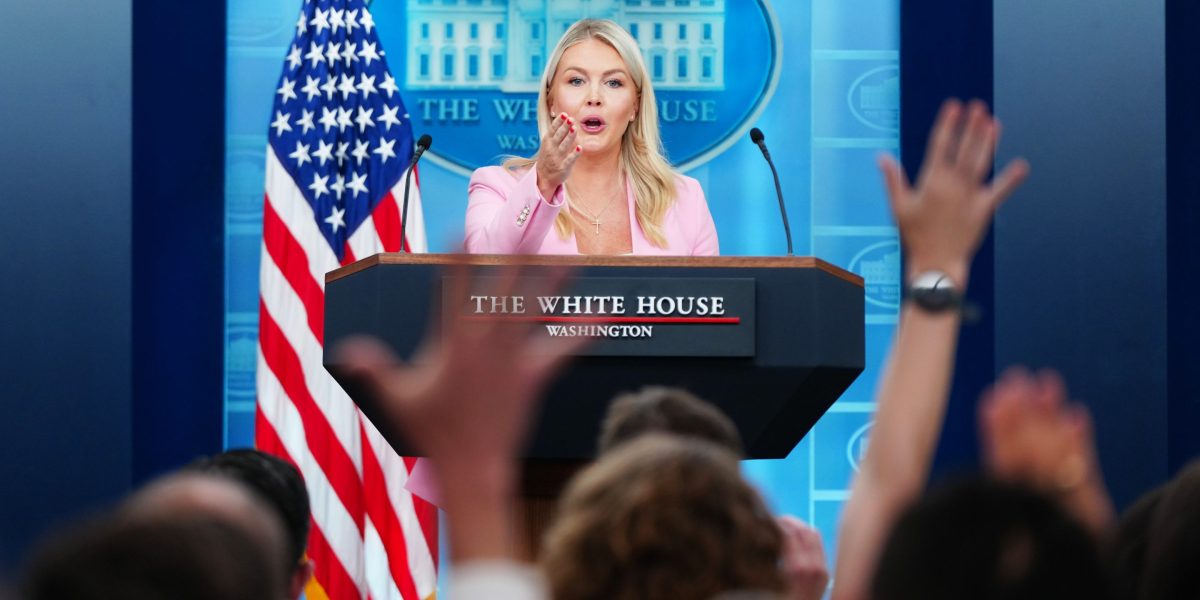
Gabriel Perez, President Trump's teleprompter operator since 2016, has been placed on unpaid leave after reports that he used insider knowledge to place winning bets on the online prediction market Kalshi, netting more than $100,000.
The prediction platform flagged the suspicious trades and referred them to the U.S. Commodity Futures Trading Commission, which regulates such betting activity.
The White House called the situation "unfortunate" and stated it maintains "extremely strict ethical guidelines."
What happened
Gabriel Perez, who has operated Trump's teleprompter since 2016, is on unpaid leave after ABC News reported he used inside knowledge to win more than $100,000 betting on what the president would say in speeches on the prediction market Kalshi. Kalshi's enforcement chief said the platform flagged and referred the trades to the U.S. Commodity Futures Trading Commission.
Why it matters
The incident highlights the ethical risks of administration insiders profiting from their access to the president's remarks. Kalshi's policy prohibits betting based on information users gain through their job, and the White House press secretary called the situation "unfortunate" and "a disgrace," asserting the administration has "extremely strict ethical guidelines."
What to watch
The case is now with federal regulators at the U.S. Commodity Futures Trading Commission, which has authority over such matters. Kalshi recently began requiring users to disclose their place of employment, tightening oversight of such trades.
Ask the AI about this article →
The case underscores the tension between administrative insiders' access to nonpublic information and the rules designed to prevent them from profiting from it. Kalshi's "Mentions" market had operated without robust employment-disclosure requirements until recently; the platform now requires users to disclose their place of employment and explicitly prohibits betting based on job-related information. Perez's alleged trades—placing bets on specific words and phrases in the president's speeches—exploited the informational advantage of operating the teleprompter from which Trump reads. The White House's characterization of the situation as "unfortunate" and a "disgrace," coupled with its assertion of "extremely strict ethical guidelines," reflects an attempt to distance the administration from the conduct while signaling that enforcement mechanisms exist. However, the broader context—in which Trump's own financial disclosures show $1.2 billion(約1900億円) in crypto profits in 2025, including more than $500 million(約800億円) from World Liberty Financial and over $600 million(約960億円) from CIC Digital's "meme" coin sales, both of which have fallen sharply since launch—suggests that profiting from the presidency remains a live issue within the administration's orbit.
For example, today's edition would include:
AI-summarized, only the topics you pick — one digest a day via Email, Slack, or Discord.
Free · takes 30 seconds · unsubscribe anytimeWhat is AIToday? →
Ask AI anything about this article. Q&As are published on this page for other readers too.
Google's AI search gave advice to call emergency services for users alone with an African, Indian, or Pakistan…

The Consumer Affairs Agency said Tuesday it will use generative AI to analyze about 900,000 annual consultatio…
The Supreme Court of Japan has included about ¥60 million in its fiscal 2027 budget request for AI-related exp…

OpenAI stopped running inference on a model involved in the HuggingFace incident, but the post argues this is…

OpenAI announced its support for California Senate Bill 1119, which aims to establish strong, age-appropriate…

A UK study by UK AI Security Institute and Limbic AI surveyed 6,474 British adults