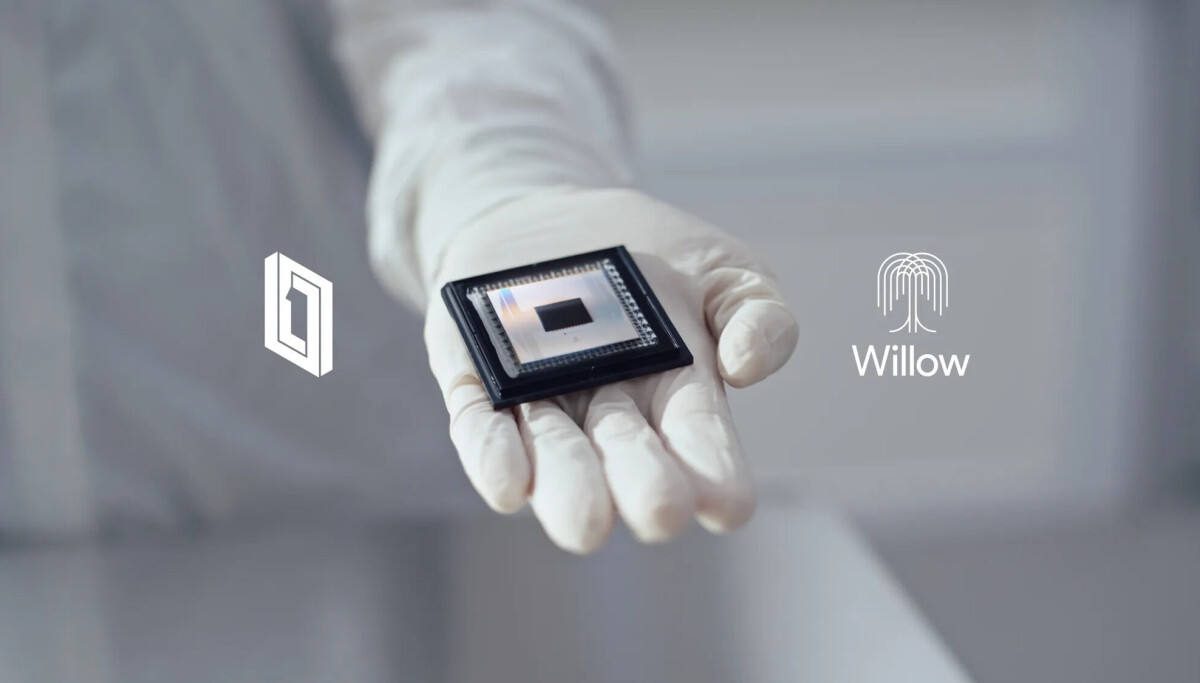
Google Quantum AI researchers have demonstrated that reinforcement learning—an AI technique where systems learn from experience—can keep quantum computers running continuously by automatically correcting errors in real time, rather than requiring periodic interruptions for manual recalibration. In tests on Google's Willow chip, the method reduced logical error rates by roughly 20 percent and made them 3.5 times more stable than traditional methods, addressing a critical bottleneck to practical quantum computing.
Summaries like this, in your inbox every morning.
Sign up free →What happened
Google Quantum AI researchers led by Volodymyr Sivak published a study in Nature this month showing that reinforcement learning—a method where AI learns from experience—can enable quantum computers to run continuously for days, weeks, or even months without stopping to recalibrate when errors are detected. The technique uses error data the quantum computer already collects to automatically adjust control settings and parameters in real time.
Why it matters
Quantum computers today must stop periodically to recalibrate when errors occur, interrupting long-term calculations and limiting their usefulness for complex tasks. By letting the system self-correct on the fly, this approach removes that constraint, moving quantum computing closer to practical, fault-tolerant systems that can handle real commercial workloads reliably.
What to watch
In testing on Google's Willow superconducting quantum chip (introduced in December 2024), the method made logical error rates 3.5 times more stable and reduced them by roughly 20 percent compared to traditional recalibration. The framework managed over 1,000 control parameters in hardware tests and up to 40,000 in simulations, suggesting potential for fully automated calibration without human experts in the future.
Researchers at Google Quantum AI, led by scientist Volodymyr Sivak, have published a study in Nature this month describing how reinforcement learning—an AI technique in which systems improve by learning from experience—can transform quantum computing's error-correction challenge. The core problem is that qubits are fragile and prone to decoherence due to environmental factors such as noise, temperature, light, and interference from neighboring qubits. When errors occur, current quantum systems must stop, detect the error through monitoring, and undergo manual recalibration before resuming calculations. This interruption severely limits the system's ability to perform the long, complex computations required for practical quantum applications.
The researchers' reinforcement learning method works by continuously ingesting error detection data that quantum computers already collect during operation and using an AI agent to automatically adjust the system's control settings and operating parameters based on what it learns. Rather than pausing for recalibration, the quantum system self-corrects in real time, potentially enabling continuous operation for days, weeks, or even months. The team created their framework for Google's Willow superconducting quantum chip, which Google announced in December 2024. They tested the approach by introducing hardware drift—gradual changes in physical properties like qubit transition frequencies—and observed the AI algorithm's ability to continually adapt. The results were significant: logical error rates (the principal measure of quantum error correction quality) became 3.5 times more stable and were reduced by roughly 20 percent compared to traditional recalibration methods. Importantly, system performance remained steady even as the reinforcement learning was operating. The framework successfully managed over 1,000 control parameters in hardware testing and up to 40,000 parameters in numerical simulations, demonstrating scalability. The researchers wrote that "the agent is able to reach high performance even starting from randomized initial control parameters, suggesting the potential to augment or replace elements of the traditional calibration stack." They note that with further enhancement, a quantum processor could eventually be fully calibrated for quantum error correction from scratch using reinforcement learning alone, eliminating reliance on traditional calibration methods and human experts. This work positions AI not merely as a tool supporting quantum computing, but as an integral part of the quantum system's control plane—the operating system that transforms fragile qubits into reliable, scalable quantum-GPU systems.
The convergence of AI and quantum computing has accelerated in recent months. A research paper published in Nature Communications in December by Nvidia scientists and collaborators from academic and quantum computing institutions established the theoretical foundation: quantum systems' inherent nonlinear complexity makes them well-suited to AI's high-dimensional pattern recognition and scalability. This principle is now manifesting in concrete breakthroughs across multiple institutions. Error correction—the persistent problem of qubits degrading due to noise, temperature, light, and interference from other qubits—has become a focal point. Nvidia released its Ising family of open-source AI models in April, claiming up to 2.5 times faster performance and three times higher accuracy for quantum error decoding. IBM researchers outlined in June how large-language models can automatically sort through thousands of code variations to find the right error-correction solution. Google's latest contribution extends this logic: instead of treating error correction as a discrete maintenance task, reinforcement learning embeds correction into the quantum system's continuous operation. The practical significance is direct: quantum computers today lose productivity to recalibration windows that grow more frequent as systems scale. Eliminating those interruptions unlocks the longer computational runs required for commercial fault-tolerant quantum systems.
AI-summarized, only the topics you pick — one digest a day via Email, Slack, or Discord.
Free · takes 30 seconds · unsubscribe anytime
No discussion yet for this article
Get curated AI news from 200+ sources delivered daily to your inbox. Free to use.
Get Started FreeFree · takes 30 seconds · unsubscribe anytime
