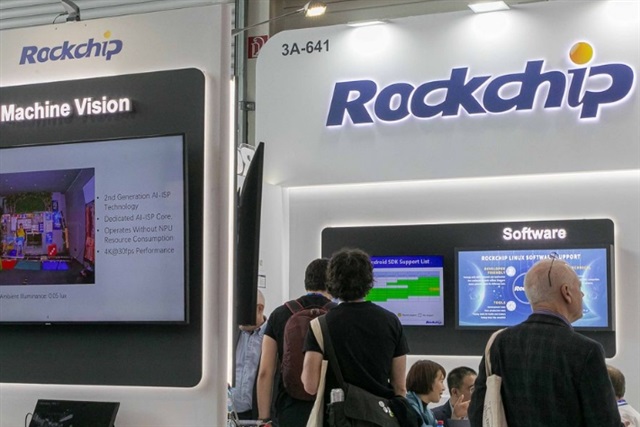
Rockchip, a China-based AIoT (artificial intelligence of things) chip designer, reported record first-half 2026 earnings with revenue rising 40.6% year-on-year to US$427 million and net profit jumping 61.73% to CNY859 million.
The outsized profit growth relative to revenue reflects accelerating adoption of edge AI chips—processors that enable AI inference directly on devices—across consumer and industrial products.
What happened
China-based chip designer Rockchip reported first-half 2026 results with revenue up 40.6% year-on-year to CNY2.88 billion (US$427 million) and net profit up 61.73% to CNY859 million, driven by scaling edge AI adoption across devices.
Why it matters
The jump in profitability outpacing revenue growth suggests Rockchip's edge AI chips—processors designed to run AI tasks directly on devices rather than in the cloud—are becoming more profitable as manufacturers integrate them at scale. This signals demand is accelerating for on-device AI capabilities in consumer and industrial electronics.
What to watch
The company's ability to maintain this profit margin growth as edge AI competition intensifies, and whether device makers continue expanding edge AI integration in their product lines.
Ask the AI about this article →
Rockchip's first-half 2026 results underscore a broadening market shift toward edge AI—the deployment of AI inference on devices themselves rather than in centralized cloud infrastructure. The company's 40.6% revenue growth is substantial, but the 61.73% surge in net profit is the more telling metric: it indicates that as edge AI adoption accelerates across consumer electronics and IoT devices, Rockchip is capturing profit at a faster rate than its top line is expanding. This typically signals either improving operational efficiency, higher-margin product mix, or better pricing power as customers compete to integrate edge AI into their products.
The timing aligns with a broader industry trend. Device makers from smartphones to smart home devices to industrial equipment are increasingly embedding AI processing capabilities locally, driven by user demand for privacy, lower latency, and offline functionality. Rockchip's position as a specialist in AIoT chips—processors designed specifically for artificial intelligence on edge devices—puts it in a favorable position to capture share of this shift, especially in the Chinese market where device makers are aggressively deploying edge AI.
For example, today's edition would include:
AI-summarized, only the topics you pick — one digest a day via Email, Slack, or Discord.
Free · takes 30 seconds · unsubscribe anytimeWhat is AIToday? →
Ask AI anything about this article. Q&As are published on this page for other readers too.
Visko raised $10 million in pre-seed funding from Llama Ventures and opened public access to its first foundat…

U.S. markets ended August higher, with the S&P 500 up 2.6% and the Nasdaq up 3.9%

Neurovia AI, an Abu Dhabi-based company, is pitching Saudi security agencies software that it says can compres…

AI company Runway has unveiled Solaris, the first model in a new category it calls "Interface World Models." I…

John Deere introduced JD, a conversational AI tool that lets farmers ask open-ended questions about their hist…

Nvidia CEO Jensen Huang said on Fox Business that AI is creating 'hundreds of thousands' of jobs, including in…