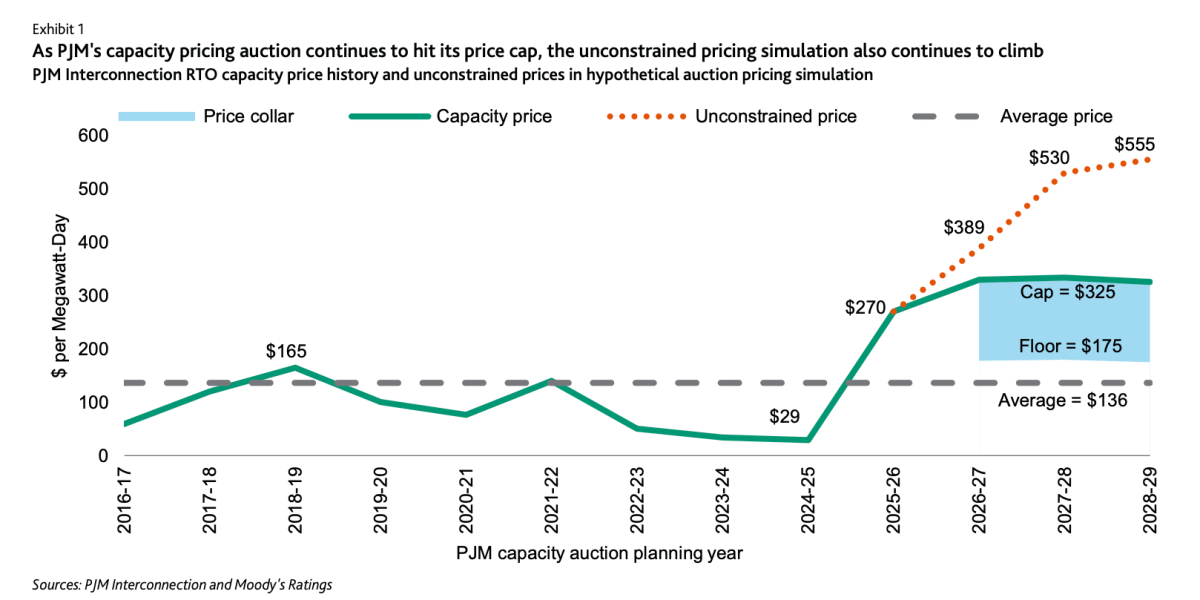
America's power grid is hitting capacity limits as AI data centers consume massive amounts of electricity, but the cost is being passed to ordinary households and small businesses rather than the tech companies building the infrastructure. PJM Interconnection's July capacity auction cleared at the maximum price cap of $325 per megawatt-day with insufficient new power supply, and Moody's Ratings flagged that current rules lack mechanisms to ensure data centers bear the cost of new generation. Residents in the region could face rate hikes of up to 60% over the next five years as Big Tech's buildout accelerates.
Summaries like this, in your inbox every morning.
Sign up free →What happened
PJM Interconnection, the largest U.S. grid operator serving roughly 67 million people across 13 states from Illinois to Virginia, cleared its capacity auction for 2028–29 at $325 per megawatt-day—the maximum price cap—while supply fell about 6.8 gigawatts short of grid reliability needs. This marks the third consecutive auction hitting the price ceiling.
Why it matters
Data centers driving AI buildout account for roughly $6.3 billion(約1兆円) of the $16.4 billion(約2.6兆円) in total capacity charges from this auction, yet the cost of building new power plants to serve that demand is spread across all ratepayers rather than billed directly to the tech companies. Moody's Ratings warned that PJM's rules lack mechanisms to ensure hyperscalers pay for new generation, and Reuters reported households and businesses in PJM territory could face rate hikes of up to 60% over the next five years.
What to watch
PJM is requesting emergency permission from the Federal Energy Regulatory Commission to hold a "backstop" capacity auction in September, signaling the normal market cannot produce enough new power fast enough. Some analysts propose requiring data center operators to sign long-term contracts for new generation, though adoption remains uneven across markets.
On July 14, PJM Interconnection, the largest grid operator in the U.S. serving roughly 67 million people across a 13-state swath from Illinois to Virginia and Washington, D.C., announced its capacity auction for 2028–29 had cleared at $325 per megawatt-day—the maximum allowed under its price cap. The auction faced a critical shortfall: supply fell about 6.8 gigawatts short of what the grid needs to stay reliable. It was the third auction in a row to slam into the price ceiling, a pattern that signals the emerging financial toll of America's AI buildout on the power system.
Moody's Ratings, in a July 22 sector report, diagnosed the core problem in direct language: "the current system lacks adequate mechanisms to ensure that the cost of building new supply is borne by the new entrants and instead socializes new build costs across all customers." When a data center activates hundreds of megawatts of new AI computing load, the cost of building power plants to serve it does not land on a hyperscaler's bill—it gets spread across every household and small business connected to the grid. The significance of this finding lies in its source: Moody's evaluates risk dispassionately for bond investors and rarely editorializes. Yet the agency explicitly flagged that other power markets in the U.S. require new large-load customers to secure power under direct supply contracts that recoup the cost of new generation over time, implying PJM's rules are out of step.
Data centers are the primary driver of demand growth in the region. PJM's market monitor, Monitoring Analytics, found that of the $16.4 billion(約2.6兆円) in total capacity charges from the July auction, about $6.3 billion(約1兆円) is directly attributable to data center demand—and $29.4 billion(約4.7兆円) over the last four auctions combined. On July 2, PJM recorded a peak electricity demand of 168.2 gigawatts, nearly 3 GW above a record set almost two decades earlier. Yet total new generation capacity that cleared this auction fell to just 525 megawatts, roughly half of what cleared six months earlier, according to Syso Technologies' analysis. Without the price cap, PJM's simulation shows the region's unconstrained capacity price would have hit $554.72 per megawatt-day—and $776.69 per megawatt-day in the Chicago-area ComEd zone—underscoring how severe the scarcity stress has become. Consumer Reports has documented individual cases: an Ohio resident's bill hit $281 in January.
The cost surge is translating into residential pressure across the region. Reuters reported that households and businesses in PJM territory could face rate hikes of up to 60% over the next five years as Big Tech's data center buildout accelerates, citing projections by ICF, a global consulting and technology services firm. Harvard Law's Electricity Law Initiative has identified two distinct cost channels pushing bills higher: utilities spreading new infrastructure costs across all ratepayers, and market-based capacity prices rising simply because supply has not kept pace with data center-driven demand. Both mechanisms are visible in PJM's July auction results. The backlash has reached multiple state legislatures, where lawmakers are moving against what consumer advocates call outsized utility profits layered on top of rising bills. Meanwhile, PJM is asking the Federal Energy Regulatory Commission for permission to hold an emergency "backstop" capacity auction in September—an unusual step that amounts to an acknowledgment that the normal market is not producing enough new power fast enough. Some analysts have proposed requiring hyperscaler data center operators to sign long-term contracts for new generation, an idea explored in discussions around a Mid-Atlantic governors' proposal, though critics warn such contracts may not close the gap fast enough and risk distorting the broader market. Adoption remains uneven, and PJM still lacks the direct-contract requirement that other markets already use.
The AI infrastructure boom is colliding with electricity supply constraints in ways that traditional utility cost-sharing rules were never designed to handle. PJM's three consecutive auctions hitting the maximum price cap of $325 per megawatt-day—with only 525 megawatts of new generation capacity clearing, roughly half of what cleared six months earlier—reveal a fundamental mismatch: demand from data centers is growing faster than the grid can add supply. Moody's Ratings, which evaluates risk for bond investors, stepped into typically-neutral territory to flag that PJM's regulatory framework differs from other U.S. power markets by failing to require new large-load customers to sign direct supply contracts. Instead, the cost burden spreads across all ratepayers, creating both fairness concerns and financial pressure on utilities to raise residential rates.
The numbers underscore the scale of the problem. Data centers account for roughly $6.3 billion(約1兆円) of the July auction's $16.4 billion(約2.6兆円) in capacity charges—and $29.4 billion(約4.7兆円) cumulatively over four auctions. Without PJM's price cap, simulation shows the unconstrained capacity price would have reached $554.72 per megawatt-day regionally and $776.69 per megawatt-day in the Chicago-area ComEd zone, illustrating how tight the supply-demand balance has become. Reuters reports households and businesses could face rate hikes of up to 60% over five years. These rising bills reflect both direct cost-shifting and simple market scarcity: supply has not kept pace with demand, so capacity prices climb. PJM's request for an emergency "backstop" auction in September is unusual—it signals the ordinary market mechanism cannot move fast enough. Some analysts propose long-term contracts binding hyperscalers to new generation costs, mirroring rules in other markets, though critics note such contracts may not close the supply gap quickly enough and risk broader market distortion.
AI-summarized, only the topics you pick — one digest a day via Email, Slack, or Discord.
Free · takes 30 seconds · unsubscribe anytime
No discussion yet for this article
Get curated AI news from 200+ sources delivered daily to your inbox. Free to use.
Get Started FreeFree · takes 30 seconds · unsubscribe anytime

