Nvidia has introduced a technique that lets AI models hand off tasks to each other without recomputing entire conversations.
The method uses simple linear math to transfer computational state between models.
It runs 2.7 to 25 times faster than traditional recomputation while preserving up to 98% performance.
What happened
Nvidia researchers developed a cross-model KV cache transfer technique that maps computational state directly from one AI model to another using linear math, eliminating the need to recompute entire conversations when tasks pass between models of different sizes.
Why it matters
When agentic AI systems hand tasks between models—such as escalating from a smaller to a larger one—the receiving model normally recomputes the full conversation from scratch, driving up compute costs and latency. This is a major bottleneck for enterprises building multi-LLM workflows. The new technique sidesteps that penalty.
What to watch
On compatible model pairs, the linear mapping runs 2.7 to 25 times faster than recomputation while retaining up to 98% of performance, according to Nvidia's experiments.
Ask the AI about this article →
Multi-model AI workflows are becoming common in enterprise settings, where tasks flow between specialized smaller models and general-purpose larger ones depending on complexity and cost. The traditional approach—recomputing from scratch each time a model hands off—creates a compounding overhead: not only does the new model need compute resources to answer the question, it must also rebuild all the internal state (called the KV cache) from the entire prior conversation. For long-running agentic systems that make many back-and-forth decisions, this tax accumulates rapidly, both in dollar cost and in response latency.
Nvidia's solution sidesteps deep learning retraining entirely. Instead of teaching a new model to "understand" the previous model's state, the researchers use linear algebra to directly map one model's KV cache into another's. This works because the cache is fundamentally a mathematical representation of what the model has "learned" from the conversation so far. On model pairs that are compatible, the mapping preserves up to 98% of performance while running 2.7 to 25 times faster than the naive recomputation approach. The speed range reflects different model sizes and conversation lengths; longer contexts see proportionally larger gains.
For example, today's edition would include:
AI-summarized, only the topics you pick — one digest a day via Email, Slack, or Discord.
Free · takes 30 seconds · unsubscribe anytimeWhat is AIToday? →
Ask AI anything about this article. Q&As are published on this page for other readers too.
Israeli startup DataAgent Ltd
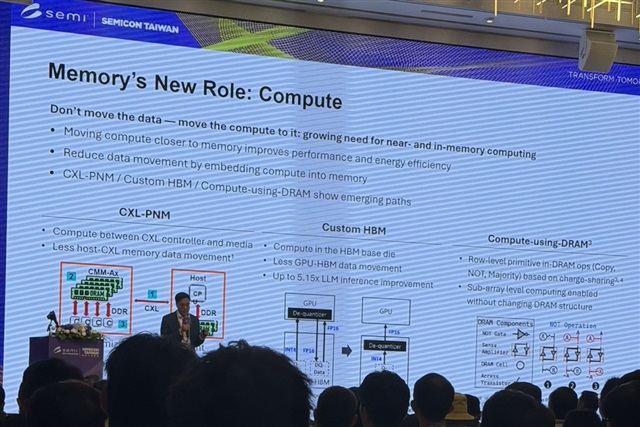
SK Hynix presented a custom HBM concept at SEMICON Taiwan 2026, where compute functions are placed in the base…
Nvidia reported earnings that were both remarkable and boring, reflecting its focus on avoiding a consolidated…

Anthropic has agreed to a $35bn cloud-computing contract with Lambda, a Nvidia-backed cloud provider

The Supreme Court of Japan has included about ¥60 million in its fiscal 2027 budget request for AI-related exp…
The Consumer Affairs Agency said Tuesday it will use generative AI to analyze about 900,000 annual consultatio…