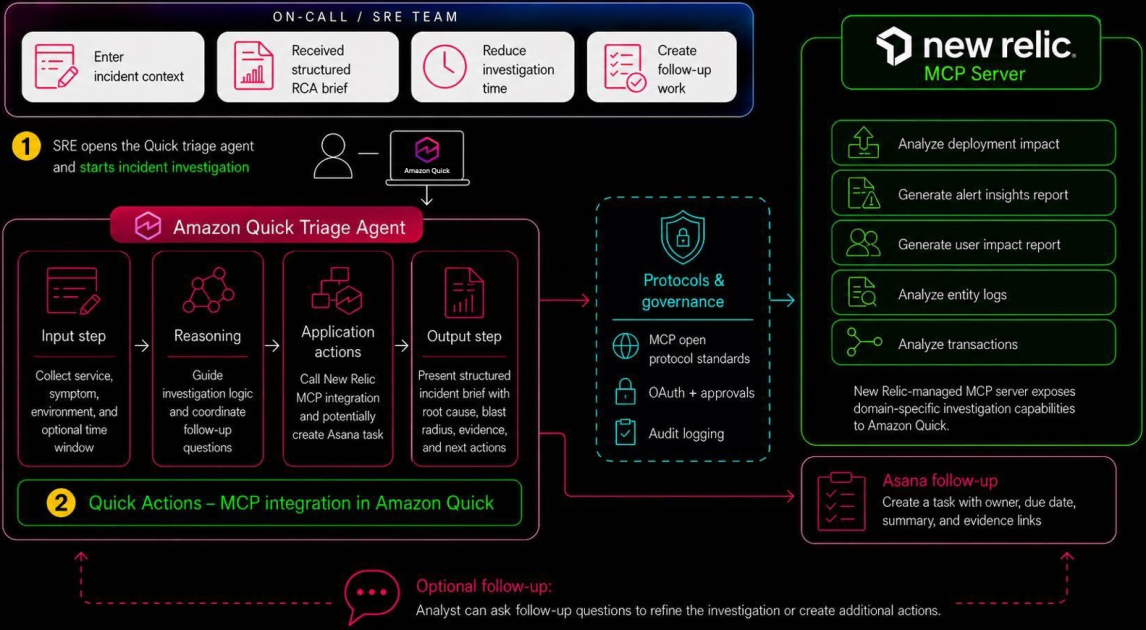
**What happened** — Amazon Quick, a conversational AI agent platform, now integrates with New Relic's observability tools and Asana's task management through native connectors. An on-call engineer can send a single prompt (e.g., "Checkout is slow and we are seeing server errors on checkout-service in production. Check the last 24 hours. Generate RCA brief") and the agent investigates the incident, assembles a root cause analysis (RCA) brief with evidence links, and creates a tracked Asana task.
**How it works** — The Amazon Quick agent calls five New Relic reasoning tools: generate_alert_insights_report (identifies key alert drivers), generate_user_impact_report (quantifies blast radius), analyze_entity_logs (surfaces error signatures), analyze_transactions (identifies slow or failing requests), and natural_language_to_nrql_query (converts plain-English questions into New Relic Query Language and runs them). The agent orchestrates these tools and Asana's task creation from a single prompt.
**So what** — In internal testing using New Relic's own applications, the agent reduced the evidence-gathering phase of incident triage, leading to faster resolution, lower risk of knowledge loss between engineering shifts, and a consistent investigation standard across the entire on-call rotation.
**Setup requirement** — Amazon Quick Professional subscription with Author permissions or higher is required to create integrations and chat agents; New Relic and Asana accounts are also needed, with Asana requiring administrative access to create an OAuth application in the developer console.
Summaries like this, in your inbox every morning.
Pick your industry and the AI tools you use, and get news related to your work every day.
Free · 30 seconds with Google · unsubscribe anytimeWhat is AIToday? →
Ask AI anything about this article. The AI reads this article, earlier AIToday articles, and Wikipedia, and cites its sources. Q&As are published on this page for other readers too.
Cammarata reinterprets InceptionV1's cat-car neuron as a V-shape detector, not two unrelated concepts

Google Deepmind's Gemini 4 Argon scored 97.5 percent on ARC-AGI-3 at a cost of $4,800, second only to GPT-6 As…
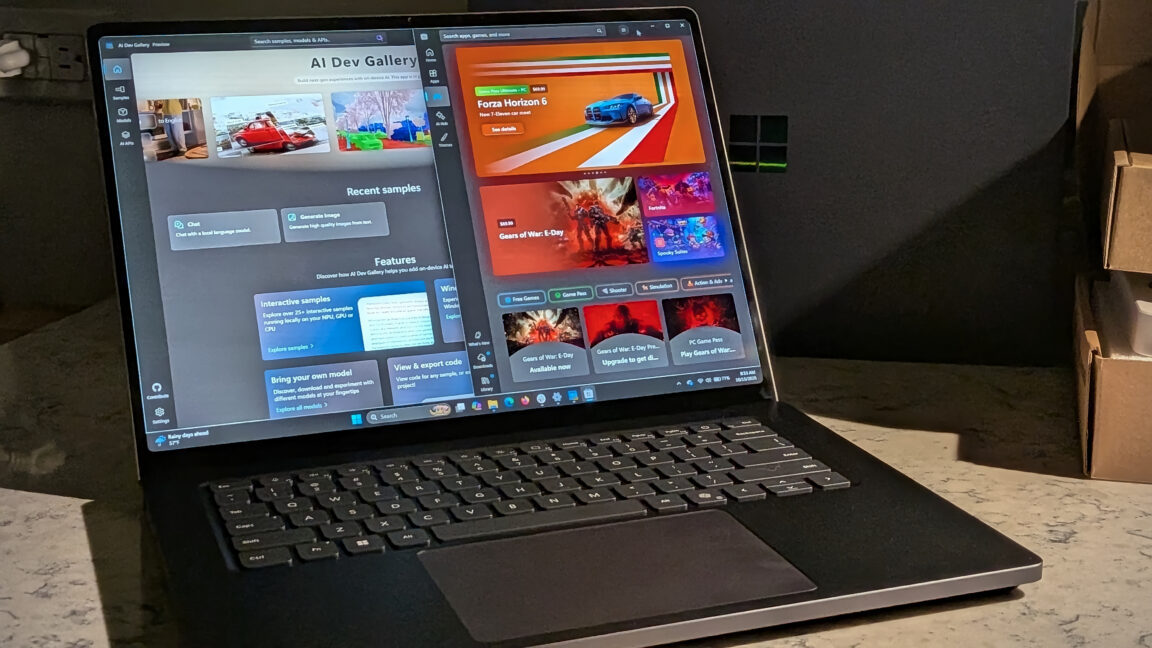
Microsoft's Surface Laptop Ultra, using Nvidia's RTX Spark platform, starts at $2,599 (up to $5,899)
Meta's new commercial terms, effective October 30th, appear to let it crawl and train AI on content from websi…
Vercel data published Thursday shows TypeSafe AI's Jev, a lightweight decision model for choosing among predet…
Reflection AI introduced Beam, an open-weight model for agentic coding and long-horizon tasks, with 501 billio…