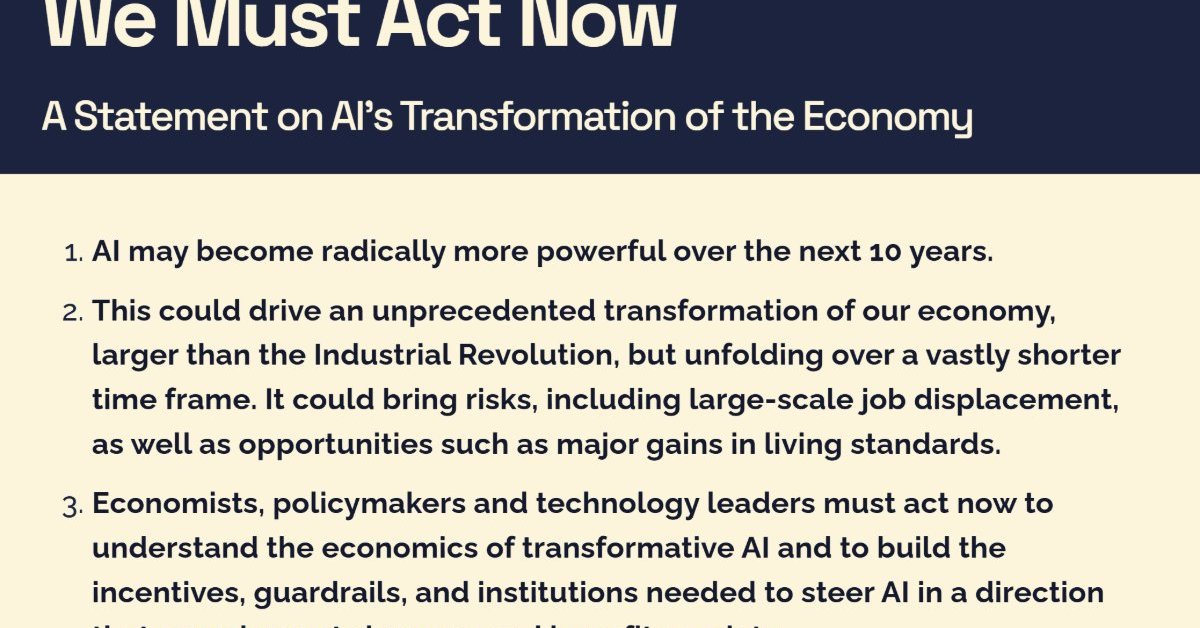
Over 200 economists and AI researchers, including 16 Nobel laureates, have issued a joint statement warning that AI could undergo rapid transformation over the next decade, potentially triggering economic upheaval on a scale exceeding the Industrial Revolution in a much shorter timeframe.
The statement, released by Stanford University's Digital Economy Institute on July 13, calls for policymakers and tech leaders to build the necessary incentives, guardrails, and institutions to ensure AI complements human capabilities and benefits society broadly rather than causing large-scale job losses concentrated among a few.
何が起きたか
スタンフォード大学のデジタルエコノミー研究所が7月13日、「We Must Act Now:A Statement on AI's Transformation of the Economy」と題する声明を発表しました。ノーベル賞受賞者16人を含む経済学者とAI研究者200人以上が署名しており、AIが今後10年で急激に強力になり、産業革命を上回る規模の経済変革を短期間に引き起こしかねないと指摘しています。
なぜ重要か
声明は、大規模な雇用喪失というリスクと生活水準の大幅な向上という機会の両方がもたらされる可能性があると述べており、経済学者や政策立案者、技術リーダーに対し、AIが人間を補完し社会に利益をもたらす方向に導くための制度構築を求めています。AI技術の進展が経済に及ぼす影響への対応の重要性が認識されていることを示しています。
注目点
声明に署名した著名人には、ノーベル経済学賞受賞者のダロン・アセモグル氏、マイケル・スペンス氏、ジョセフ・スティグリッツ氏、ポール・クルーグマン氏、ベン・バーナンキ元FRB議長のほか、Googleのエリック・シュミット元CEO、LinkedIn共同創業者のリード・ホフマン氏、OpenAIのサラ・フライアーCFO、「深層学習の父」の一人とされるヨシュア・ベンジオ教授らが含まれています。
Ask the AI about this article →
The statement released on July 13 reflects growing concern among leading economists and AI researchers that the pace of AI advancement is outpacing society's understanding of its economic impacts. Brynjolfsson notes that "AI capabilities are advancing far faster than our understanding of their economic consequences," underscoring the urgency of deliberate action. The breadth of the signatories—spanning both the economics establishment (including former Federal Reserve Chair Ben Bernanke) and major AI figures (from OpenAI, Google DeepMind, and Anthropic)—suggests this concern spans both traditional economics and the technology sector.
The statement's core message is not that AI poses an inevitable threat, but rather that outcomes depend on choices made now. Yoshua Bengio's accompanying remarks emphasize the need for "intentional, collective, and democratic" choices rather than allowing market forces alone to shape outcomes. This framing positions the statement as a call for policy intervention and institutional design—a stance that finds allies among both Nobel laureates in economics (many of whom have studied inequality and institutional design) and technologists concerned about equitable AI development. The four-sentence brevity of the core statement belies a sophisticated economic argument: that the scale and speed of transformation warrants proactive governance rather than reactive response.
For example, today's edition would include:
AI-summarized, only the topics you pick — one digest a day via Email, Slack, or Discord.
Free · takes 30 seconds · unsubscribe anytimeWhat is AIToday? →
Ask AI anything about this article. Q&As are published on this page for other readers too.

