AIToday

MRI・PKUTECHが「AI Memory RAG」開発、過去の議論を踏まえた分析・回答が可能に

Top Companies AI — Japan (2/2)3h ago
MRI・PKUTECHが「AI Memory RAG」開発、過去の議論を踏まえた分析・回答が可能に

Key takeaway

MRI and PKUTECH jointly developed "AI Memory RAG," a new retrieval-augmented generation technology that enables analysis and answers informed by past discussions and decision-making processes—addressing a key limitation of traditional RAG, which struggles to track evolving information and historical context in continuously accumulated documents like news and meeting minutes. The new technology structures documents across temporal, network, and change-history dimensions, allowing organizations to make faster and more informed decisions in fields such as news monitoring, intelligence analysis, development management, and knowledge transfer.

Summaries like this, in your inbox every morning.

Sign up free →

3 Key Points

  • 何が起きたか

    シンクタンク・コンサルティングの三菱総合研究所(MRI)とAI・データ分析のPKUTECH(ピーケーユーテック)は、7月8日に新しいRAG(検索拡張生成)技術「AI Memory RAG」を共同開発したと発表しました。過去の議論や判断プロセスに照らした横断的な分析・回答ができるのが特徴です。

  • なぜ重要か

    従来のRAGは類似した情報の検索が中心で、継続的に蓄積されるニュースや議事録に関して、過去の議論や変更の経緯を踏まえた回答が難しく、時間経過による変化も把握しにくいという課題がありました。新技術はこうした制限を克服し、実務での迅速で適切な意思決定が可能になるとみられます。

  • 注目点

    AI Memory RAGは、ニュースや議事録などの文書を時系列構造・グラフ(ネットワーク)構造・リポジトリ(変更履歴)構造の3つの形式で自動判定して保持します。ニュース監視・インテリジェンス分析、開発管理・議事録管理、ナレッジ継承などの分野での活用を想定しており、両社は実証を通して実用性を高め、ソリューション化を目指しています。

In Depth

On July 8, Mitsubishi Research Institute (MRI)—a major think tank and consulting services firm—and PKUTECH, an AI and data analytics company, announced the joint development of "AI Memory RAG," a new retrieval-augmented generation technology designed to overcome limitations in how enterprises extract value from accumulated data.

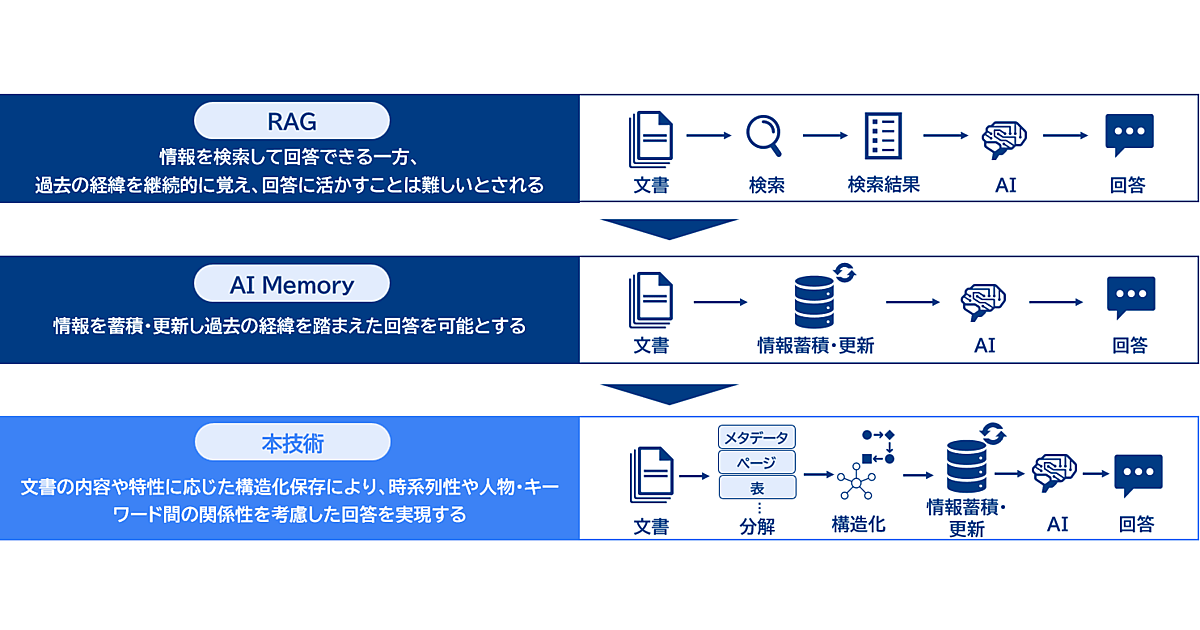
Traditional RAG technology works by allowing AI systems to supplement their pre-trained knowledge with relevant company-specific data, improving the accuracy of responses. However, this approach has a significant weakness: while it excels at finding similar documents or passages, it struggles to capture the full context of how decisions evolved over time. Documents that continuously accumulate—such as news feeds and meeting minutes—create particular challenges. Past discussions, the reasons why approaches changed, and the processes through which consensus was reached all become difficult to track and retrieve, and temporal changes become hard to discern.

AI Memory has recently emerged as a solution to this problem. Rather than treating each query in isolation, AI Memory systems maintain persistent memory of past information, dialogue histories, and accumulated knowledge, which the generative AI then continuously draws on to produce answers. Recognizing the promise of this approach, MRI and PKUTECH built on AI Memory by adding technology to maintain and search information while preserving both temporal and contextual relationships in appropriate data formats, creating AI Memory RAG.

The key innovation lies in how the system structures and stores data. Documents targeted for search—primarily news and meeting minutes—are decomposed into granular components: pages, chapters, tables, and metadata. The system then automatically determines the optimal storage format for each component based on its content characteristics. Information is held in one of three structural forms: a temporal (time-ordered) structure, a graph or network structure that captures relationships between people and keywords, or a repository structure that tracks change history and revision logs. When answering a query, the system combines AI Memory's query-processing mechanism with these structured representations, analyzing the incoming query to generate a plan for which data to retrieve and what reasoning steps to perform.

MRI and PKUTECH envision the technology being deployed in three main domains: news monitoring and intelligence analysis, development management and meeting minute management, and knowledge transfer across organizations. The companies plan to verify accuracy and conduct proof-of-concept trials to increase practical utility, with the ultimate goal of integrating AI Memory RAG into full commercial solutions.

Context & Analysis

The development of AI Memory RAG reflects a growing recognition of a practical gap in enterprise AI deployment. While traditional RAG has become a standard approach for grounding language models in proprietary data, it operates primarily as a semantic search tool—retrieving similar documents or passages without full understanding of how information has evolved or changed. Organizations increasingly face a different problem: they need AI systems that can trace back through accumulated institutional knowledge, understand how decisions were made in the past, and apply that historical context to new questions.

AI Memory is an emerging paradigm that addresses this by having AI systems maintain persistent memory of conversations and knowledge over time, mimicking human institutional memory. By combining this with structured data representations—temporal sequences for time-stamped information, graph structures for relationships between people and concepts, and change-history structures for tracking decisions and reversals—MRI and PKUTECH have created a system that can retrieve not just "what was said" but "how we got here." This is particularly valuable in domains like intelligence analysis and development management, where understanding the evolution of thinking and the rationale behind decisions is as important as the decisions themselves.

FAQ

How does AI Memory RAG differ from traditional RAG?
Traditional RAG focuses on searching for similar information, but has difficulty providing answers that account for past discussions, the history of changes, and consensus-building processes—especially with continuously updated documents like news and meeting minutes. AI Memory RAG adds capabilities to maintain and search for temporal sequences and context in appropriate data formats, allowing cross-functional analysis and answers based on historical decision processes.
What data structures does AI Memory RAG use to store information?
The technology automatically decomposes documents (news, meeting minutes, etc.) into pages, chapters, tables, and metadata, then stores them in one of three structures based on content: temporal sequence, graph (network) structure, or repository (change history) structure.
What use cases are targeted?
The technology is designed for news monitoring and intelligence analysis, development management and meeting minute management, and knowledge transfer.

Discussion

No comments yet. Be the first to share your thoughts!

Log in to join the discussion

Related Articles

Stay ahead with AI news

Get curated AI news from 200+ sources delivered daily to your inbox. Free to use.

Get Started Free

Free · takes 30 seconds · unsubscribe anytime

1 minute a day. The AI essentials.

200+ sources · Email / LINE / Slack

Get it free →