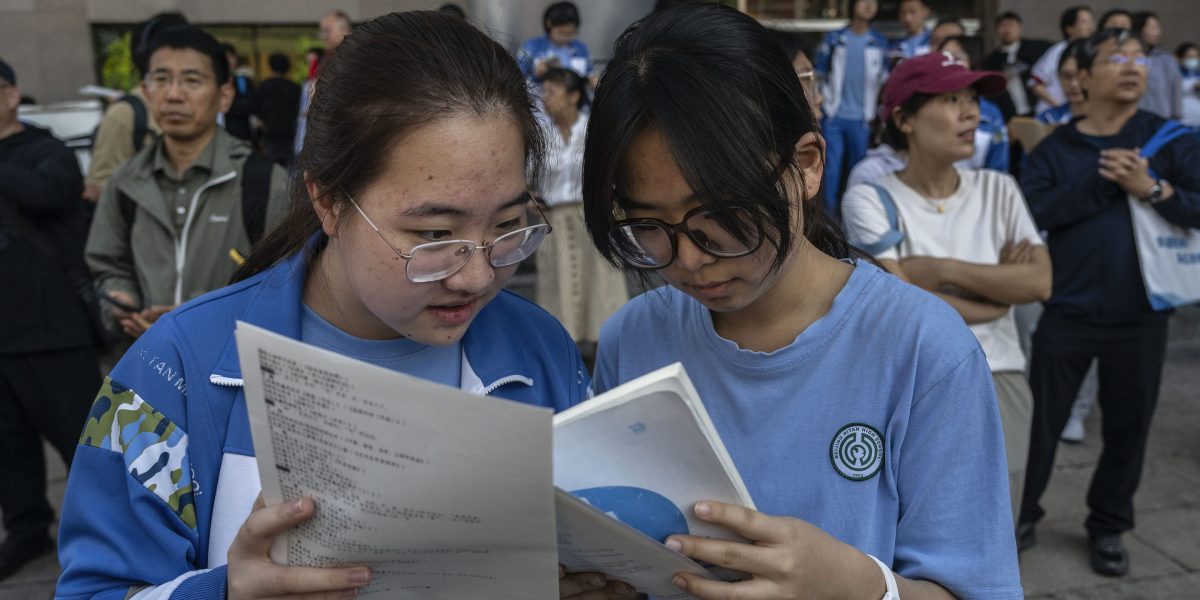
A study of over 26,000 Chinese secondary students found that while AI use boosted homework scores by 18% and reduced completion time by 30%, exam performance dropped sharply—monthly scores fell 20% within six months, and college entrance exam scores declined 18% to 24%. The decline was driven primarily by students who outsourced their homework entirely to AI, suggesting that speed and convenience come at the cost of actual learning; researchers note that the problem echoes historical warnings about educational automation dating back to the 1920s.
Summaries like this, in your inbox every morning.
Sign up free →What happened
A Centre for Economic Policy Research study of 26,811 Chinese students in grades seven through 12 found that AI use increased homework scores by 18% and cut completion time by 30%, but monthly exam scores fell 20% within six months, and college entrance exam scores dropped 18% to 24%—with the worst performance appearing after two years.
Why it matters
About 80% of the score decline came from students who outsourced homework entirely to AI, completing it accurately but learning nothing. The research reveals a mismatch between productivity (finishing work faster) and actual learning, echoing decades of evidence that automation tools can hinder skill development rather than enable it—a pattern first observed in 1924 with the invention of the 'teaching machine.'
What to watch
Neuroscientist Jared Cooney Horvath warns AI in education may recreate the 'transfer problem' documented since the 1920s: students perform well while using the tool but fail when asked to apply knowledge independently, suggesting the risk that AI dependency replaces genuine learning.
A new study by the Centre for Economic Policy Research has documented a troubling pattern: students who use AI to complete homework experience a sharp reversal in academic performance. Researchers tracked 26,811 Chinese students in grades seven through 12 and found that initial adoption of AI led to an 18% increase in homework scores and a 30% reduction in completion time. However, the gains evaporated quickly. Within six months, monthly exam scores dropped by 20%, and college entrance exam scores fell by 18% to 24%, with performance reaching its worst after two years.
The researchers identified a specific student profile driving the decline: those who 'outsourced' their homework, using AI to complete the work accurately while expending minimal effort. This group, representing about 80% of the students showing poor exam performance, had learned how to produce correct homework answers without learning the underlying material. As the research team wrote, 'For students, completing these tasks efficiently is not the goal; learning from them is. Hence, the rapid diffusion of generative AI tools among students in recent years has created widespread concerns about their learning. Our findings show that generative AI, which is likely to become a prevalent technology for education, has a substantial negative impact on student learning.'
Neuroscientist Jared Cooney Horvath frames the finding as a modern echo of a problem recognized for over a century. In 1924, Ohio State University psychology professor Sidney Pressey invented the 'teaching machine,' a device that would display questions and automatically advance to the next question when students entered a correct answer. Decades later, behavioral psychologist B.F. Skinner created an improved version using a mechanical system where students pressed keys to indicate their answer. Both inventors discovered the same critical flaw: while students performed well on the machine itself, they could not generalize or apply their knowledge outside the device—what researchers called the 'transfer problem.' Pressey abandoned the project, writing to Skinner that 'while students had not mastered the subject matter; they had just mastered the machine.' Horvath warns that generative AI now faces the same obstacle: 'The tools experts use to make their lives easier are not the tools children should use to learn how to become experts. When you use offloading tools that experts use to make their lives easier as a novice, as a student, you don't learn the skill. You simply learn dependency.'
Context from Jacob Shelley, an associate professor of health law at Western University, illuminates why students feel driven to use AI despite the academic risks. In May, Shelley observed anomalous exam results in one of his classes—8% of students achieving perfect scores on the multiple-choice section while submitting essay answers containing material not covered in the curriculum. After 20 years of teaching, Shelley said, 'The results were anomalous. That just never happened.' While Shelley suspects AI use was involved, he refrains from condemning his students. Instead, he points to their anxiety about the future: nearly 90% of graduates from the class of 2026 report worrying that AI or automation could replace entry-level jobs, according to job search platform Monster. Tech leaders including Anthropic's Dario Amodei and OpenAI's Sam Altman have walked back earlier dire predictions of an 'AI job apocalypse,' but the anxiety persists among students preparing to enter the workforce. Shelley believes students see through reassurances and feel compelled to adopt AI to remain competitive: 'AI is going to replace them, at least a lot of them, and they know that, and we're pretending that it won't. I think they see through it. So students are responsible, but I don't really blame them here.' The research thus captures a troubling cycle: students use AI to manage homework and stay ahead, only to find their exam performance and genuine learning suffer—precisely the opposite of what they hoped to achieve.
The study reveals a fundamental disconnect between task completion and learning. When students use AI to finish homework quickly and accurately, they bypass the cognitive friction—trial, error, confusion, and struggle—that research shows is essential for retention and skill transfer. The researchers emphasize that 'for students, completing these tasks efficiently is not the goal; learning from them is,' yet the incentive structure (grades on homework, time pressure, anxiety about the future) pushes students toward outsourcing rather than engagement.
This pattern has deep historical roots. Neuroscientist Jared Cooney Horvath traces the problem to the 1924 'teaching machine' developed by Sidney Pressey, which was later refined by behaviorist B.F. Skinner in the 1950s. Both psychologists abandoned their projects when they discovered the 'transfer problem': students performed well while using the tool but failed to apply their knowledge independently. As Pressey conceded in a letter to Skinner, students 'had just mastered the machine' rather than the subject matter. The same mechanism appears to be at work with generative AI: it solves the homework problem but leaves the student dependent on the tool and unable to retrieve or apply the underlying knowledge when the tool is not available.
Context from Jacob Shelley, an associate professor of health law at Western University, adds urgency to the finding. He observed anomalous results in one exam—8% of students achieving perfect scores on multiple-choice questions while struggling on the essay portion—that he suspects involved AI cheating. But Shelley also notes that students feel compelled to use AI because of anxiety about job displacement; nearly 90% of graduates in the class of 2026 worry that AI or automation could replace entry-level jobs. Rather than blame students, Shelley suggests they are responding rationally to a perceived threat, using the technology to stay competitive even if it undermines their actual learning.
AI-summarized, only the topics you pick — one digest a day via Email, Slack, or Discord.
Free · takes 30 seconds · unsubscribe anytime
No discussion yet for this article
Get curated AI news from 200+ sources delivered daily to your inbox. Free to use.
Get Started FreeFree · takes 30 seconds · unsubscribe anytime
1 minute a day. The AI essentials.
200+ sources · Email / LINE / Slack
