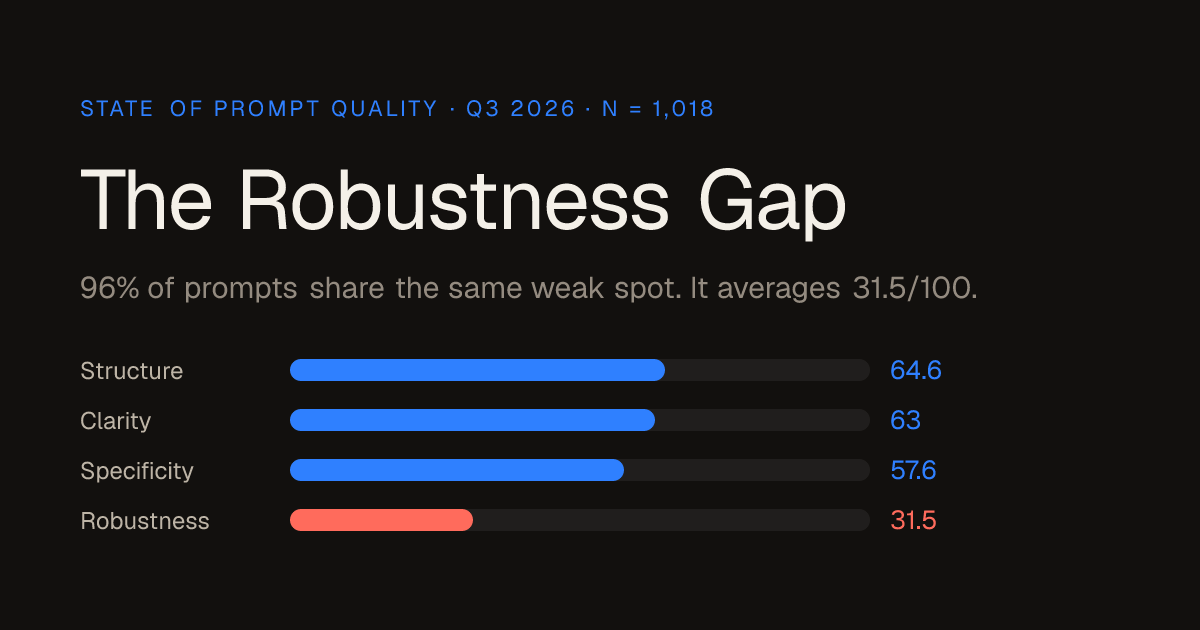
A new analysis of over 1,000 real AI prompts reveals that almost all fail the same way: they collapse when given unexpected or messy input, not when used under ideal conditions. Robustness—how well a prompt handles edge cases like empty messages or off-topic questions—scored an average of just 31.5 out of 100, and was the weakest dimension in 96% of prompts evaluated. Only 10.5% of prompts reached the score of 75 considered reliable for repeated production use. The research identifies four simple one-to-four-sentence improvements that can significantly raise robustness scores, with adding an output format specification delivering the largest measured lift.
Summaries like this, in your inbox every morning.
Sign up free →What happened
PromptEval analyzed 1,018 real prompts submitted between May 20 and July 11, 2026, scoring them 0–100 on clarity, specificity, structure, and robustness. The average score was 54, but robustness averaged just 31.5—the lowest of the four dimensions in 96% of all prompts. Only 10.5% of prompts scored 75 or higher, the threshold for reliable reuse.
Why it matters
Prompts that work in testing often fail in actual use because they are not built for messy, unexpected inputs. The rubric found that 83.6% of prompts score below 50 on robustness—meaning they handle clean, cooperative input but collapse when users feed in empty messages, garbage text, or off-topic questions. For reusable system prompts (67% of the dataset), this weakness multiplies across many runs, amplifying the cost of poor robustness.
What to watch
Four simple structural habits can close the gap. Adding an output format specification yields the largest lift (+29 points). Defining constraints—telling the model what NOT to do—adds +24. A persona role adds +17. Pasting a single example of desired output adds +10, but only 5.2% of prompts include one; the report identifies this as the biggest untapped lever. The dataset is 74% English, 19% Arabic, 6% Portuguese.
Between May 20 and July 11, 2026, PromptEval's automated evaluator scored 1,018 real prompts submitted for evaluation on a fixed rubric spanning four dimensions: clarity, specificity, structure, and robustness. The rubric rated each prompt 0–100. Overall, the average score was 54; the median was 60. Two-thirds of prompts landed between 40 and 79—functional, capable of producing an answer—while only 12% fell below 30 (truly broken). At the high end, just 10.5% scored 75 or above, the threshold the report identifies as the production bar where a prompt is consistent enough to trust in repeated use.
The critical finding is not the overall distribution but the shape of weakness within it. Robustness—defined as the prompt's behavior when input deviates from the expected (empty messages, garbage text, questions in another language, hostile input)—averaged 31.5 across all prompts. This was the lowest of the four dimensions in 95.7% of all classified prompts. Among robustness-specific sub-scores, constraint definition (telling the model what NOT to do) averaged only 52.2, the second-lowest behavior in the entire rubric. The report frames this not as an outlier but as the core problem: "A prompt that scores 60 on clarity and 30 on robustness behaves perfectly in the demo and falls apart the first week of real use, because real use is where the messy input lives."
The dataset breaks down by use case and language: content creation and education together comprise 58% of classified prompts. The data is 74% English, 19% Arabic, and 6% Portuguese. System prompts—reusable prompts that run many times—represent 67% of the set; for these, a single robustness failure multiplies across many invocations and inflates the downstream cost. To isolate actionable levers, PromptEval compared average scores for prompts with and without four structural habits. Declaring an output format (one line like "Answer as a numbered list" or "Return valid JSON") delivered the largest measured lift: prompts with it averaged 59.8, those without averaged 31.1, a gap of +29. Setting constraints (telling the model what to never do: "Do not invent sources") added +24 (64.5 with, 40.8 without). Assigning a persona with a point of view ("You are a pediatric nurse explaining to a worried parent") added +17 (58.7 with, 42.2 without). Pasting one worked example of the desired output added +10 (63.7 with, 53.3 without) but was the rarest habit: only 5.2% of prompts included one, suggesting the largest untapped opportunity.
The report recommends a sequence of improvements for anyone optimizing a reusable prompt. First, add one sentence addressing edge cases: "If the input is empty, unclear, or off-topic, say so and ask for clarification instead of guessing." This single sentence targets the behavior 85% of prompts score under 50 on. Second, declare the output format (the biggest measured lift, +29). Third, set two or three constraints. Fourth, paste one example. Following this sequence, the report claims, would place a prompt in the top 5% by habit alone. The study acknowledges selection bias: these are prompts people chose to submit for evaluation, often suspecting a problem, so scores likely skew lower than the general population. The benchmark was frozen on July 11, 2026, and PromptEval offers free evaluations (three per month) for individuals to check their own robustness score.
The finding cuts against the intuition that prompt quality is a dashboard of evenly distributed weaknesses. Instead, PromptEval's rubric reveals a sharp, predictable failure mode: prompts are engineered for the happy path—the clean, cooperative input they were tested with—and fall apart immediately when confronted with real-world noise. The dataset spans three languages and multiple use cases (content creation, education, and smaller samples in finance, legal, and AI agents), yet robustness emerges as the systematic weak point in 96% of cases. This is not a tail effect but a structural pattern.
The gap between average robustness (31.5) and average scores on the other three dimensions (all in the 60s) points to a training or cultural problem in how prompts are written. Most practitioners optimize for the demonstration scenario, where they control both the question and the model's context. The moment a prompt enters production—where users pose messy, ambiguous, or adversarial questions—it lacks the guardrails to degrade gracefully. The four structural habits the report isolates (output format, constraints, persona, and examples) are not technical tricks but communication patterns; they cost one to four sentences and require no specialized knowledge. The fact that only 5.2% of prompts include a worked example, despite a measured +10 lift, suggests a widespread gap between known best practices and actual adoption.
No discussion yet for this article
Get curated AI news from 200+ sources delivered daily to your inbox. Free to use.
Get Started FreeFree · takes 30 seconds · unsubscribe anytime
1 minute a day. The AI essentials.
200+ sources · Email / LINE / Slack
