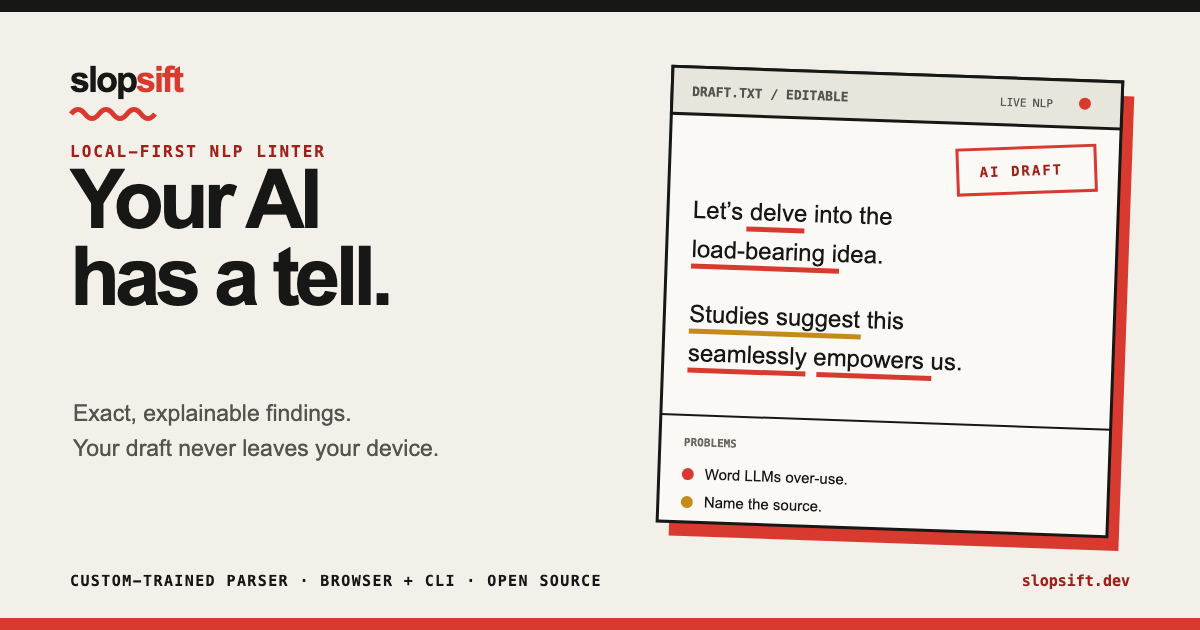
SlopSift is a local, dependency-parser-based linter that detects patterns of weak or inflated writing—unsupported claims, canned arguments, vague attribution—by analyzing grammatical structure rather than word lists. The 16 MiB model runs entirely on-device in Node and browser WebAssembly, keeping your draft private. It's available as a live editor, CLI tool, and AI agent skill.
Summaries like this, in your inbox every morning.
Sign up free →What happened
A developer released SlopSift, a local dependency parser that analyzes writing to identify patterns like unsupported claims, canned arguments, vague attribution, and mechanical outlines. The tool runs entirely on-device using a 16 MiB quantized model and does not upload text to remote servers.
Why it matters
Many AI-writing tools rely on word matching or API wrappers; SlopSift instead maps grammatical relationships between words to inspect sentence structure and logical claims. For writers and coding agents, it offers real-time, privacy-preserving feedback as they draft—catching inflated or borrowed certainty that both AI and human writers produce.
What to watch
SlopSift is available as a web editor (editable live), a CLI tool that emits ESLint-shaped JSON for CI integration, and an AI agent skill that lets coding agents run the linter and edit without flattening the writer's voice. The model was trained using structured distillation from a larger parser plus 50 controlled examples targeting grammatical relationships used by the linter rules.
SlopSift is a local-first linter designed to catch weak or inflated writing patterns in drafts. The core innovation is its use of a custom-trained dependency parser that maps grammatical relationships between words, rather than relying on word-list matching or basic parts-of-speech tagging.
The tool works in three steps. First, it builds a dependency graph: a small, quantized ONNX model (16 MiB) predicts parts of speech and the grammatical links holding a sentence together. Second, it matches constructions: authorable rules inspect the graph for structural tells—unsupported claims, canned arguments, vague attribution, mechanical outlines, and repetition. Third, it categorizes findings as errors (strong tells requiring attention), warnings (findings needing review), or notes (candidates for the writer to consider).
To train the model, the creator used a compact pretrained English encoder and fine-tuned it for parts-of-speech and dependency parsing. Training combined structured distillation from a larger parser with 50 controlled examples targeting the grammatical relationships used by the linter rules, with separate template families reserved for evaluation. The resulting model is small enough to run entirely on-device in Node.js and browser WebAssembly—no remote uploads, no API calls.
SlopSift is available in three forms: a live web editor where you can type and see findings in real time, a CLI tool that lints Markdown and code comments and emits ESLint-shaped JSON for CI pipelines, and an AI agent skill that lets coding agents run the linter, interpret its findings, and edit without flattening the writer's voice. The creator notes that SlopSift is not an AI detector and does not claim to know who typed a sentence; it simply catches vague, inflated, repetitive, or borrowed-certainty writing patterns that appear in both human and AI-generated text.
SlopSift addresses a gap in AI-writing tools by moving beyond word-list matching to structural analysis. Most existing linters stop at counting flagged phrases or basic parts-of-speech tagging; SlopSift instead builds a dependency graph to understand how words relate grammatically, then applies rules that inspect those relationships for logical or rhetorical weaknesses. This allows it to catch patterns like unsupported certainty, vague attribution, and borrowed phrasing that simple regex or vocabulary filters would miss.
The tool was trained efficiently: it starts with a compact pretrained English encoder, then fine-tunes it for parts-of-speech and dependency parsing using structured distillation from a larger parser combined with 50 controlled examples targeting the specific grammatical relationships the linter rules need. By keeping the model to 16 MiB and quantizing it to ONNX format, the creator ensured it runs entirely on-device in both Node and browser environments, preserving user privacy and enabling real-time feedback without network calls.
SlopSift's approach sidesteps false positives common to rule-based AI detectors. Rather than claiming to identify whether an AI wrote a passage, it simply flags writing patterns—vague attribution, mechanical outlines, repetitive structure—that can appear in both human and AI-generated text. This makes it useful for writers (and coding agents) who want structural feedback without being told their work is fraudulent.
AI-summarized, only the topics you pick — one digest a day via Email, Slack, or Discord.
Free · takes 30 seconds · unsubscribe anytime
No discussion yet for this article
Get curated AI news from 200+ sources delivered daily to your inbox. Free to use.
Get Started FreeFree · takes 30 seconds · unsubscribe anytime
1 minute a day. The AI essentials.
200+ sources · Email / LINE / Slack
