What happened
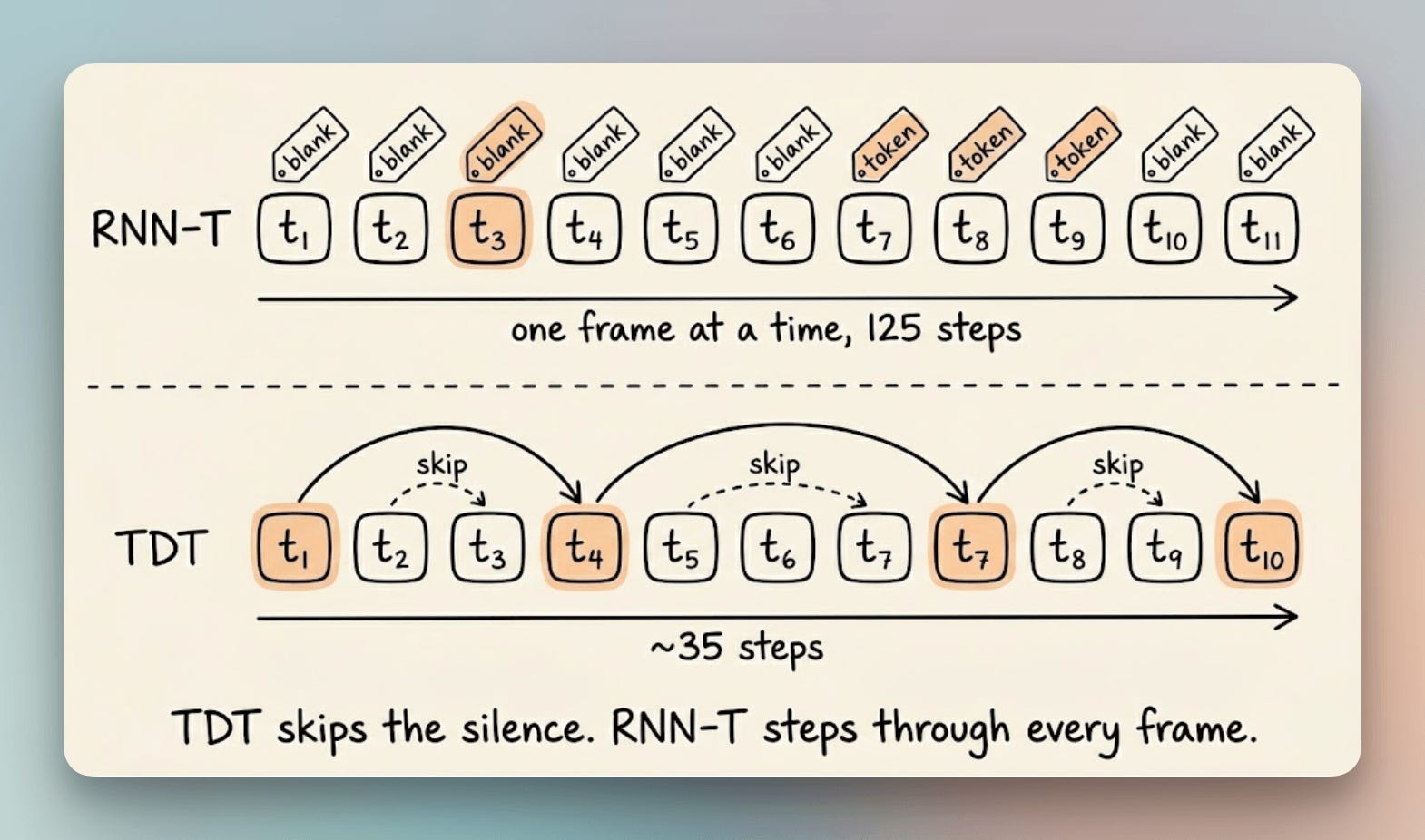
Researchers found that speech recognition systems waste compute processing silence instead of speech. A new decoder architecture called Token-and-Duration Transducer (TDT) lets the model skip ahead through silence rather than confirming it frame-by-frame. On English speech recognition, TDT matches or beats standard models on accuracy while decoding up to 2.82x faster.
Why it matters
Voice agents feel laggy partly because traditional systems process every frame of silence one at a time. For a typical 10-second audio clip, standard decoders run about 125 sequential calls, most confirming nothing happened. Faster decoding directly improves real-time voice agent responsiveness without requiring larger models or more training data.
What to watch
NVIDIA's Parakeet TDT models now lead the Huggingface Open ASR Leaderboard on throughput (RTFx, a metric measuring seconds of audio processed per second of wall-clock time) despite using the same encoder size and training data as plain RNN-T models ranked below them. Speechmatics runs this approach in production and scored 1.07% pooled word error rate on the Pipecat voice agent benchmark across 1,000 samples.
Summaries like this, in your inbox every morning.
Pick your industry and the AI tools you use, and get news related to your work every day.
Free · 30 seconds with Google · unsubscribe anytimeWhat is AIToday? →
Ask AI anything about this article. The AI reads this article, earlier AIToday articles, and Wikipedia, and cites its sources. Q&As are published on this page for other readers too.
A solo developer built Yurune, a web app that plays synthesized rain, wave and forest sounds and lets users ta…

The developer benchmarked Moonshine Voice's Japanese "Small Streaming" model against faster-whisper's small mo…

The Japan Actors Union adopted a generative AI guideline for voice on October 15, requiring prior consent from…

SpaceXSI released Grok Voice 3.0, rated 86.9 on Artificial Analysis' Speech-to-Speech Index, ahead of OpenAI's…

Square launched the Square Kiosk, a pill-shaped ordering device with a 21.5-inch touchscreen and an AI voice l…

YouTube is adding a "Made with AI" label to tracks "altered or fully generated" using AI, starting today in th…