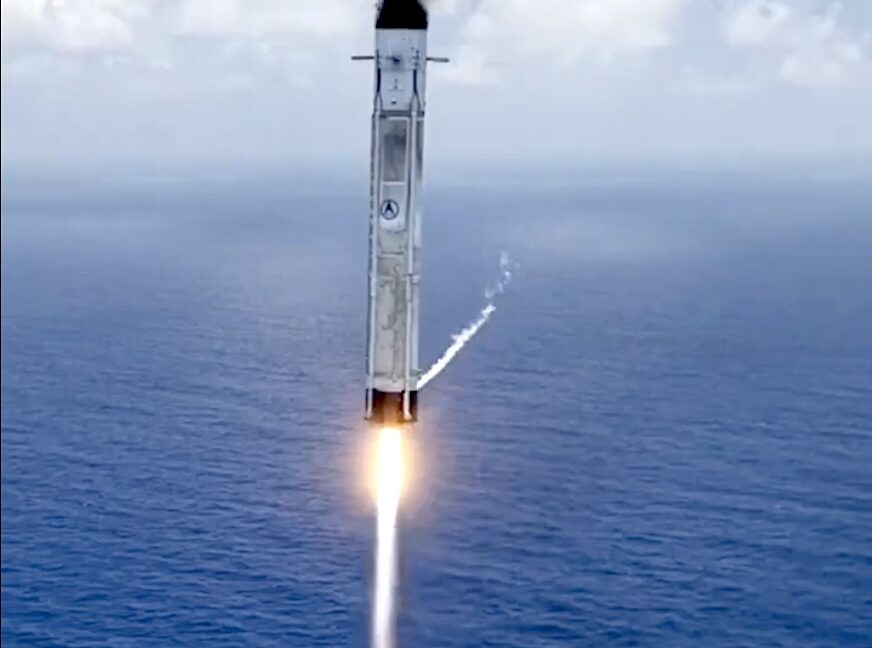
What happened
China's state-owned rocket developer successfully recovered the first stage of a Long March 10B rocket for the first time on Friday, catching it mid-air using a net system aboard an offshore vessel in the South China Sea. The rocket, standing approximately 209 feet tall and powered by seven kerosene-fueled engines, lifted off from Hainan Island and deployed a payload called CX-26 before the booster was captured and brought to rest using tensioned cables.
Why it matters
This makes China the third entity to achieve controlled rocket recovery, after SpaceX (Falcon 9 in 2015 and Starship in 2024) and Blue Origin (New Glenn in November). China's approach—combining an offshore vessel with a net catch—avoids the weight penalty of landing legs and reduces fuel consumption during descent, potentially offering a different path to lowering launch costs. US military officials have flagged China's progress in reusable rocketry as a concern for maintaining American space leadership, noting that sustained reuse could enable faster launch cadences.
What to watch
CASC stated that the first stage reuse flight test is expected to be completed by the end of this year. The Long March 10B is a medium-lift rocket with approximately 16 metric tons payload capacity to low-Earth orbit. China's broader Moon program relies on a heavier Long March 10 configuration, combining three reusable first-stage boosters, as the country aims to land citizens on the Moon by 2030.
Summaries like this, every morning.
China's successful mid-air booster recovery marks a significant inflection point in the country's spacefaring ambitions. Unlike SpaceX's propulsive landing approach or Blue Origin's offshore platform catches, China has chosen a hybrid strategy that uses an offshore vessel and net capture—a method that trades some operational complexity for engineering advantages in payload efficiency. By eliminating the structural and fuel-consumption penalties of landing legs, the Long March 10B's design may offer a competitive edge as Chinese rocket makers race to match the launch cadences that SpaceX currently dominates.
The recovery represents validation of several critical technologies that underpin China's reusable launch architecture: multiple engine restarts at high altitude, precise navigation and control, and the novel sea-based net-capture system itself. This success occurs within a broader competitive context: China is the world's second-largest spacefaring nation, but SpaceX and other US operators currently launch payloads into orbit about twice as often. US military officials have explicitly identified China's progress in reusable rocketry as a potential asymmetry, warning that operational reuse could enable the faster cadences needed to threaten American space assets.
Framed against China's lunar ambitions, this booster recovery is a stepping stone toward a heavier Long March 10 configuration designed to use three reusable first-stage boosters stacked together. That architecture is central to China's goal of landing astronauts on the Moon by 2030—a timeline that depends on the reliable, affordable access to orbit that reusable rockets enable. The planned first-stage reuse flight test by year-end will be the next test of whether this approach scales beyond the maiden flight.
Pick your industry and the AI tools you use, and get news related to your work every day.
Free · 30 seconds with Google · unsubscribe anytimeWhat is AIToday? →
Ask AI anything about this article. The AI reads this article, earlier AIToday articles, and Wikipedia, and cites its sources. Q&As are published on this page for other readers too.

