AIToday

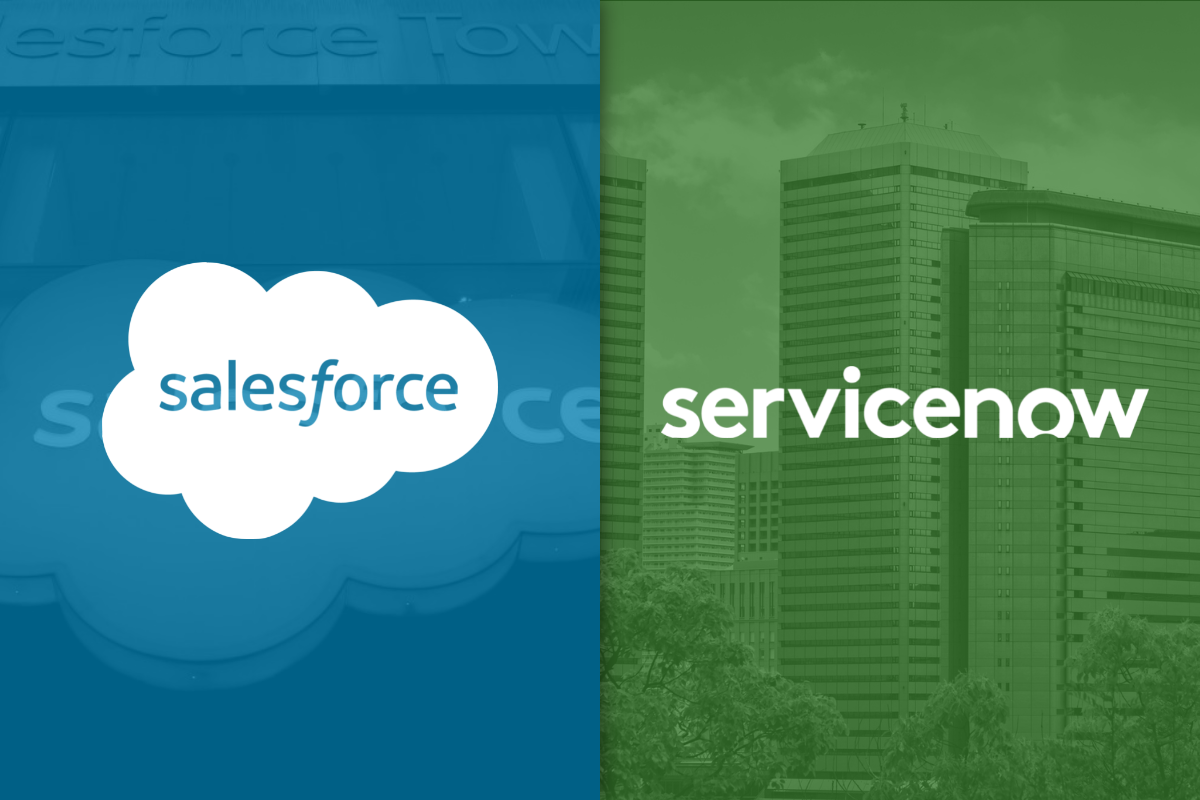
Salesforce edges ServiceNow as cheaper AI play despite slower growth

Yahoo Finance AI7h agoSend on LINE
Salesforce edges ServiceNow as cheaper AI play despite slower growth

Key takeaway

Salesforce and ServiceNow, two enterprise software leaders, are both betting on agentic AI (digital workers that autonomously perform tasks) to drive future growth. ServiceNow projects faster expansion, guiding for subscription revenue to reach at least $30 billion(約4.8兆円) by 2030 from $15.7 billion(約2.5兆円) this year. However, Salesforce is a better value for risk-conscious investors: it trades at just over 18 times earnings versus ServiceNow's more than 56 times earnings, offering downside protection if AI adoption or impact slows.

Summaries like this, in your inbox every morning.

Sign up free →

3 Key Points

  • What happened

    Both Salesforce and ServiceNow have rolled out agentic AI tools to compete in enterprise software. ServiceNow guides for subscription revenue to grow from $15.7 billion(約2.5兆円) this year to at least $30 billion(約4.8兆円) by 2030, with AI accounting for 30% of annual contract value by then. Salesforce's Agentforce AI agents performed 3.8 billion discrete tasks in Q1 fiscal 2027 and grew 111% from the prior quarter, but the company guides for only 10–11% revenue growth this year.

  • Why it matters

    ServiceNow trades at more than 56 times earnings with expected long-term earnings growth of 24.6% annually, while Salesforce trades at just over 18 times earnings with expected earnings growth of 16.1% annually. For investors uncertain how AI will reshape these businesses, Salesforce's lower valuation relative to growth offers better protection against downside risk if AI's impact disappoints.

  • What to watch

    Both stocks have fallen sharply from their highs—ServiceNow nearly 60% below its peak, Salesforce about 57% below—reflecting market caution about how AI might ultimately affect these software companies in the coming years.

In Depth

Salesforce and ServiceNow, two of enterprise software's largest players, are both racing to establish leadership in agentic AI—digital workers capable of autonomously performing business tasks. The question for investors is which represents the better opportunity given the risks and rewards of AI's uncertain trajectory in the corporate software market.

ServiceNow's AI strategy centers on workflow automation, the core strength of its existing business. The company recognized that the same repetitive, rule-based tasks it has long helped automate—such as IT support ticket submission—are exactly what AI agents excel at performing without human intervention. Rather than be displaced by this technology, ServiceNow is repositioning itself as the control layer: software that helps enterprises deploy, monitor, and direct AI agents, functioning like an airport control tower that coordinates which plane takes off when. The company's confidence in this pivot is evident in its financial guidance. Management expects subscription revenue to reach at least $30 billion(約4.8兆円) by 2030, more than doubling from the $15.7 billion(約2.5兆円) it expects this year. More tellingly, it believes AI will represent 30% of its annual contract value by 2030, underscoring management's conviction that agentic AI will become central to its revenue base. However, the stock has not benefited from this bullish outlook, sitting nearly 60% below its all-time high as the broader market has sold off software stocks amid uncertainty about AI's true impact on the sector.

Salesforce, the dominant customer relationship management (CRM) platform, faces a different but related challenge. AI has become increasingly capable at generating entire software applications from text prompts, raising questions about whether products like Salesforce could be disrupted. Yet a meaningful gap exists between coding a demo application and deploying, maintaining, and debugging it in a real enterprise environment. Salesforce's stickiness as an ecosystem—customers run sales, marketing, customer service, and other functions within its platform—provides defensibility. Like ServiceNow, Salesforce has aggressively introduced agentic AI capabilities; its Agentforce platform had AI agents complete 3.8 billion discrete tasks as of the first quarter of fiscal year 2027 (ended April 30), with growth of 111% from the previous quarter. However, overall revenue growth is much more modest. The company guides for 10–11% revenue growth this year, more than 4% of which comes from its recent acquisition of Informatica. Once acquisition benefits are absorbed, Salesforce may see only single-digit revenue growth—a stark contrast to ServiceNow's double-digit expansion ambitions.

When weighing these two stocks, valuation becomes the critical differentiator given the legitimate uncertainty surrounding AI's ultimate impact. Analysts project ServiceNow will grow earnings by 24.6% annually over the long term, yet the stock trades at more than 56 times earnings—a premium that offers little margin for error if adoption or growth disappoints. Salesforce, by comparison, is forecast to grow earnings by 16.1% annually but trades at just over 18 times earnings, roughly one-third the earnings multiple of its faster-growing peer. For investors unable to predict how AI will reshape these businesses in the coming years, Salesforce's lower valuation relative to its expected growth offers better downside protection. Both stocks have been pressured by the broader AI-driven selling in software, with Salesforce down about 57% from its high. But Salesforce's cheaper valuation positions it as the more prudent choice for risk-conscious investors in this uncertain environment.

Context & Analysis

Both Salesforce and ServiceNow operate in enterprise software markets where agentic AI represents a significant long-term opportunity and near-term threat. ServiceNow's core business in workflow automation—handling repetitive corporate tasks like IT support tickets—faces direct competition from AI agents that can perform such tasks autonomously. The company's pivot toward building software to deploy and manage those agents reflects a strategy to stay relevant by becoming the control layer rather than being displaced. Similarly, Salesforce faces pressure from AI's growing capability to code entire applications, yet its position as a sticky ecosystem where customers run sales, marketing, and customer service operations gives it defensibility beyond pure coding tasks.

The divergence in growth rates and valuations reveals different risk profiles. ServiceNow's guidance projects it will more than double subscription revenue by 2030 and derive 30% of annual contract value from AI, signaling confidence in agentic AI's enterprise adoption. Salesforce's slower projected growth—single digits after acquisition benefits fade—reflects either lower conviction in AI's near-term impact or a slower path to monetization. The market has priced these different outlooks sharply: ServiceNow at 56× earnings versus Salesforce at 18× earnings. For investors facing genuine uncertainty about how AI will ultimately reshape enterprise software, the valuation gap suggests Salesforce offers a margin of safety if either company's AI expectations prove overly optimistic.

FAQ

What is agentic AI and how are these companies using it?
Agentic AI refers to digital workers that can autonomously perform tasks without human intervention. ServiceNow is positioning itself as a control center—like an airport control tower—to help customers deploy and manage AI agents. Salesforce's Agentforce AI agents have performed 3.8 billion discrete tasks as of Q1 fiscal 2027.
How much revenue growth is each company expecting?
ServiceNow guides for subscription revenue to grow from $15.7 billion(約2.5兆円) this year to at least $30 billion(約4.8兆円) by 2030. Salesforce guides for 10–11% revenue growth this year, which includes more than 4% from its recent Informatica acquisition.
Why does valuation matter for picking between these stocks?
ServiceNow trades at more than 56 times earnings with 24.6% expected annual earnings growth, while Salesforce trades at just over 18 times earnings with 16.1% expected annual earnings growth. At lower valuations, investors get better protection if AI's impact on these businesses proves weaker than hoped.

Get the latest Large Language Models news every morning

AI-summarized, only the topics you pick — one digest a day via Email, Slack, or Discord.

Free · takes 30 seconds · unsubscribe anytime

Discussion

No comments yet. Be the first to share your thoughts!

Log in to join the discussion

Related Articles

Stay ahead with AI news

Get curated AI news from 200+ sources delivered daily to your inbox. Free to use.

Get Started Free

Free · takes 30 seconds · unsubscribe anytime