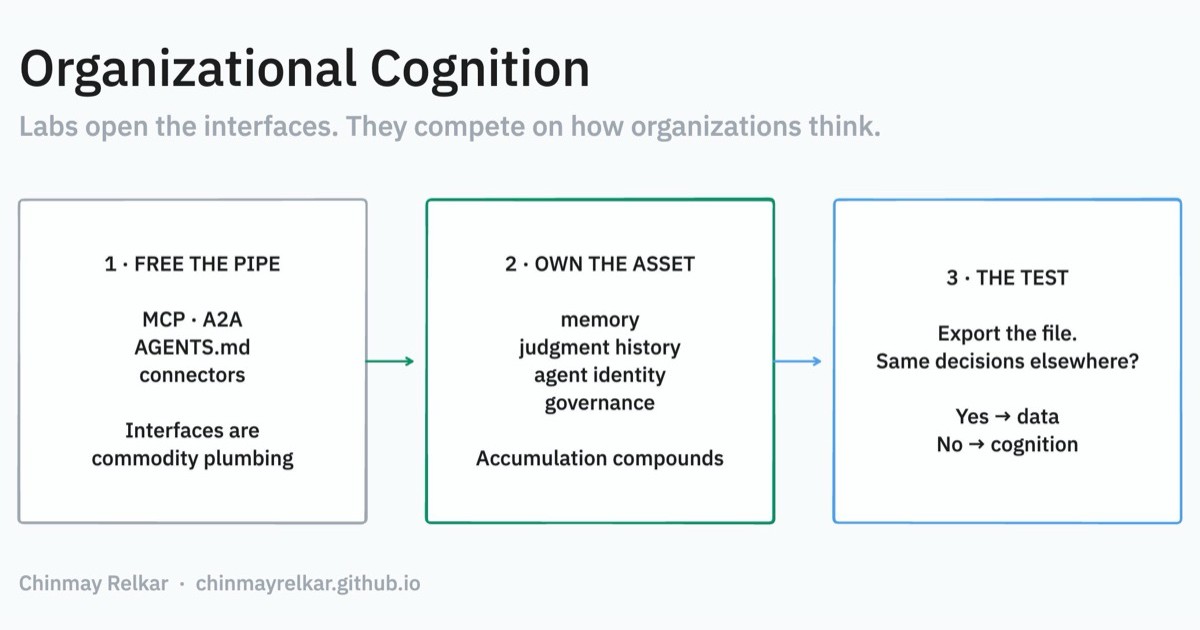
AI labs are converging on the same infrastructure, but they are giving away the connectors.
They are betting the prize is organizational cognition—the ability to encode how a specific organization decides and coordinates—not smarter models.
Whoever accumulates the most context about how a company actually works, through open standards, will own the next layer.
What happened
Major AI labs—Anthropic, OpenAI, Google, and others—are building identical infrastructure layers (memory systems, connectors, agent frameworks, governance tools) while donating their interface standards (MCP, A2A, AGENTS.md) to neutral foundations controlled by competitors. In July 2026, MCP's core protocol became more stateless for edge deployment, while memory and policy logic moved into proprietary product layers.
Why it matters
The convergence suggests the real competitive asset is not smarter models or better workflows, but the ability to capture and encode how a specific organization makes decisions—what the essay calls organizational cognition. This includes tacit judgment (which reviewer approves what, what "done" means to a team, risk tolerance) rather than just facts or generic retrieval. Companies are betting that whoever accumulates the most organization-specific context through open interfaces will win, even if rivals control the pipes.
What to watch
The split between open interfaces and proprietary accumulation. MCP and AGENTS.md are now read natively by major coding agents across platforms; the real moat is whether a vendor can become the system of record for how an organization perceives, decides, coordinates, and learns—patterns currently lived in people but increasingly captured in products.
Ask the AI about this article →
The essay argues that industry observers have misread the AI landscape by focusing on model intelligence, workflows, distribution, or context-window constraints. Each theory explains part of the pattern—why labs build certain features or enter certain markets—but none accounts for why every frontier lab is simultaneously building the same infrastructure layer (memory, connectors, custom instructions, agent frameworks, identity, governance) while donating the interface standards to neutral foundations their competitors also control. This apparent paradox resolves if the real asset is not the pipe but what flows through it: organization-specific judgment. Organizational cognition, as the essay defines it, is the accumulated patterns of how a company perceives, decides, coordinates, and learns. These patterns currently live largely in tacit human knowledge—unwritten norms, approval processes, trade-off heuristics, and noticing when a rule is stale. The new opportunity is a substrate that can externalize, accumulate, govern, and productize those patterns at scale. The essay distinguishes this sharply from knowledge management, documentation, or generic retrieval-augmented generation (RAG). A style guide is a thin static slice. The cognition is the live process: which rule wins when two conflict, recognizing a rule is stale, breaking it once and being right, updating the decision-making system based on the outcome. By opening the interfaces, labs are betting that the winner will not be whoever controls the connector protocol, but whoever becomes the system of record for how an organization actually works—the trusted accumulation surface for its judgment, governance, and learning loops.
AI-summarized, only the topics you pick — one digest a day via Email, Slack, or Discord.
Free · takes 30 seconds · unsubscribe anytime
Ask AI anything about this article. Q&As are published on this page for other readers too.

