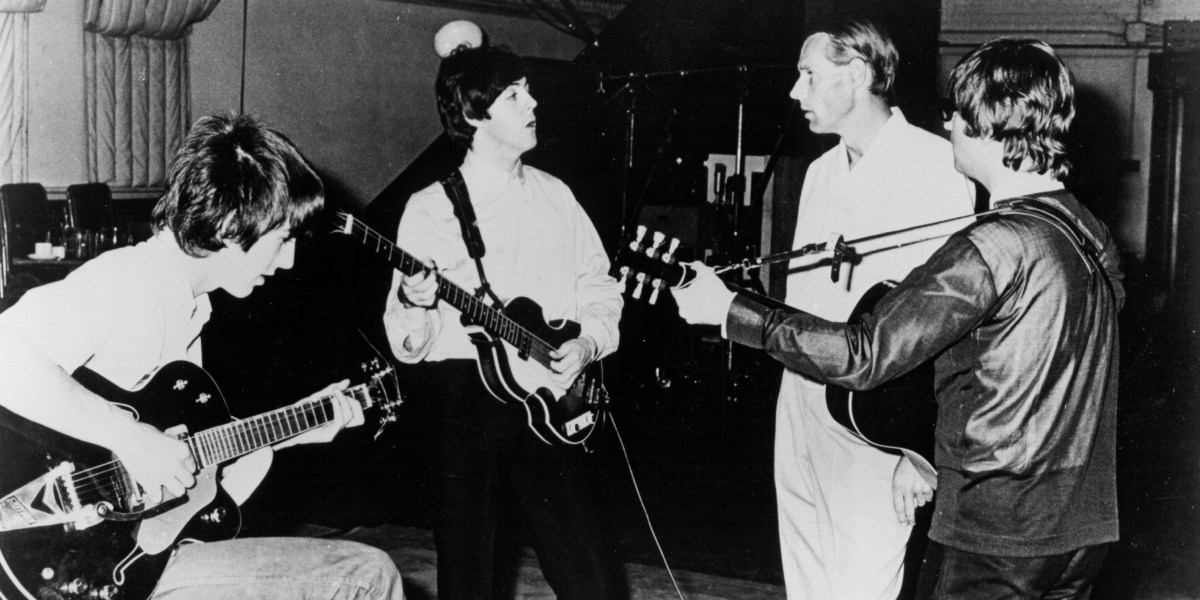
As artificial intelligence makes answers abundant, executives must shift from seeking better answers to mastering judgment—the ability to ask the right questions and challenge their own assumptions. The article uses George Martin's work with the Beatles as a historical model: he succeeded not by being a better musician or songwriter but by hearing creative possibilities others missed and pushing back on the band's instincts. Today's leaders face a similar test—using AI not just to optimize existing processes but to stress-test strategies and invent entirely new possibilities.
Summaries like this, in your inbox every morning.
Sign up free →What happened
A Fortune opinion piece argues that as AI makes answers abundant and cheap, leadership success will depend less on producing answers and more on asking the right questions—using the Beatles producer George Martin as a model of someone who added value not through technical skill but through creative judgment.
Why it matters
Organizations are bolting AI onto old structures built for scarcity. Most are stuck at "optimization" (doing yesterday's work faster), missing the chance to use AI as a stress-test of assumptions and, ultimately, as a partner in creating things that didn't exist before. Leaders who treat AI only as a tool to execute faster will find that advantage disappears once everyone has access to the same tools.
What to watch
The piece outlines three leadership levels: Level One (optimize—summarize, automate); Level Two (simulate—use AI to challenge assumptions rather than confirm plans); and Level Three (create—invent possibilities neither human nor machine could alone). The central claim is that judgment—the ability to frame the right problem—is now the scarce resource, not intelligence.
The article opens with a 1965 anecdote: Paul McCartney played George Martin a song called "Yesterday" and asked what it needed. Martin heard what McCartney didn't—a string quartet on a rock record, something unprecedented. McCartney resisted; Martin pushed. The result became one of the most recorded songs in history. The lesson, the author argues, is that the most valuable person in the room isn't always the one with the most answers, but sometimes the one who hears a possibility no one else can.
The author then makes a provocative claim: "the Age of Answers is over." This doesn't mean answers no longer matter, but rather that AI can now write business plans, diagnose diseases, draft legal briefs, and produce strategic recommendations in seconds—work that once required teams of experts. When answers become abundant, they stop being a competitive advantage. George Martin proved this decades before AI existed: he wasn't a better songwriter than Lennon or McCartney, nor a better musician than Harrison or Starr. What he brought was a different way of hearing possibility—orchestration, tape experimentation, and the willingness to tell hard truths. That, the author argues, is what AI should amplify: human creativity and judgment, not replace it.
Yet most organizations use AI differently. Within minutes, whiteboards fill with timelines, milestones, decision trees, and Gantt charts. Every team finds the "X" on the map; every team builds the fastest route to get there. The problem: not one team questions whether they're using the right map. The author observes that innovation rarely begins with an X on the map; it begins by questioning whether the map describes the right territory. For years, helping accomplished leaders make that shift was extraordinarily difficult, because success rewards certainty while organizations reward predictability. But today, leaders can ask AI to generate the solution they were about to build in under a minute. That changes the conversation completely: the question is no longer whether AI can produce better answers, but what leaders must do when everyone has access to the same ones.
The article argues that most organizations treat AI as a technology challenge, when it's really a leadership challenge. Every technological revolution exposes an outdated operating system; the constraint becomes the assumptions, structures, and habits built for the world the technology is replacing. Martin never tried to make the Beatles sound like a classical ensemble he was comfortable with; he didn't force the new sound into his old training. Most organizations do the opposite with AI—they create an AI task force, appoint a Chief AI Officer, mandate AI training, rewrite company policies. These initiatives bolt a revolutionary capability onto organizations built for a world where information was scarce, expertise was expensive, and answers were difficult to obtain. That world no longer exists.
The author then outlines three levels of AI leadership. Level One is Optimize: do yesterday's work better—summarize meetings, write reports, automate customer service, generate code. The gains are real, but efficiency stops being a competitive advantage when everyone has the same tools. Level Two is Simulate: challenge today's assumptions. The author describes giving military fellows an innovation challenge; they built the fastest possible route to a solution without ever asking whether it was the right solution. Today, the author skips the debate: ask AI to generate the answer they were about to spend a week building. It usually does, in under a minute. That's Level Two—using AI not to confirm a plan, but to stress-test whether the plan should exist at all. Leaders use AI to become a skeptical customer, an aggressive competitor, an impossible board member. Level Three is Create: invent tomorrow's possibilities. This is where AI stops being an assistant and becomes a creative partner. Instead of asking AI "How can you help me do my job better?", the better question is "What can we create together that neither of us could create alone?" This is the level George Martin operated on with the Beatles—not optimizing or stress-testing their sound, but creating something none of the five of them could have made alone.
The real revolution, the author concludes, isn't AI—it's what AI reveals about leadership. For decades, intelligence was the scarce resource. It isn't anymore. AI democratizes intelligence, but it does not democratize judgment. Intelligence produces answers; judgment decides which questions are worth asking. Judgment recognizes when a problem has been framed too narrowly, when everyone—including the machine—is converging on the same obvious solution, and when it's time to abandon the map before someone else draws a better one. George Martin never out-wrote Lennon and McCartney. He didn't need to. He heard what they couldn't yet hear, and he told them the truth about it. That's the job now—not to out-answer the machine, but to hear the question it can't ask. The article ends by posing three questions for the next AI strategy meeting: Where are we merely optimizing yesterday? Where should we be using AI to challenge our assumptions instead of confirming them? What could we create that has never existed before?
The article reframes AI leadership as a judgment problem, not a capability problem. As the author notes, organizations currently treat AI as a technology challenge—creating task forces, appointing Chief AI Officers, rewriting policies—when the real constraint is outdated organizational structures and assumptions built for a world where expertise and answers were scarce. The core insight is that once everyone has access to the same AI tools, the ability to produce answers quickly becomes table stakes, not differentiation.
The George Martin analogy works because it shifts focus from technical prowess to creative listening and the courage to challenge consensus. Martin's value lay in recognizing that the Beatles' instincts, while strong, were incomplete—and in having the credibility and ear to push them toward something none of them could have imagined alone. The article argues that this is precisely what leaders must do now: use AI to surface the "obvious" solution everyone (including the machine) converges on, then question whether that's the right problem to solve.
The three-level framework—Optimize, Simulate, Create—describes an arc from efficiency (Level One, where competitive advantage erodes fastest) through disciplined skepticism (Level Two, where leaders stress-test assumptions) to invention (Level Three, where human and machine co-create). The author's claim that "AI democratizes intelligence, but it does not democratize judgment" is the pivot point: intelligence (pattern recognition, analysis speed) is now a commodity; judgment (framing the right question, recognizing blind spots) remains rare and valuable.
AI-summarized, only the topics you pick — one digest a day via Email, Slack, or Discord.
Free · takes 30 seconds · unsubscribe anytime
No comments yet. Be the first to share your thoughts!
Log in to join the discussion





Get curated AI news from 200+ sources delivered daily to your inbox. Free to use.
Get Started FreeFree · takes 30 seconds · unsubscribe anytime
