AIToday

Researcher RL-trains model to RL-train other models

r/MachineLearning5h ago

Key takeaway

A researcher used reinforcement learning to train Qwen3.6-35B, a large language model, to automatically design and submit training jobs for smaller models running on GPU clusters. The trainer agent learns by receiving reward signals when the models it trains improve on hidden benchmarks. This creates a recursive structure—an RL loop training other RL loops—and achieved a peak reward of approximately 0.63, demonstrating that AI models can learn to optimize training workflows.

Summaries like this, in your inbox every morning.

Sign up free →

3 Key Points

  • What happened

    A machine learning practitioner trained Qwen3.6-35B-A3B, a large language model, using reinforcement learning to act as a trainer agent that writes and submits complete training jobs for smaller models (0.6B or 1.7B Qwen instances) to GPU clusters. The agent receives reward when the models it trains score higher on hidden evaluations, creating a nested loop of RL training inside RL training.

  • Why it matters

    This demonstrates a novel approach to automating machine learning workflow optimization—rather than manual tuning of training configurations, an AI model learns to design training jobs that improve other models' performance. For ML practitioners, this suggests potential efficiency gains in hyperparameter search and training pipeline design, though the work is an early-stage proof of concept.

  • What to watch

    The agent was trained on 6 task families, with one held out entirely as a generalization test. Episode reward climbed from approximately 0.0 to approximately 0.63 at peak performance, indicating the trainer agent learned to write increasingly effective training jobs.

In Depth

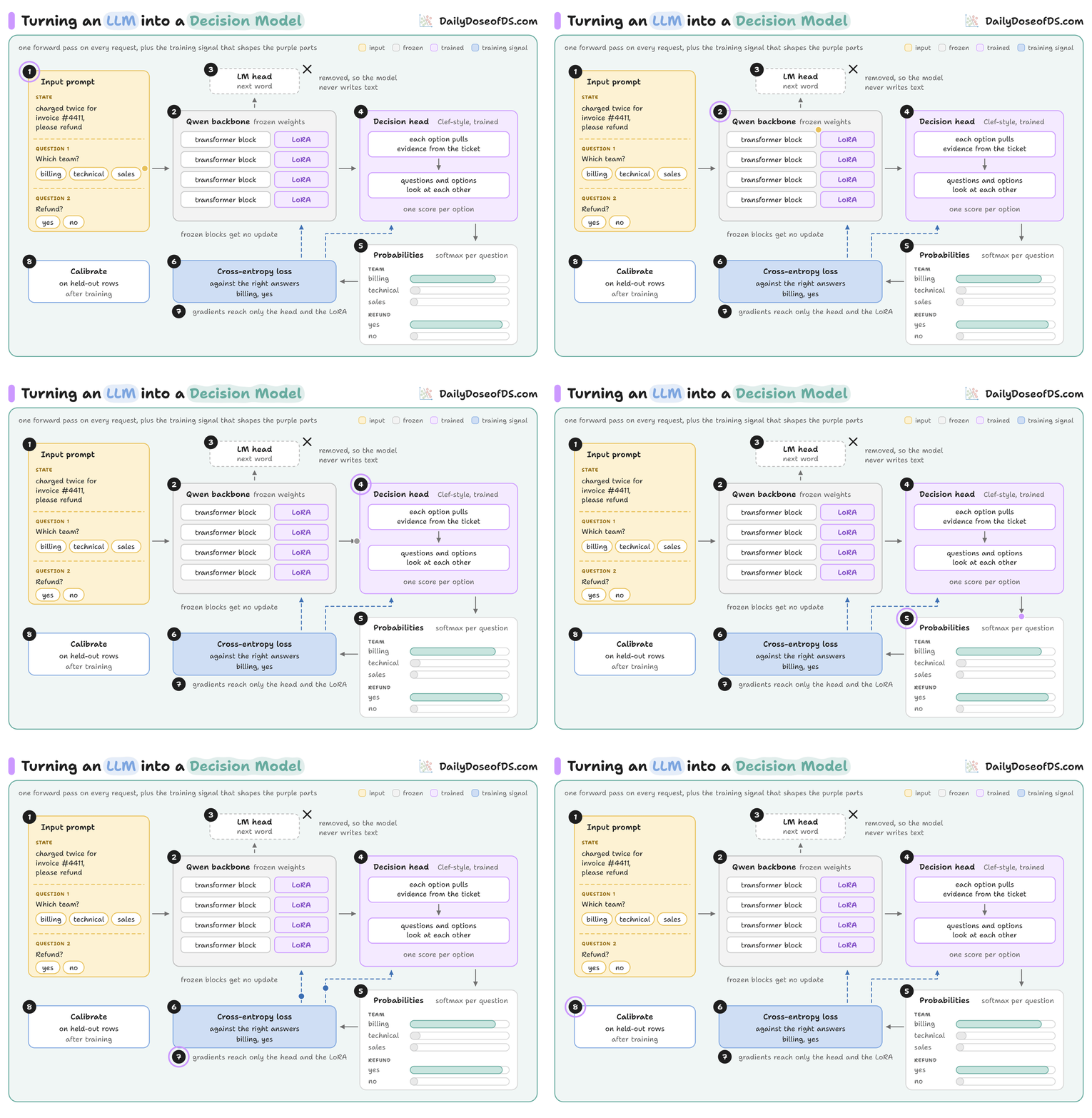
The practitioner built a system in which Qwen3.6-35B-A3B, a large language model with 35 billion parameters, learns through reinforcement learning to generate complete training configurations for smaller models. The trainer writes three components for each job: a verification environment and rubric (to evaluate the trained model), a dataset, and hyperparameters. These jobs are dispatched to a pool of up to 16 Runpod GPU pods, where a lightweight RL framework called prime-rl runs a GRPO training algorithm on small Qwen models (either 0.6B or 1.7B parameters). After training, each model is evaluated on a hidden benchmark, and its improvement from pre- to post-training becomes the reward signal fed back to the outer RL loop. The trainer agent itself was optimized using Tinker, a technique combining LoRA (a parameter-efficient fine-tuning method) with GRPO (a reinforcement learning algorithm). To test generalization, the practitioner created six task families and withheld one entirely from training, using it only as a test of whether the agent had learned to write training jobs that work on novel problems. The results show episode reward climbing from approximately 0.0 to a peak of approximately 0.63, indicating the agent progressively learned to write better training configurations. The practitioner frames this as an instance of recursive RL—using reinforcement learning to train a system that itself applies reinforcement learning—and emphasizes both the technical novelty and the conceptual appeal of automating the decision-making that normally requires human expertise in machine learning engineering.

Context & Analysis

This work sits at the intersection of two trends in machine learning: the use of large language models to generate code and configurations, and reinforcement learning applied to meta-learning problems. Rather than treat hyperparameter tuning as a separate search problem, the practitioner embedded it as a task an RL agent learns to solve. The nested structure—RL training an agent that writes RL training jobs—creates a feedback loop where success in the inner loop (the small model improving) directly reinforces the outer agent's decisions. The choice to hold out one task family entirely as a generalization probe is methodologically sound, testing whether the trainer learned general principles rather than task-specific patterns. The reward climbing from approximately 0.0 to approximately 0.63 suggests the agent learned meaningful behavior, though the article does not specify what downstream metrics (accuracy, loss, or other domain-specific measures) the hidden evaluation measured.

FAQ

What model was used as the trainer agent?
Qwen3.6-35B-A3B was RL-trained using Tinker (LoRA + GRPO) to act as the trainer agent.
What sizes of models did the trainer agent train?
The trainer agent wrote training jobs for small Qwen models: 0.6B and 1.7B parameter variants.
How was the trainer agent itself trained?
The trainer agent was RL-trained with Tinker (LoRA + GRPO), using the inner model's improvement on a hidden evaluation as the reward signal.

Discussion

No discussion yet for this article

Stay ahead with AI news

Get curated AI news from 200+ sources delivered daily to your inbox. Free to use.

Get Started Free

Free · takes 30 seconds · unsubscribe anytime

1 minute a day. The AI essentials.

200+ sources · Email / LINE / Slack

Get it free →