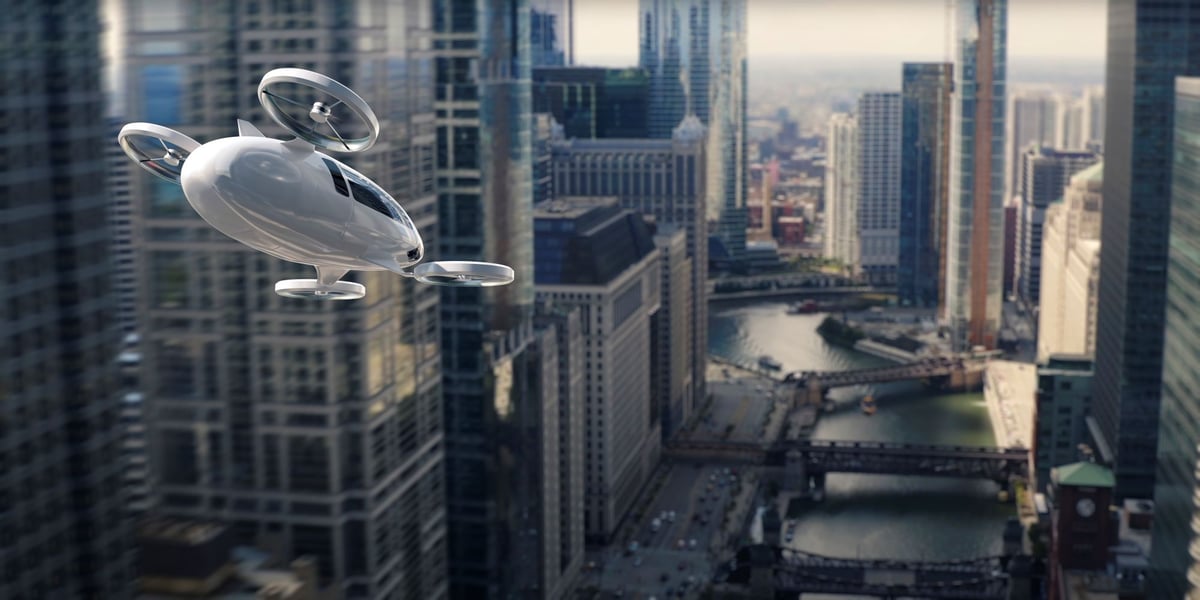
Archer Aviation announced two new autonomous aircraft—Thunder for defense and Halo for commercial use—developed with Anduril, a defense technology company. The partnership drove a 20% single-day stock jump, but the company faces certification and manufacturing hurdles, and remains unprofitable with losses of $743 million(約1200億円) over the trailing 12 months. Investors should expect a long wait before the company turns a profit.
Summaries like this, in your inbox every morning.
Sign up free →What happened
Archer Aviation announced two new autonomous vertical take-off and landing aircraft developed with defense company Anduril—Thunder for defense applications and Halo for commercial use. Thunder's first flight is expected next year. The stock rose around 20% on the announcement day, though it remains down 37% year to date.
Why it matters
The partnership expands Archer's addressable market beyond air taxi services (its existing Midnight aircraft) into higher-margin defense applications where demand can be high. CEO Adam Goldstein called the platform "the most sophisticated vertical lift aircraft platform ever developed." However, the company still faces hurdles: aircraft certification requirements, the capital-intensive nature of manufacturing, and growing losses of $743 million(約1200億円) over the trailing 12 months mean profitability remains distant.
What to watch
Archer must achieve aircraft certification and scale manufacturing to prove the business model works. Growth investors should expect this to be a patient, long-term bet—significant revenue and profitability are years away.
Archer Aviation announced a significant partnership with Anduril, a defense technology and autonomous systems company, to develop a new autonomous VTOL (vertical take-off and landing) platform with both commercial and defense variants. Last week, the company unveiled Thunder, the defense-focused aircraft from this platform, which is engineered to provide the speed, range, and payload capacity required for defense applications while maintaining cost-efficiency. Archer expects Thunder to conduct its first flight next year. A few days later, Archer announced Halo, the commercial variant of the same platform, which will also be autonomous and capable of handling heavy payloads.
Archer's CEO Adam Goldstein praised the achievement in a statement, saying, "This is the most sophisticated vertical lift aircraft platform ever developed--it's exactly what our customers need." The company already has experience in the eVTOL space through its Midnight aircraft, a piloted variant designed for air taxi services that has been undergoing certification. Thunder and Halo represent a broader expansion into both defense and commercial markets.
The market responded positively to the announcement: Archer's stock jumped around 20% on the day the company revealed Thunder and the Anduril partnership. The surge reflects investor enthusiasm about the expanded market opportunity, particularly in defense where demand is often robust. However, significant headwinds remain. The stock is still down 37% year to date, and market sentiment remains mixed about the company's long-term viability. Archer faces multiple challenges: its aircraft designs still require regulatory certification before they can be deployed, the eVTOL manufacturing industry is capital-intensive, and the company's losses have been mounting—totaling $743 million(約1200億円) over the trailing 12 months. Until Archer begins manufacturing at scale and customers validate the aircraft in real-world operations, the timeline to profitability will remain uncertain. For growth-oriented investors willing to accept substantial risk and a lengthy holding period, Archer presents a bet on the eventual success of autonomous vertical lift technology; for others, the path to profitability appears too distant and uncertain.
Archer Aviation's announcement of Thunder and Halo represents a strategic pivot beyond its original focus on air taxi services with the Midnight aircraft. By partnering with Anduril, a defense technology and autonomous systems company, Archer is tapping into the defense sector, where demand is typically higher and margins may be more favorable than in commercial air taxi markets. CEO Adam Goldstein's characterization of the platform as "the most sophisticated vertical lift aircraft platform ever developed" signals confidence in the technical achievement, and the market responded with a 20% single-day surge.
However, the broader investment picture remains cautious. Despite the positive announcement, Archer's stock sits down 37% year to date, reflecting lingering concerns about execution risk and the path to profitability. The company faces two critical hurdles: obtaining aircraft certification (still pending for its commercial Midnight variant) and achieving profitable manufacturing at scale. As a capital-intensive business, Archer's trailing 12-month losses of $743 million(約1200億円) underscore how far it remains from break-even. The market's hesitation suggests that while the opportunities are significant, the uncertainties—certification timelines, manufacturing ramp timelines, and cash burn rates—remain material constraints on near-term value creation.
AI-summarized, only the topics you pick — one digest a day via Email, Slack, or Discord.
Free · takes 30 seconds · unsubscribe anytime
No discussion yet for this article
Get curated AI news from 200+ sources delivered daily to your inbox. Free to use.
Get Started FreeFree · takes 30 seconds · unsubscribe anytime
