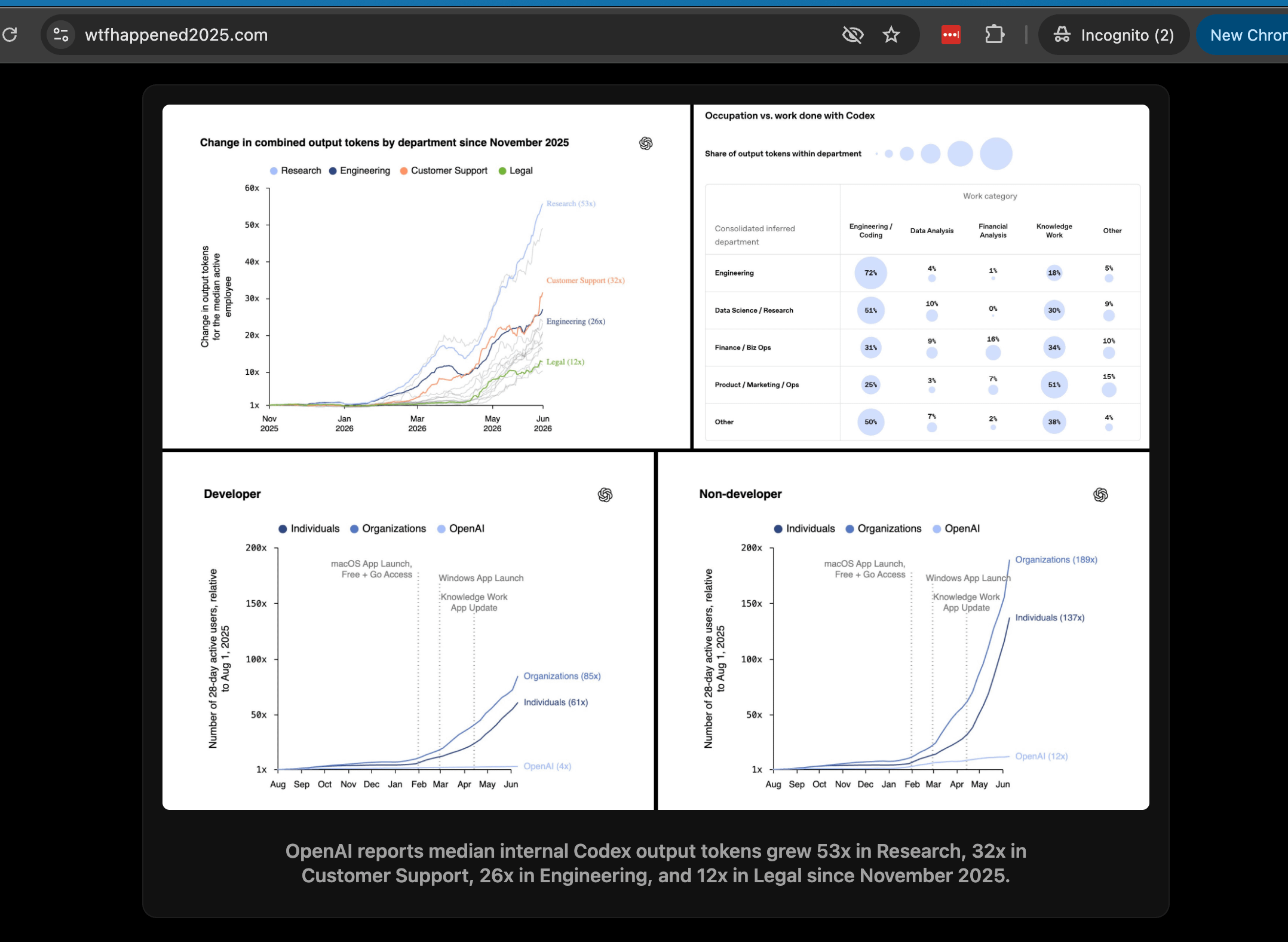
What happened
OpenAI's internal Codex usage across departments rose sharply between November 2025 and June 2026. Research saw median output tokens increase 56 times, Customer Support 32 times, Engineering 27 times, and Legal 13 times. This follows a period when OpenAI workers were spending less than 10% of their tokens on Codex through August 2025.
Why it matters
Despite having unlimited AI access, OpenAI employees were vastly underusing AI tools until late 2025. The recent surge suggests that when organizations invest in review workflows, tooling, and persistent execution environments—what the company calls support for agents running across multiple tasks—teams unlock substantially higher productivity gains. This indicates that raw model access alone does not drive adoption; infrastructure and organizational practices do.
What to watch
OpenAI frames agents as changing work 'in every department,' with external observers noting growth in token consumption especially among research teams and patterns like concurrent agents and reusable skills. The practical takeaway is that adoption emerges where organizations can sustain review loops and long-running workflows, not simply through model improvements.
Summaries like this, in your inbox every morning.
Pick your industry and the AI tools you use, and get news related to your work every day.
Free · 30 seconds with Google · unsubscribe anytimeWhat is AIToday? →
Ask AI anything about this article. The AI reads this article, earlier AIToday articles, and Wikipedia, and cites its sources. Q&As are published on this page for other readers too.
XPeng appeared at the Paris Automotive Summit, presenting not only automotive expertise but a broader technolo…

Itaú's ia.i, a text- and voice-activated assistant spanning accounts, credit, cards and insurance, reached abo…
Goldman Sachs says German exports have rebounded, driven by demand from the US, the EU, and the AI buildout

Forbes reports that Coca-Cola is using AI to reinvent its marketing, and presents the company's approach as a…

Amazon introduced Bee Frontier, a wearable personal AI, for $74.99 in Onyx, Lavender and Sage, and Bee Eclipse…

Wall Street ended down sharply, with worries about the AI trade and high oil prices weighing on the market