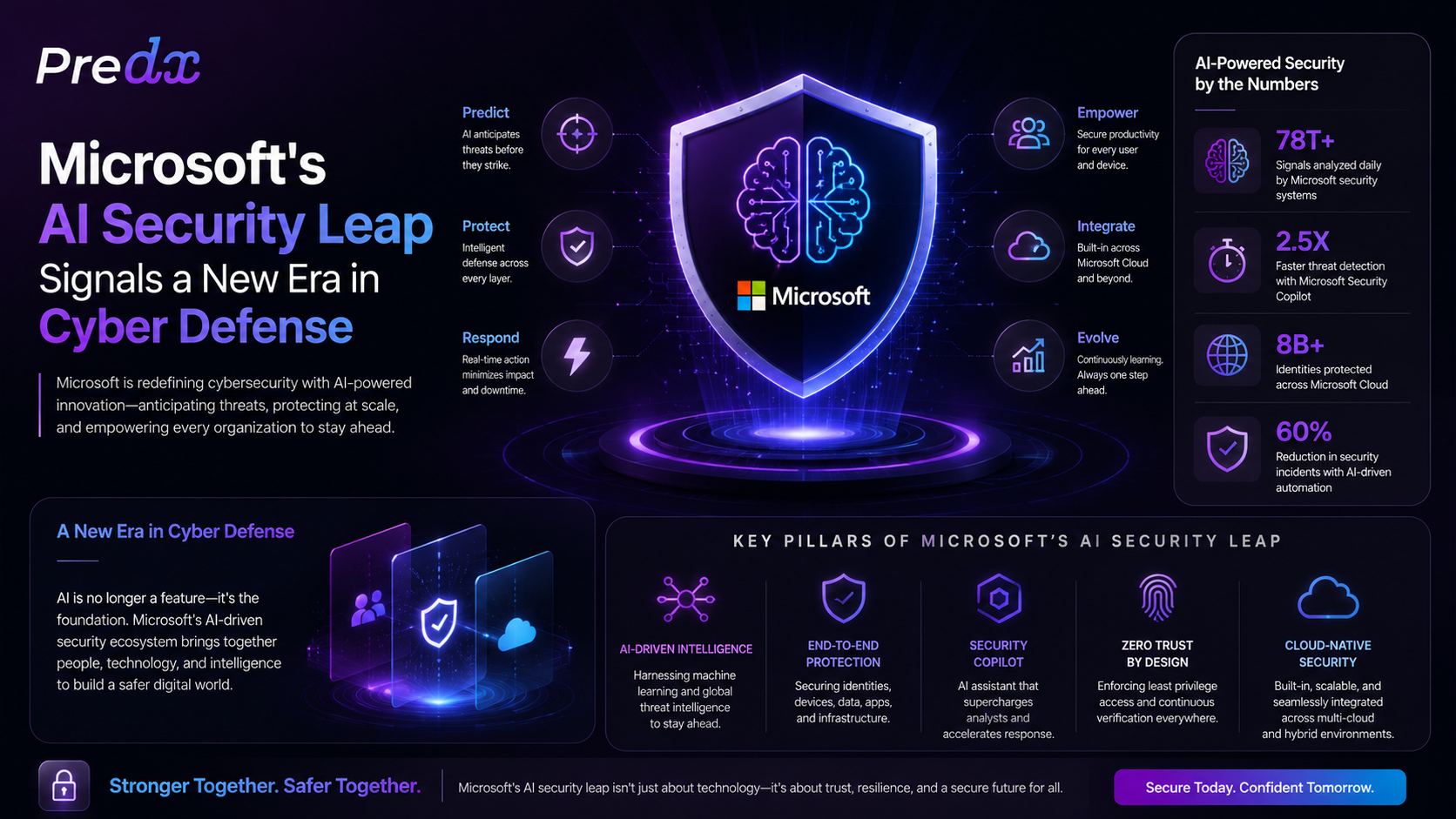
Microsoft has unveiled its first dedicated cybersecurity AI model alongside agentic security capabilities that allow AI agents to proactively analyze threats and assist security teams in real time. Rather than relying on predefined rules and manual investigation, the system understands complex attack patterns and recommends actions autonomously, addressing enterprises' growing need for faster response to ransomware, phishing, and AI-assisted cyber threats. This move reflects a broader shift in which AI is becoming an active participant in digital defense rather than a tool awaiting human direction at every stage.
Summaries like this, in your inbox every morning.
Sign up free →What happened
Microsoft introduced its first dedicated cybersecurity AI model and new agentic security capabilities that enable AI agents to analyze security data, identify risks, and assist teams in responding to attacks in real time, rather than waiting for manual intervention at each stage.
Why it matters
As ransomware, phishing, and AI-assisted cyber threats intensify, organizations need faster threat detection and response. Microsoft's autonomous AI approach reduces response times and alert fatigue by handling repetitive security tasks and connecting complex attack patterns—capabilities that may become decisive as enterprises invest heavily in AI-driven defense.
What to watch
The announcement signals a competitive race among technology companies to develop AI systems for cybersecurity. Companies that deliver reliable, autonomous security tools may gain significant competitive advantage as organizations continue prioritizing AI-driven defense strategies.
Microsoft has announced the introduction of its first dedicated cybersecurity artificial intelligence model, bundled with a new generation of agentic security capabilities designed to help organizations identify, analyze, and respond to digital threats. The system represents a departure from traditional cybersecurity approaches that rely on predefined rules and manual investigation. Instead, Microsoft's AI model is built to understand complex attack patterns, connect related security events across an organization's infrastructure, and recommend appropriate actions in real time.
The core innovation lies in autonomous AI agents that handle repetitive security tasks—such as initial threat triage and pattern matching—while freeing human security analysts to conduct deeper investigations and make more informed decisions. By reducing the volume of manual work and the time required to move from threat detection to response, the system aims to lower response times and reduce the alert fatigue that plagues many security teams. The announcement emphasizes that as businesses contend with rising ransomware attacks, phishing campaigns, and AI-assisted cyber threats, intelligent security systems are becoming essential infrastructure.
The timing of the announcement also reflects broader industry momentum. Technology companies are increasingly recognizing that cybersecurity represents one of the most promising applications for artificial intelligence—more so than content generation or productivity features alone. As enterprises seek solutions that can detect vulnerabilities before they become major incidents, the companies that can deliver reliable, autonomous security tools are positioning themselves for significant competitive advantage. Microsoft's launch signals that the future of cybersecurity belongs to systems that anticipate and prevent threats rather than simply reacting after the fact.
Microsoft's move reflects a fundamental shift in how the technology industry views artificial intelligence. Rather than limiting AI to content generation and productivity tools, companies now recognize cybersecurity as one of the most promising and competitive applications. The announcement underscores that enterprises are actively seeking solutions capable of detecting vulnerabilities before they escalate into major incidents—a capability that traditional rule-based systems cannot provide. This positioning matters because organizations facing accelerating threat velocity need systems that can work proactively without waiting for human authorization at every decision point.
The competitive landscape is intensifying around this capability. As stated in the body, companies capable of delivering reliable, autonomous security tools may gain significant advantage as organizations continue investing in AI-driven defense strategies. This is not merely a product launch; it signals how AI is reshaping cybersecurity from a reactive, manual discipline into one that is faster, smarter, and increasingly predictive. For enterprises already struggling with alert fatigue and response delays, the promise of AI-powered agents handling routine investigation tasks while flagging high-priority risks represents a material operational shift.
AI-summarized, only the topics you pick — one digest a day via Email, Slack, or Discord.
Free · takes 30 seconds · unsubscribe anytime
No comments yet. Be the first to share your thoughts!
Log in to join the discussion

Get curated AI news from 200+ sources delivered daily to your inbox. Free to use.
Get Started FreeFree · takes 30 seconds · unsubscribe anytime
