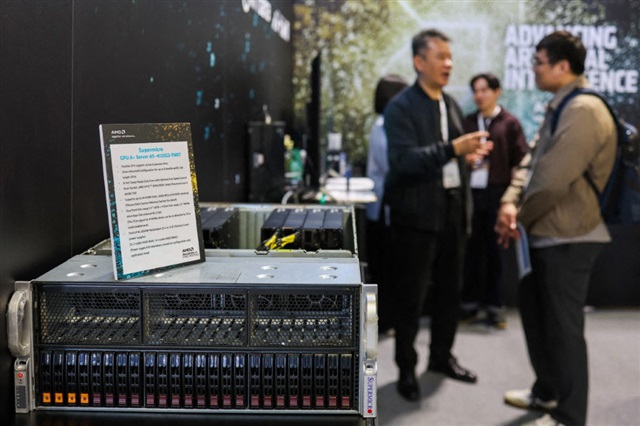
Supermicro has reported a record US$60 billion(約9.6兆円) in orders in its preliminary fourth-quarter results, with a large share coming from SpaceX and other companies building custom AI infrastructure outside major cloud providers. This reflects a shift toward what the industry calls "neocloud" buyers — organizations that build their own large-scale AI systems — signaling that Supermicro's focus on specialized rack-scale AI infrastructure is now driving both volume and profitability for the server maker.
Summaries like this, in your inbox every morning.
Sign up free →What happened
Supermicro's preliminary fourth-quarter results show the server maker has accumulated a record US$60 billion(約9.6兆円) in orders, with a significant portion tied to SpaceX and other companies building custom AI infrastructure outside traditional cloud providers.
Why it matters
The order backlog signals that Supermicro's bet on rack-scale AI infrastructure (specialized hardware configurations for large-scale AI workloads) is now translating into volume and profitability. A new class of "neocloud" buyers — companies like SpaceX that build their own AI systems rather than relying on hyperscalers (large cloud providers) — is becoming a major driver of server demand, reshaping the market beyond the traditional cloud giants.
What to watch
The company's full fourth-quarter revenue results will clarify whether the record order book translates to near-term revenue growth, and how much of that backlog is tied to SpaceX and other neocloud customers versus traditional cloud providers.
Supermicro, a server hardware manufacturer based in the United States, reported preliminary fourth-quarter results indicating a record US$60 billion(約9.6兆円) in customer orders. According to the company's disclosure, a significant portion of this order book is tied to SpaceX, Elon Musk's aerospace and space-exploration company, and to other organizations building custom AI infrastructure systems. The company's bet on rack-scale AI infrastructure — specialized, modular server configurations designed to support large-scale artificial intelligence workloads at scale — is now translating into both volume and profitability. This marks a shift for Supermicro from merely accumulating orders to demonstrating that its strategy is generating actual profit growth. The emergence of what industry observers call "neocloud" buyers reflects a broader trend in how organizations approach AI. Rather than relying exclusively on hyperscalers (large cloud providers such as Amazon Web Services, Google Cloud, or Microsoft Azure), companies like SpaceX are opting to design, build, and operate their own AI infrastructure customized to their specific needs. This approach allows these organizations greater control over their technology, lower latency for their applications, and potentially lower per-unit costs at scale. However, Supermicro's preliminary results also came alongside softer revenue figures, suggesting that while the order backlog is substantial, conversion of those orders into recognized revenue may take time. The full fourth-quarter revenue disclosure will provide clarity on the pace at which Supermicro can fulfill this order book and convert it into profitability.
Supermicro's record US$60 billion(約9.6兆円) order backlog reflects a fundamental shift in how organizations are approaching artificial intelligence infrastructure. Historically, companies relied on hyperscalers (Amazon, Google, Microsoft) to provide cloud-based AI services. The emergence of "neocloud" buyers — led by SpaceX — indicates that some of the largest and most sophisticated organizations now prefer to design and operate custom AI systems optimized for their specific workloads. This shift favors specialized hardware makers like Supermicro, which sell rack-scale AI infrastructure (modular, high-density server configurations tailored for large-scale AI training and inference) rather than competing directly with cloud giants on breadth of service. The concentration of orders around a few major players like SpaceX, combined with the scale of the backlog, suggests that this trend is not marginal but represents a material redirection of capital away from traditional cloud toward custom infrastructure — a transition that benefits Supermicro's business model and profitability, not just its order volume.
AI-summarized, only the topics you pick — one digest a day via Email, Slack, or Discord.
Free · takes 30 seconds · unsubscribe anytime
No discussion yet for this article
Get curated AI news from 200+ sources delivered daily to your inbox. Free to use.
Get Started FreeFree · takes 30 seconds · unsubscribe anytime
1 minute a day. The AI essentials.
200+ sources · Email / LINE / Slack
