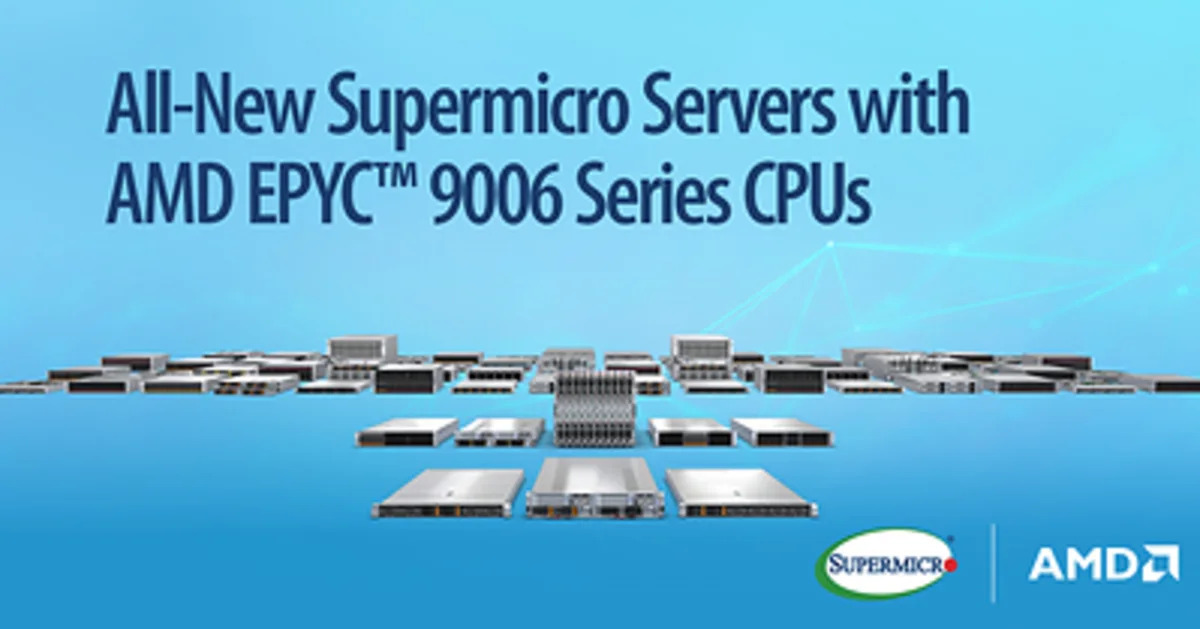
Supermicro announced its H15 server portfolio with 6th Gen AMD EPYC 9006 Series CPUs, delivering a 1.7x generational CPU performance improvement and supporting up to 256 cores and 512 threads. The systems include 33% more cores, 2X PCIe bandwidth, and 2.6X higher memory bandwidth, optimized for cloud, enterprise, storage, HPC, and AI workloads, with a 72-GPU AMD Helios Platform for large-scale AI training and inference.
Summaries like this, in your inbox every morning.
Sign up free →What happened
Supermicro introduced its H15 server portfolio powered by 6th Gen AMD EPYC 9006 Series CPUs, featuring up to 256 cores and 512 threads, with 33% more cores, 2X PCIe bandwidth, and 2.6X higher memory bandwidth compared to the prior generation. The new systems also support AMD Instinct GPUs and AMD Pensando networking, and include a 72-GPU AMD Helios Platform designed for large-scale AI training and high-throughput inference.
Why it matters
Businesses running AI workloads—cloud providers, enterprises, and HPC users—can now execute more concurrent AI agents and accelerate applications within the same power envelope, addressing the infrastructure demands of scaling agentic AI. Supermicro positioned the portfolio as delivering optimized performance and efficiency while maintaining its modular Data Center Building Block Solutions (DCBBS) architecture, which the company says helps lower total cost of ownership.
What to watch
Supermicro's portfolio is positioned as the industry's broadest offering for cloud, enterprise, storage, HPC, and agentic AI workloads, backed by the company's U.S. supply chain and global services team. The company notes customers can access more details through its AMD servers portfolio page and accompanying video summary.
On July 23, 2026, Supermicro announced its next-generation H15 server portfolio, powered by 6th Gen AMD EPYC 9006 Series CPUs, optimized for AI and enterprise workloads. The systems deliver a breakthrough 1.7x generational CPU performance improvement and support up to 256 cores and 512 threads per server. The hardware gains are substantial: the new generation includes 33% more cores, 2X PCIe bandwidth, and 2.6X higher memory bandwidth compared to the prior generation.
The portfolio integrates AMD Instinct GPUs and AMD Pensando networking to create a comprehensive rack-scale system built on Supermicro's Data Center Building Block Solutions (DCBBS) architecture. A flagship offering, the 72-GPU AMD Helios Platform, is specifically designed for large-scale AI training and high-throughput inference. According to Vik Malyala, Chief Business Officer at Supermicro, the new systems "deliver the next generation of AI infrastructure, optimized for high performance, rapid scalability, and peak efficiency," backed by the company's global services team and U.S. supply chain.
Dan McNamara, senior vice president and general manager of Compute and Enterprise AI at AMD, emphasized that "as enterprises scale agentic AI, they need infrastructure that delivers exceptional performance, efficiency, and flexibility." He noted that combining the latest AMD EPYC CPUs, Instinct GPUs, and Pensando networking with Supermicro's modular designs enables customers to "deploy AI infrastructure faster while improving utilization, reducing energy consumption, and lowering total cost of ownership."
Supermicro's H15 announcement comes as enterprises increasingly deploy agentic AI—autonomous systems that can execute multiple tasks independently—requiring infrastructure that balances raw compute performance with energy efficiency. The 1.7x generational CPU performance improvement, combined with significantly expanded memory and I/O bandwidth (2.6X and 2X respectively), addresses a core constraint in AI scaling: the ability to run more concurrent agents without proportionally increasing power consumption. By maintaining the same power envelope while delivering these gains, the systems appeal to cost-conscious cloud operators and enterprises managing large AI infrastructure deployments.
The emphasis on Supermicro's Data Center Building Block Solutions (DCBBS) architecture and modular design reflects the company's competitive positioning around rapid deployment and customization. The inclusion of AMD Pensando networking alongside the CPU and GPU stack suggests an integrated approach to minimizing latency and bottlenecks across the full system stack—a requirement for efficient multi-agent AI workloads where coordination overhead can become a limiting factor.
AI-summarized, only the topics you pick — one digest a day via Email, Slack, or Discord.
Free · takes 30 seconds · unsubscribe anytime
No comments yet. Be the first to share your thoughts!
Log in to join the discussion


Get curated AI news from 200+ sources delivered daily to your inbox. Free to use.
Get Started FreeFree · takes 30 seconds · unsubscribe anytime
1 minute a day. The AI essentials.
200+ sources · Email / LINE / Slack
