AIToday

AI Engineering Shifts from Agent Autonomy to Human-Centered Loop Systems

Latent Space11h ago
AI Engineering Shifts from Agent Autonomy to Human-Centered Loop Systems

Key takeaway

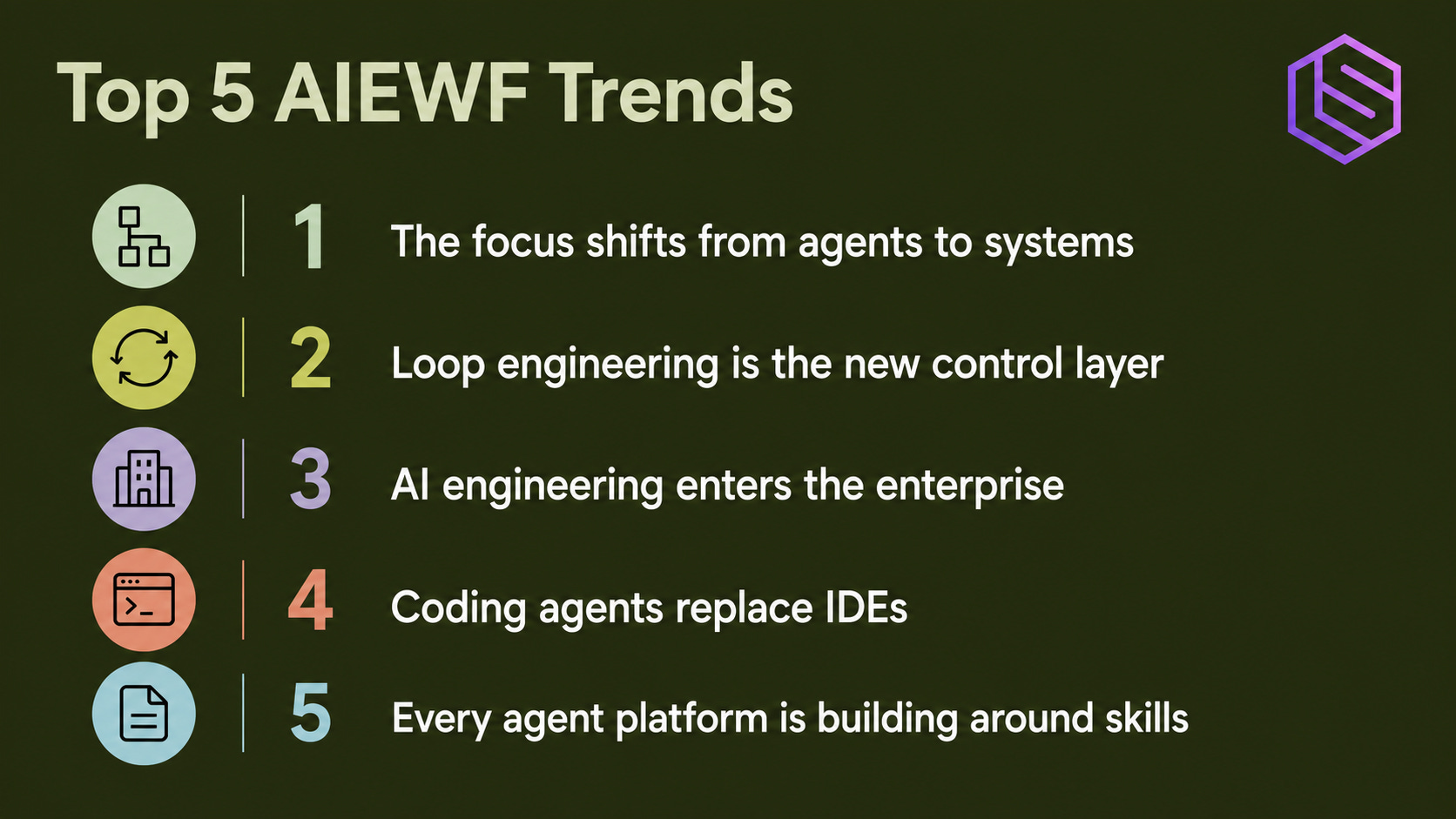
The AI Engineer World's Fair 2026 showed that AI engineering has matured from 2023's autonomous-agent hype into a discipline centered on human oversight and reliable systems. Rather than removing humans from the equation, engineers now design "loops" where agents handle execution while humans maintain control in an outer layer. Enterprises are adopting this model through roles like forward deployed engineers, though adoption remains concentrated among early adopters and practical details—like balancing automation with human decision-making—are still being worked out.

Summaries like this, in your inbox every morning.

Sign up free →

3 Key Points

  • 何が起きたか

    The AI Engineer World's Fair 2026 revealed a fundamental shift in how developers work with AI. Instead of building fully autonomous agents, engineers now focus on "loop systems" where humans oversee agents in an "outer loop" while agents handle execution in an "inner loop." This represents a major departure from 2023's focus on autonomous projects like AutoGPT.

  • なぜ重要か

    Complete agent autonomy has proven both unreliable and undesirable at scale. The field has learned that AI engineers augment human work rather than replace it. For enterprises, this means new roles like "forward deployed engineers" (FDEs) are emerging to implement and maintain agentic systems, requiring careful orchestration of integrations and team contributions. Organizations now need to decide which parts of their software lifecycle to automate and where humans should intervene.

  • 注目点

    The conference highlighted tension between "software factory" and "orchestra" metaphors for managing multiple agents. Tools like Claude Code, Codex, Gemini CLI, Cursor, and Warp now enable coding agents to understand objectives, explore codebases, modify files, and iterate—far beyond simple autocomplete. However, skepticism remains: one speaker warned that "factories" and "loops" may still fail as the field learns what actually works in production.

In Depth

The AI Engineer World's Fair 2026 presented a field transformed from its 2023 origins. When swyx coined the term "AI engineer" in June 2023, he was naming an emerging developer archetype born from the explosion of large language models. That same year, the conversation centered on "prompt engineering" and autonomous agent proof-of-concepts like AutoGPT, BabyAGI, and GPT-Engineer. By 2026, the emphasis had shifted dramatically.

Former OpenAI researcher Lilian Weng, now co-founder of Thinking Machines Lab, illustrated this evolution through her own published work. Her influential 2023 essay, "LLM Powered Autonomous Agents," framed AI agents in terms of planning, memory, and tool use. Her new 2026 essay, "Harness Engineering for Self-Improvement," takes a fundamentally different approach: the system surrounding the model—its harness—has become as important as the agent itself. This harness manages workflows, context, permissions, evaluation, persistent state, and continuous improvement. AutoGPT, the "buzzy autonomous agent project everyone was talking about in 2023," went unmentioned at the 2026 conference. Instead, discussions centered on infrastructure: Claude Code, Codex, Gemini CLI, Cursor, Warp, and the machinery needed to make coding agents reliable in production.

The field's reasoning is practical. Complete agent autonomy has proven both unreliable and undesirable, especially at scale. Anthropic's Thariq Shihipar noted that their latest model, Claude Fable, behaves like an organic system—"models are grown, not designed," with capability gains arriving unpredictably in "a spiky way." This unpredictability underscores why oversight matters. The dominant organizational pattern that emerged from the conference was the "loop" structure: an inner loop where agents perform autonomous execution, and an outer loop where humans maintain oversight through feedback, evaluation, and decision-making. Roland Gavrilescu, co-founder and CEO of Introspection (which builds infrastructure for deploying self-improving systems), explained how "autoresearch" provides the feedback structure for this arrangement. Former Google engineering leader Addy Osmani summed it up: "agents can run much more of the inner execution loop, but that outer loop is still engineering."

This framework is finding its way into enterprises through new roles called "forward deployed engineers" (FDEs). Natalie Meurer, who leads FDE efforts at Sierra, noted that implementing AI into organizations typically requires "a lot of orchestration." Every enterprise client wants to know how to maintain everything its agentic ecosystem can do, manage all integrations, and coordinate all teams. Cursor's Pauline Brunet described the FDE mission: deploy cloud agents, long-running agents, automations, and applications built on the Cursor SDK such that when the FDE team leaves, the organization sustains ROI and does not turn systems off. Warp CEO Zach Lloyd emphasized that organizations must choose which parts of their software lifecycle to automate and where humans should remain in the loop—decisions that vary by codebase and risk tolerance.

The tools enabling this shift have evolved dramatically since 2023. Coding agents like Claude Code, Codex, Gemini CLI, Cursor, and Warp now understand broad objectives, explore codebases, modify multiple files, run tests, debug failures, and iterate autonomously before presenting work to developers. This represents a leap beyond GitHub Copilot's line-completion model. Vercel's recent release of eve, described as an "agent framework" comparable to its popular Next.js framework, extends this capability to web development. Vercel's Chief of Software, Andrew Qu, noted that agents are a new type of software—less predictable than web applications, with much more dynamic interfaces and outputs. Infrastructure needs continue to emerge; a year prior, the importance of sandboxes and secure code execution for long-running jobs was not yet apparent.

Yet skepticism tempered the optimism. A debate on the final day pitted fully autonomous agents against practical oversight. Dex Horthy of HumanLayer cautioned that "the hype is outrunning the discipline," noting that deterministic control loops like Kubernetes differ fundamentally from the emerging agent loops. Geoffrey Huntley, creator of the Ralph Loop, offered an analogy: "We're kind of like locomotive engineers now. That's our job: to keep the locomotive on the rails." Charlie Holtz, CEO of Conductor, warned against framing the future as mere "software factories," preferring the image of a human at the front of an orchestra. Huntley himself cautioned that "a year from now, we're going to see a whole bunch of folks saying, our factories failed, our loops failed. These are things that we are still yet to figure out."

Context & Analysis

The AI Engineer World's Fair 2026 marked a clear inflection point in how the field approaches AI systems. Three years ago, when the term "AI engineer" was coined in June 2023, autonomous agents like AutoGPT dominated the conversation. The field has since discovered that end-to-end autonomy is neither reliable nor practical at enterprise scale. The shift reflects a maturation of engineering practices: developers have moved from prompt engineering to building robust harnesses that manage workflows, context, permissions, evaluation, and continuous improvement. This mirrors how systems engineering has historically evolved—from individual component optimization to systemic design.

The "loop" concept emerged as the dominant metaphor at the 2026 conference, capturing this reality. Lilian Weng's evolution from her 2023 essay on autonomous agents to her 2026 work on "harness engineering for self-improvement" exemplifies the field's reorientation. Rather than asking whether agents can replace humans, engineers now ask where humans should remain in the loop and how to build oversight systems. This distinction carries practical weight: Anthropic's observation that models are "grown, not designed" and exhibit unpredictable capability jumps makes human oversight not just desirable but necessary. For enterprises, this has spawned new organizational structures—the forward deployed engineer role—where specialists sit alongside customer teams to implement and manage agentic systems.

FAQ

What happened to AutoGPT and the 2023 autonomous agent hype?
AutoGPT wasn't even mentioned at the 2026 conference. The field learned that complete agent autonomy is unreliable and undesirable at scale, so focus shifted to agents that augment human engineers rather than replace them. The conversation now revolves around infrastructure like Claude Code, Codex, and Cursor that make coding agents dependable in production.
What is a 'loop' in AI engineering and why does it matter?
A loop is a system with an "inner loop" where agents perform autonomous work and an "outer loop" where humans oversee and maintain control. The outer loop can include feedback signals, evaluations, and human input. This approach balances agent capability with human oversight, and has become central to how enterprises deploy AI systems.
What role are 'forward deployed engineers' playing in enterprise AI adoption?
Forward deployed engineers (FDEs) work directly with organizations to implement AI capabilities. They handle orchestration of integrations, manage teams contributing to agents, and aim to deliver measurable ROI so organizations maintain the systems after they leave. However, enterprise AI adoption remains concentrated among early adopters.

Discussion

No discussion yet for this article

Stay ahead with AI news

Get curated AI news from 200+ sources delivered daily to your inbox. Free to use.

Get Started Free

Free · takes 30 seconds · unsubscribe anytime

1 minute a day. The AI essentials.

200+ sources · Email / LINE / Slack

Get it free →

