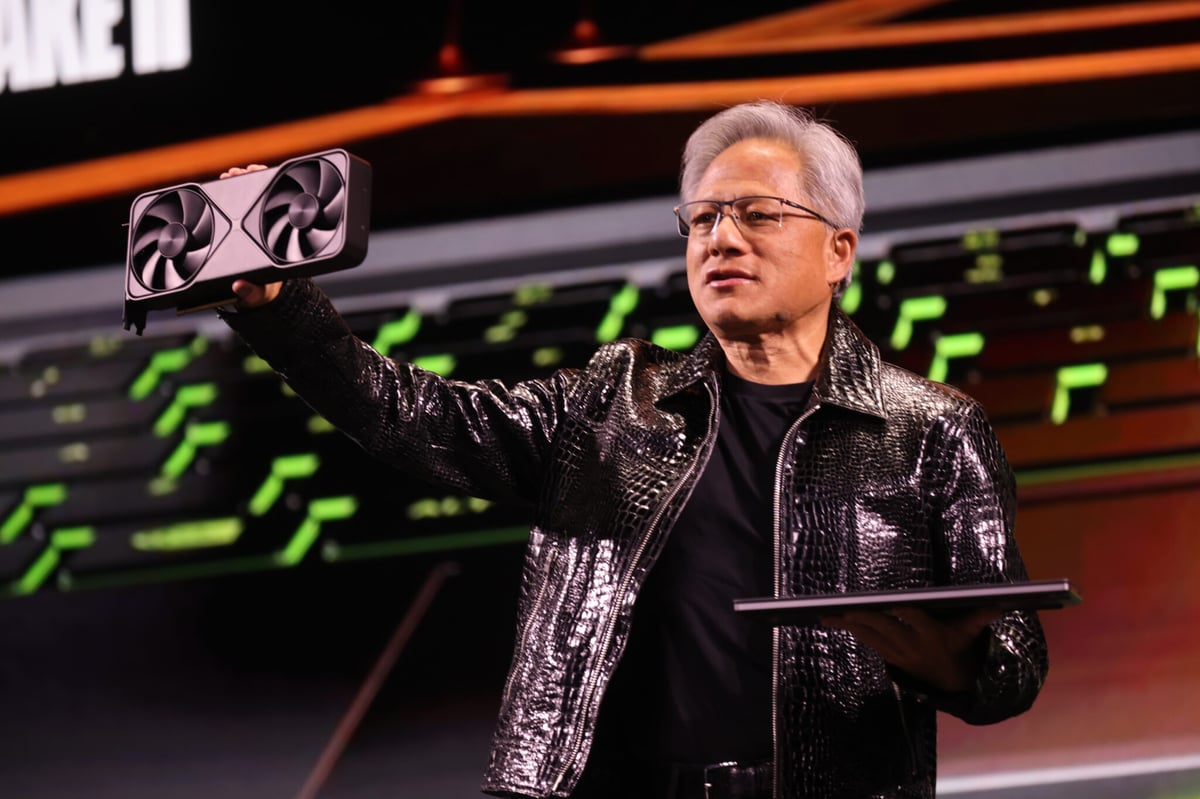
Nvidia CEO Jensen Huang highlighted memory as AI's biggest constraint at CES 2026, and that diagnosis has proven prescient: memory makers Micron and Sandisk have posted explosive revenue growth from AI data-center demand, with Micron reporting $41.4 billion(約6.6兆円) in fiscal Q3 2026 revenue and Sandisk up 251% year-over-year. Both companies are locking in multiyear customer contracts—Micron with $22 billion(約3.5兆円) in commitments and Sandisk with at least $42 billion(約6.7兆円)—suggesting sustained growth as long as AI infrastructure spending persists. Their stock returns this year have dramatically outpaced Nvidia's, reflecting investor confidence in the memory shortage thesis.
Summaries like this, in your inbox every morning.
Sign up free →What happened
Nvidia CEO Jensen Huang told CES 2026 attendees that memory has become the biggest bottleneck for AI systems—a view validated by surging revenue at memory and storage makers. Micron reported fiscal Q3 2026 total revenue of $41.4 billion(約6.6兆円) (up from $37.3 billion(約6兆円) for full-year 2025), while Sandisk's Q3 2026 revenue reached $5.9 billion(約9400億円), up 251% year-over-year.
Why it matters
Data centers need far more memory to keep AI conversations and context stored over time, forcing companies to sign multiyear supply deals. Micron secured 16 strategic customer agreements with $22 billion(約3.5兆円) in cash deposits and commitments; Sandisk signed three contracts worth at least $42 billion(約6.7兆円). This locks in long-term revenue and may help stabilize the historically cyclical memory industry.
What to watch
Micron shares have climbed nearly 200% thus far in 2026, while Sandisk has surged almost 500%—both far outpacing Nvidia's 11% gain—though both stocks have pulled back in recent days as the AI sector faced a sell-off. The scale of the memory shortage and the multiyear customer commitments suggest the outperformance could persist if AI infrastructure spending continues.
At CES 2026 in January, Nvidia CEO Jensen Huang articulated a problem that has since rippled through the semiconductor and cloud-computing industries: memory has become the biggest bottleneck in AI. The insight centers on a fundamental shift in how AI systems are expected to operate. Unlike earlier large language models that operated statelessly—answering queries without memory—today's systems are increasingly asked to retain entire conversation histories. Huang framed it in his CES speech: "We would like this AI to stay with us our entire lives and remember every single conversation we've ever had with it, right? Every single lick of research that I've asked for." He noted that this accumulating context memory "no longer fits inside an HBM," signaling that data centers must expand memory and storage capacity far beyond what was previously required.
The market has validated that diagnosis through the financial results of two memory and storage companies: Micron Technology and Sandisk. Micron reported total revenue of $41.4 billion(約6.6兆円) in its fiscal 2026 third quarter—a dramatic jump from its full-year 2025 revenue of just $37.3 billion(約6兆円). The surge was driven by its cloud and data center divisions, which reported combined revenue of $25.2 billion(約4兆円) in Q3 2026, compared with $4.8 billion(約7700億円) in Q3 2025. Sandisk, with a smaller top line, posted equally striking momentum: its fiscal 2026 third-quarter revenue reached $5.9 billion(約9400億円), representing a 251% increase year-over-year. Its data center and edge divisions (which supply memory storage for applications like drones and automotive sensors) were the principal growth engines, with data center revenue climbing from $197 million(約320億円) to $1.4 billion(約2200億円) and edge revenue jumping from $927 million(約1500億円) to $3.6 billion(約5800億円).
Both companies have moved aggressively to lock in this demand through long-term customer contracts. Micron signed 16 strategic customer agreements in its fiscal third quarter, with cumulative cash deposits and financial commitments totaling $22 billion(約3.5兆円) to date. Sandisk signed three contracts in its third quarter alone, with total contractual revenue of at least $42 billion(約6.7兆円). These multiyear arrangements are significant because they provide revenue stability and pricing certainty in an industry historically prone to cyclicality, where spot prices fluctuate sharply with supply and demand swings.
The stock market has rewarded both suppliers handsomely. Thus far in 2026, Micron shares have climbed nearly 200%, while Sandisk has surged almost 500%—vastly outpacing Nvidia's 11% gain. Though both stocks have pulled back in recent days amid a broader AI sector sell-off, the underlying trend reflects investor confidence that the memory and storage shortage will persist as long as AI infrastructure investment continues. Analysts note that the AI infrastructure build-out is not expected to slow down anytime soon, and as long as it continues, demand for memory and storage chips will remain robust, potentially allowing both companies to sustain growth over several years.
Jensen Huang's observation at CES 2026 identifies a critical shift in AI infrastructure needs: as language models evolve from stateless query-answering systems to persistent assistants that retain user history, memory and storage have become the binding constraint rather than compute power alone. This insight is grounded in a real technical challenge—context windows and persistent memory require exponentially more capacity than earlier AI workloads, and data centers cannot simply scale compute without proportional memory expansion.
Micron and Sandisk have capitalized on this trend through aggressive customer contracts that lock in multiyear revenue streams, insulating them from the cyclicality that has historically plagued the memory and storage industry. Micron's 16 strategic agreements totaling $22 billion(約3.5兆円) in commitments and Sandisk's three contracts worth at least $42 billion(約6.7兆円) represent not just one-time sales but recurring revenue anchors. This structural shift—from spot purchases to long-term supply agreements—explains why both companies have attracted investor enthusiasm despite the AI sector experiencing a recent sell-off.
The stock performance gap between memory makers and Nvidia reflects a market reallocation toward the suppliers of the actual scarcity. While Nvidia remains the dominant chip designer, the near-term constraint is no longer compute but the memory and storage needed to feed that compute at scale. As long as data-center infrastructure investment continues, this dynamic may sustain.
AI-summarized, only the topics you pick — one digest a day via Email, Slack, or Discord.
Free · takes 30 seconds · unsubscribe anytime
No discussion yet for this article
Get curated AI news from 200+ sources delivered daily to your inbox. Free to use.
Get Started FreeFree · takes 30 seconds · unsubscribe anytime
1 minute a day. The AI essentials.
200+ sources · Email / LINE / Slack
