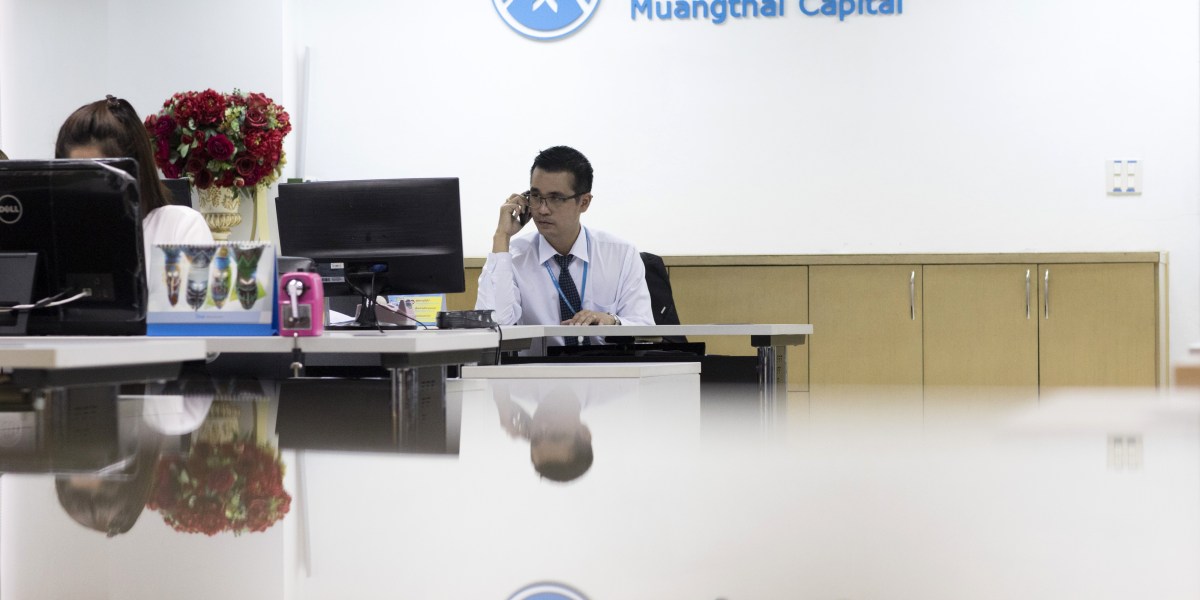
Parithad Petampai, the new CEO of Muangthai Capital (Thailand's largest microlender), defended the industry's role in lending to the country's poorest 10% at a recent investment summit in Singapore. While microfinance provides critical capital for farmers, education, and medical care, the sector faces mounting criticism for high interest rates (28–33% annually) and debt-trap risks—a cautionary tale already playing out in Cambodia, where borrowers owe over $3,900 on average. Parithad argues profits must be capped at moderate levels and the Thai government should support rather than shun the industry, which relies heavily on foreign investors and development agencies.
Summaries like this, in your inbox every morning.
Sign up free →What happened
Parithad Petampai took over as CEO of Muangthai Capital, Thailand's largest microlender, in August after a court deemed his father legally incapacitated; his father passed away in April. The firm now operates over 9,000 physical branches across Thailand and reported 2025 revenue of 30.74 billion Thai baht ($936 million(約1500億円)).
Why it matters
Parithad argues microfinance is essential for Thailand's bottom 10%—farmers need loans to buy fertilizers, parents to pay school fees, accident victims to afford medical care. Yet the industry faces criticism for high interest rates (averaging 28–33% annually) and pushing vulnerable borrowers into debt cycles, a problem especially acute in neighboring Cambodia. The Bank of Thailand has warned of rising financial costs for micro-SMEs relying on high-interest nano-finance loans.
What to watch
Thailand's microfinance market is expected to reach 273 billion baht ($8.2 billion(約1.3兆円)) by 2027, according to the Asian Development Bank in 2023. Muangthai issued a landmark $335 million(約540億円) social bond on the Singapore Exchange in September 2024, with JPMorgan as sole global coordinator, after facing challenges in the Thai bond market.
Parithad Petampai's assumption of the CEO role at Muangthai Capital marks a generational transition at Thailand's largest microlender. After sitting alongside his father Chuchat for nearly twelve years without direct operational control, Parithad stepped into the position last August following a court decision, then lost his father to death in April—a compressed timeline that forced him to learn the role rapidly while grieving. His management has already sparked internal modernization efforts (such as pushing for digital record-keeping rather than paper-based systems), revealing friction between his generation and his parents' traditional approach.
The broader context frames Muangthai within Thailand's booming microfinance sector, a high-stakes market where firms serve borrowers with limited access to mainstream banking. Parithad's core argument—that without microfinance, the poorest Thais cannot afford fertilizers, school fees, or emergency medical care—rests on genuine unmet demand. However, this moral case is shadowed by industry-wide risks. Interest rates of 28–33% annually and documented debt traps in neighboring Cambodia (where borrowers owe over $3,900 on average, more than three times median income) suggest that microfinance, while filling a capital gap, can also trap vulnerable populations in perpetual cycles of borrowing. The Bank of Thailand's March warning about rising financial costs and over-reliance on high-interest nano-finance loans indicates that even Thai regulators view the sector as a potential systemic risk.
Parithad's solution—capping profits at moderate levels and arguing that Thailand's government should support rather than shun the industry—reflects his conviction that the business can balance social impact with sustainability. The September 2024 issuance of a $335 million(約540億円) social bond on the Singapore Exchange (a landmark deal in the Thai context) signals that international capital markets and development institutions are willing to finance Muangthai's mission, even as Thai government and banking entities remain cautious. This split—where foreign investors and multilateral agencies (Asian Development Bank, International Finance Corporation, German Investment Corporation, Japan International Cooperation Agency) provide capital while domestic Thai institutions withhold it—suggests that the microlending debate remains contentious at home.
No discussion yet for this article
Get curated AI news from 200+ sources delivered daily to your inbox. Free to use.
Get Started FreeFree · takes 30 seconds · unsubscribe anytime
1 minute a day. The AI essentials.
200+ sources · Email / LINE / Slack
