
OpenAI merged its dedicated Codex code-writing model into the main GPT-5.5 language model as of GPT-5.4 (released in early 2025). Version 5.3, shipped in early February, was the last standalone Codex release. This repeats a pattern: OpenAI shut down the original Codex in 2023, then revived it in May 2025 as Codex-1 before folding it back into the main model.
GPT-5.5 requires fewer tokens (units of text the model processes) than GPT-5.4 to complete the same coding tasks, meaning faster responses and lower computing costs for the same work. However, despite this efficiency gain, OpenAI raised API pricing by approximately 20 percent, so users will pay more overall.
Developers who rely on dedicated coding AI for programming tasks will now get those features built into GPT-5.5's general-purpose model instead of a separate tool. GPT-5.5 emphasizes agentic coding—where AI autonomously completes coding work with minimal human oversight—and improved ability to control computers, which may shift how teams structure code review and automation workflows.
Ask the AI about this article →
For example, today's edition would include:
AI-summarized, only the topics you pick — one digest a day via Email, Slack, or Discord.
Free · takes 30 seconds · unsubscribe anytimeWhat is AIToday? →
Ask AI anything about this article. Q&As are published on this page for other readers too.
Anthropic has signed a $35 billion cloud computing deal with Lambda, an Nvidia-backed cloud provider

SoundHound AI stock trades at about $7, near the bottom of its 52-week range, after swinging between less than…

Vertiv, which makes power and cooling equipment for data centers, agreed to acquire Utility Innovations, a lea…

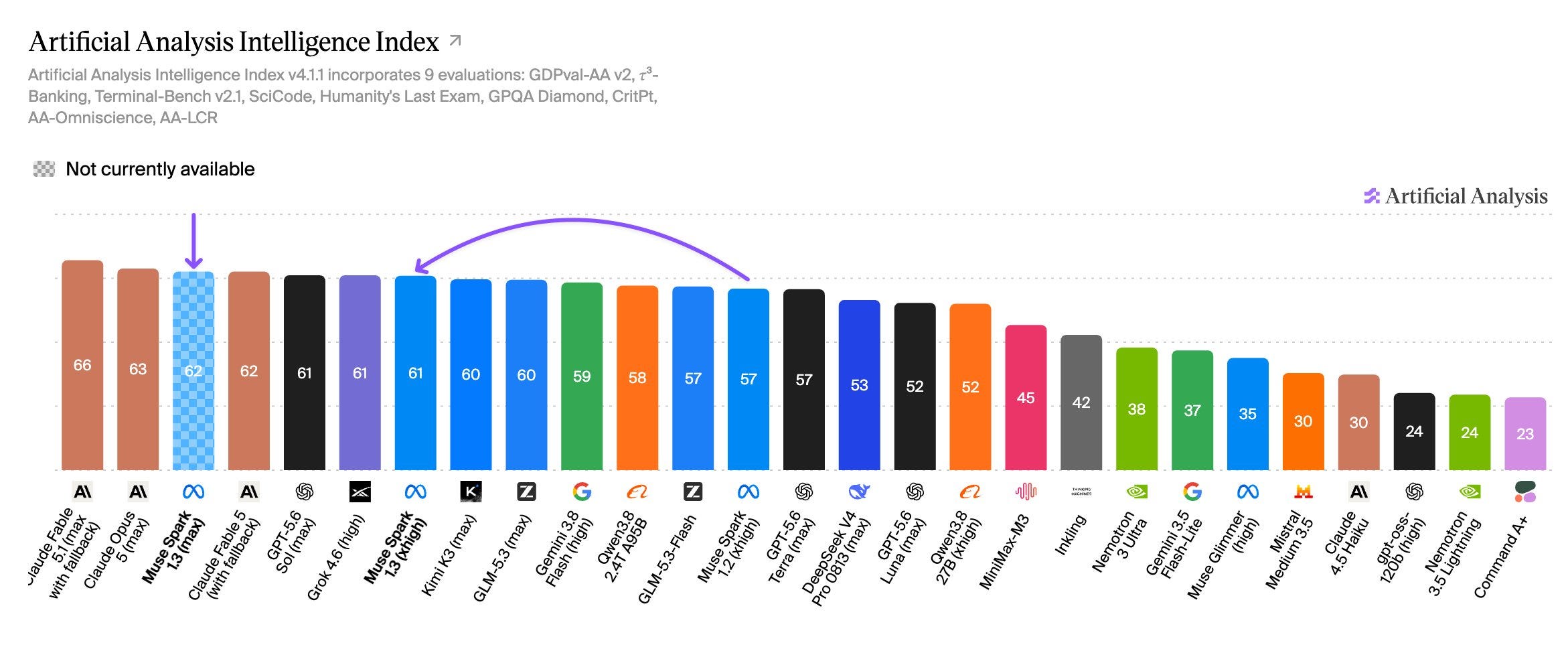
Meta released Muse Spark 1.3, which per AAII is now the #3 model in the world
The original author of CABiNet (ICRA 2021) rebuilt the repo and compared its performance against YOLO26-sem on…

A developer built Deepity, a C++ machine learning library, to test Predictive Coding Networks (PCNs), an alter…

