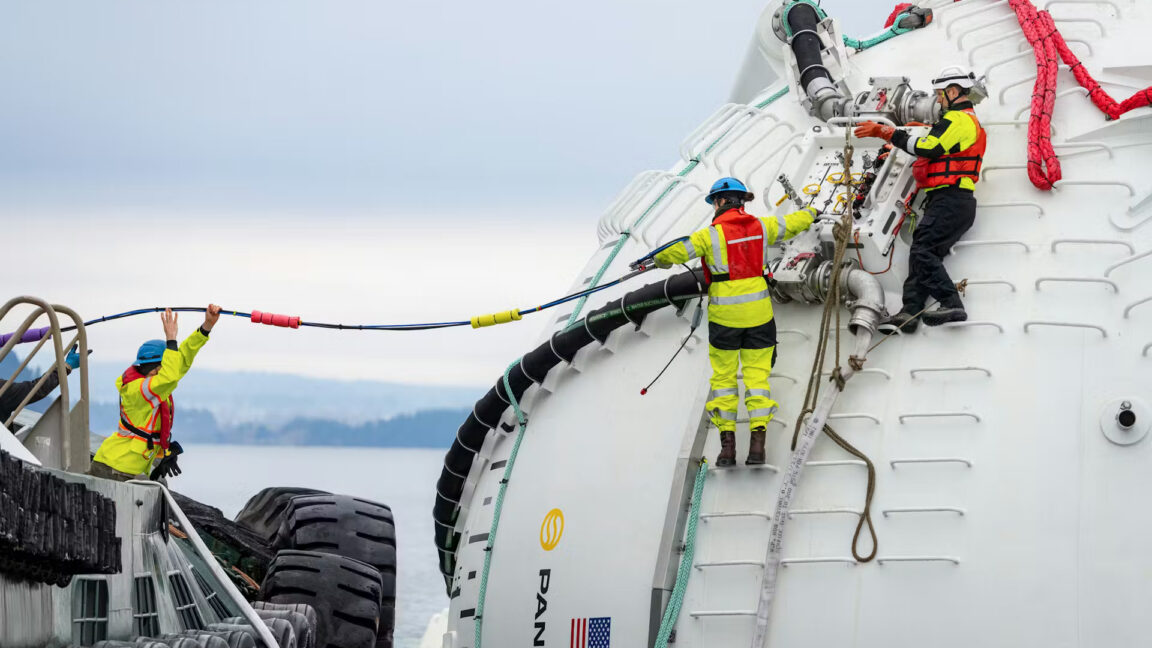
Panthalassa raised $140 million in its latest funding round to complete a pilot manufacturing facility near Portland, Oregon, and accelerate deployment of floating wave-powered computing nodes. The company's newest prototype, Ocean-3, is scheduled for testing in the northern Pacific Ocean later in 2026 and reaches about 85 meters in length.
Each node is a large steel sphere that harnesses wave motion to drive water upward through a tube into a pressurized reservoir, spinning a turbine generator to produce renewable energy for onboard AI chips. The nodes would transmit inference tokens (the AI model's outputs) to customers worldwide via satellite link rather than sending power to land-based data centers.
Floating ocean-based nodes face significant challenges: satellite links offer limited bandwidth and signal delays compared to fiber-optic cables used by traditional data centers, making coordination between multiple nodes difficult. Maintenance and replacement of nodes scattered across the ocean, along with their need to survive for more than a decade in harsh conditions without human intervention, also present engineering hurdles.
Ask the AI about this article →
For example, today's edition would include:
AI-summarized, only the topics you pick — one digest a day via Email, Slack, or Discord.
Free · takes 30 seconds · unsubscribe anytimeWhat is AIToday? →
Ask AI anything about this article. Q&As are published on this page for other readers too.

