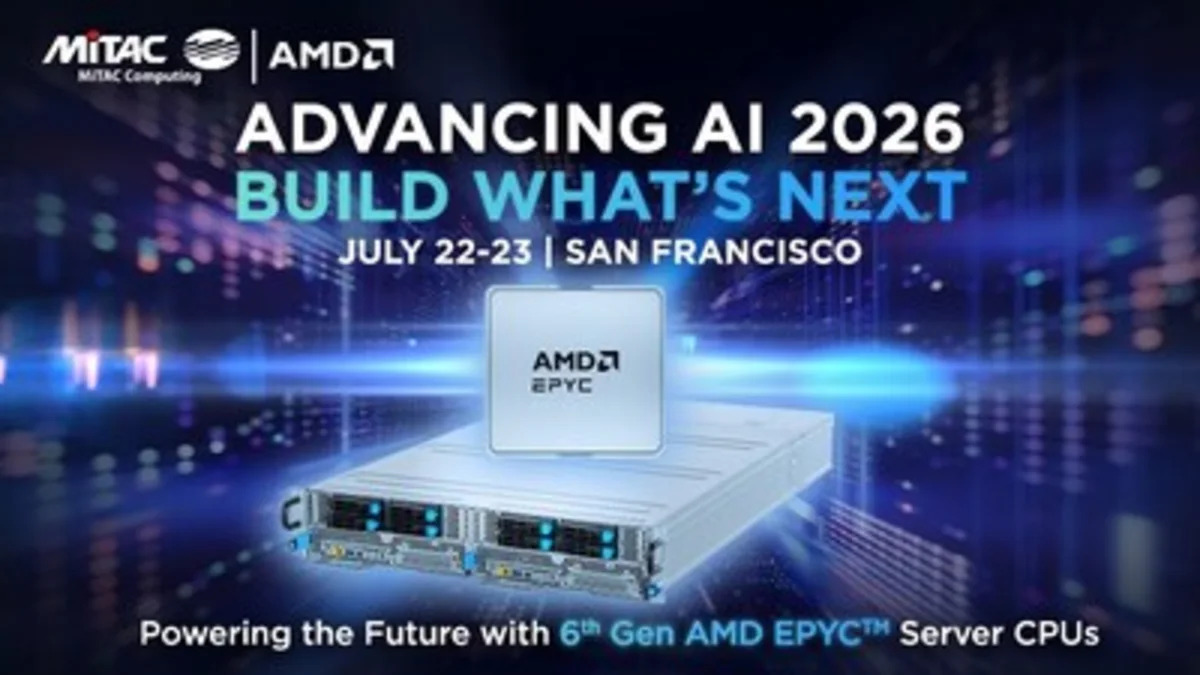
MiTAC Computing, a subsidiary of MiTAC Holdings Corporation, introduced two new server platforms powered by AMD's 6th Gen EPYC Server CPUs on July 23, 2026 at AMD Advancing AI. The M2810Z6 and M2610Z6 systems are engineered for agentic AI, cloud, HPC, and enterprise workloads, with support for Venice Zen 6 architecture, PCIe Gen 6, and CXL 3.1 to optimize performance, memory bandwidth, and power efficiency in modern data centers.
Summaries like this, in your inbox every morning.
Sign up free →What happened
MiTAC Computing unveiled two new server platforms — the M2810Z6 and M2610Z6 — built on AMD's 6th Gen EPYC Server CPUs, featuring support for Venice Zen 6 architecture, PCIe Gen 6, and CXL 3.1. The M2810Z6 supports up to 600W cTDP and up to 4TB of DDR5-8000 memory per node, while the M2610Z6 supports up to 400W cTDP and up to 4TB of DDR5-6000 memory.
Why it matters
Agentic AI workloads require infrastructure that balances compute density, memory bandwidth, and I/O capability. MiTAC's new platforms are designed to let customers deploy AI-ready infrastructure while supporting existing business workloads, with the flexibility and efficiency that modern data centers demand.
What to watch
Both systems are 2U 2-node platforms with 16 DDR5 DIMM slots per node and flexible NVMe storage options (E3.S, E1.S, U.2), plus OCP 3.0 TSFF expansion for AI, HPC, and cloud-scale deployment.
On July 23, 2026, MiTAC Computing Technology Corp., a subsidiary of MiTAC Holdings Corporation (TWSE:3706), unveiled its latest agentic AI infrastructure portfolio at AMD Advancing AI in San Francisco. The centerpiece of the announcement was the introduction of two new server platforms built on AMD's 6th Gen EPYC Server CPUs: the M2810Z6 and the M2610Z6.
The M2810Z6 is a 2U 2-node, single-socket system built around the 6th Gen AMD EPYC SP7 architecture, with each node supporting a single AMD EPYC Server CPU up to 600W cTDP. The platform offers 16 DDR5 DIMM slots per node with capacity up to 4TB of DDR5-8000 memory, and includes flexible front hot-swap NVMe storage options supporting E3.S, E1.S, and U.2 form factors. It also includes OCP 3.0 TSFF expansion for AI, HPC, and cloud-scale deployments. The M2610Z6 follows a similar form factor as a 2U 2-node platform but is built around the 6th Gen AMD EPYC SP8 architecture. Each node supports AMD EPYC 9006 SP8 server processors up to 400W cTDP, 16 DDR5 DIMM slots, and up to 4TB of DDR5-6000 memory. MiTAC positioned the M2610Z6 as a cost-efficient and versatile option for virtualization, storage, edge, and telco workloads, while also offering OCP 3.0 TSFF connectivity and flexible NVMe hot-swap storage.
Both platforms leverage AMD's Venice Zen 6 architecture, PCIe Gen 6 I/O subsystem, and CXL 3.1 standard. Rick Hwang, President of MiTAC Computing Technology, stated that "Agentic AI and next-generation enterprise workloads require infrastructure that is fast, scalable and efficient," and emphasized that MiTAC's new platforms are designed to provide "the building blocks to deploy AI-ready infrastructure while supporting the workloads that run their business today." The portfolio reflects MiTAC's commitment to delivering infrastructure choices that align compute density, memory bandwidth, and I/O capability with the evolving demands of modern data centers.
MiTAC's launch of the M2810Z6 and M2610Z6 reflects the broader industry shift toward specialized infrastructure for agentic AI and next-generation enterprise workloads. Both platforms are built on AMD's 6th Gen EPYC Server CPUs, which support Venice Zen 6 architecture, PCIe Gen 6 I/O subsystem, and CXL 3.1. Rick Hwang, President of MiTAC Computing Technology, positioned these systems as addressing the need for infrastructure that is "fast, scalable and efficient" — emphasizing that agentic AI requires a careful balance between compute density, memory bandwidth, and I/O capability to meet evolving data center requirements. The dual-node, single-socket design per node allows customers to configure systems suited to specific workloads, whether prioritizing raw performance (M2810Z6 at 600W cTDP) or cost efficiency and versatility (M2610Z6 at 400W cTDP).
AI-summarized, only the topics you pick — one digest a day via Email, Slack, or Discord.
Free · takes 30 seconds · unsubscribe anytime
No comments yet. Be the first to share your thoughts!
Log in to join the discussion


Get curated AI news from 200+ sources delivered daily to your inbox. Free to use.
Get Started FreeFree · takes 30 seconds · unsubscribe anytime
1 minute a day. The AI essentials.
200+ sources · Email / LINE / Slack
