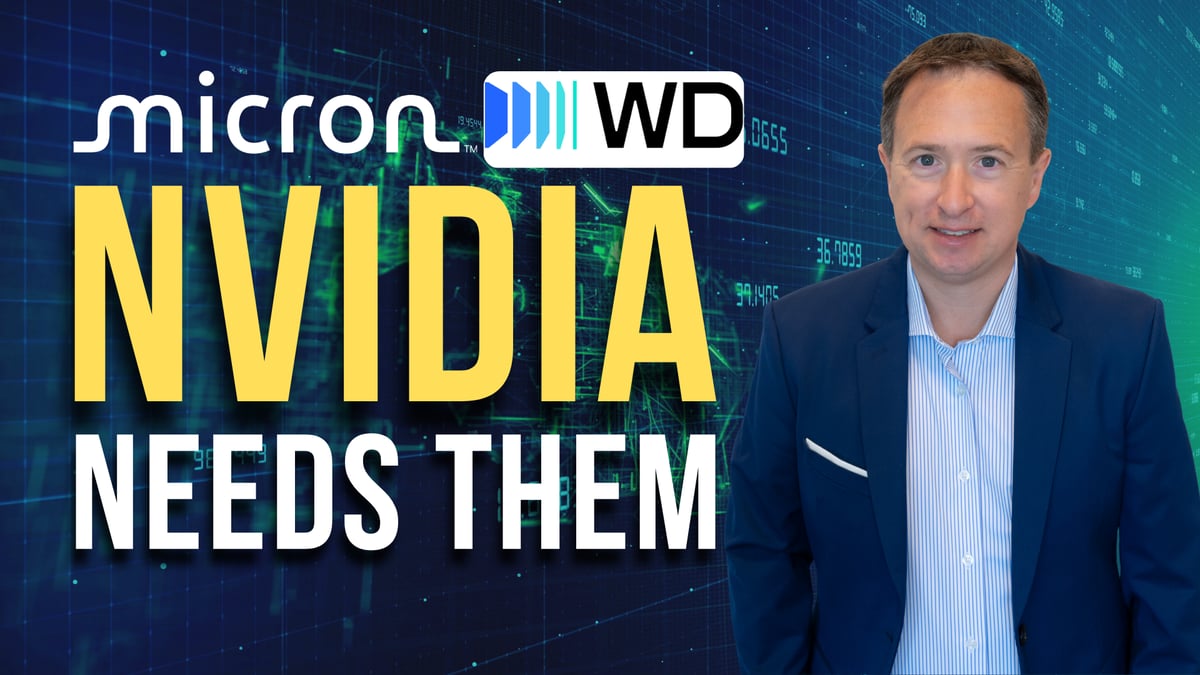
Micron Technology and Western Digital occupy complementary positions in AI infrastructure, with Micron supplying memory solutions to address processor bottlenecks and Western Digital offering economical storage for large datasets. As Nvidia GPUs demand more memory, capacity, and performance, investors must weigh whether memory or storage constraints will drive greater value creation in the AI build-out.
Summaries like this, in your inbox every morning.
Sign up free →What happened
Micron Technology and Western Digital are compared as suppliers of two critical layers of AI infrastructure—memory (Micron) and storage (Western Digital)—as demand from Nvidia GPU deployments grows.
Why it matters
Nvidia's processors require more memory, capacity, and performance; Micron addresses memory bottlenecks in advanced processors, while Western Digital provides cost-effective storage for expanding data sets. The choice between them depends on which constraint (memory or storage) will prove more valuable as AI infrastructure scales.
What to watch
Stock prices as of July 16, 2026 showed Micron down 8.87% and Western Digital down 6.91%, reflecting near-term investor sentiment on both memory and storage segments.
Micron Technology and Western Digital supply two essential, complementary layers of AI infrastructure as the sector builds out to support Nvidia's GPU deployments. Micron's core contribution is memory: it addresses the memory bottleneck that limits the performance of advanced processors. As Nvidia GPUs become more powerful and widely deployed, they require not only more raw compute capacity but also faster and larger memory subsystems to feed data to those processors at the necessary rate. Western Digital, by contrast, focuses on the storage layer—providing economical solutions for the rapidly expanding data sets that AI systems require for training and inference. The two companies thus face related but distinct opportunities: one unlocks processor performance through memory, the other manages the economic and logistical challenges of storing and retrieving enormous datasets. The comparison hinges on Nvidia's escalating requirements: its GPUs now demand more memory, greater capacity, and higher performance across the board. For investors evaluating which company may benefit more, the question becomes whether the memory bottleneck or the storage bottleneck will prove the more significant constraint—and therefore command greater margin and volume upside—as AI infrastructure investment continues. Stock prices on July 16, 2026 showed Micron down 8.87% and Western Digital down 6.91%, reflecting the near-term trading mood for both memory and storage suppliers.
Micron Technology and Western Digital serve adjacent but distinct roles in the AI infrastructure stack that Nvidia's rapid GPU deployment has brought into focus. The article frames the choice between them as a matter of which bottleneck—memory or storage—will prove more constraining (and therefore more valuable) as AI workloads scale. Micron's memory products directly address processor performance limits, a first-order concern for compute-heavy AI systems. Western Digital's storage solutions tackle the secondary but equally urgent challenge of housing and retrieving the datasets that train and serve AI models. The stock price movements on July 16, 2026 (Micron down 8.87%, Western Digital down 6.91%) suggest both segments faced investor headwinds on that date, but the article's framing implies the relative strength of each business over the medium term depends on which infrastructure constraint becomes the binding one as AI adoption deepens.
AI-summarized, only the topics you pick — one digest a day via Email, Slack, or Discord.
Free · takes 30 seconds · unsubscribe anytime
No comments yet. Be the first to share your thoughts!
Log in to join the discussion


Get curated AI news from 200+ sources delivered daily to your inbox. Free to use.
Get Started FreeFree · takes 30 seconds · unsubscribe anytime
