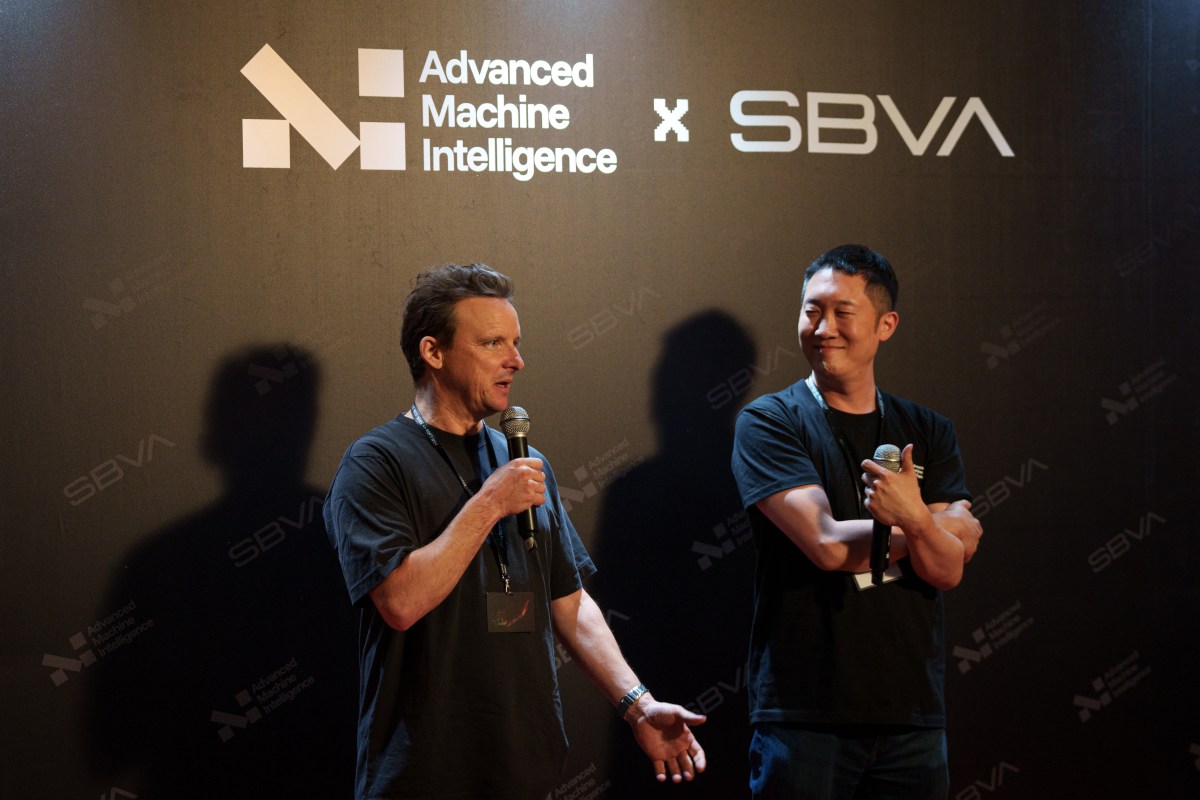
Alexandre LeBrun, CEO of Yann LeCun's world model startup AMI Labs, rejects the trendy labels "AGI" and "superintelligence" as undefined and unhelpful. Instead, he is focused on building AI systems that understand and predict the physical world—a capability he sees as essential for safe, context-aware robotics in manufacturing, healthcare, and other real-world industries where current AI systems fall short. The pre-product startup, which raised $1.03 billion(約1600億円) in March, is now scouting partners in South Korea and Asia to access the hardware ecosystems and rapid adoption mindset needed to train world models on reality.
Summaries like this, in your inbox every morning.
Sign up free →What happened
Alexandre LeBrun, CEO of Yann LeCun's world model startup AMI Labs, said in an interview that the company never uses terms like "AGI" or "superintelligence" because there is no good definition and they are not useful words.
Why it matters
LeBrun argues that world models—AI systems that predict the next state of the physical world rather than the next word—are essential for robotics and industries that operate in the real world, where large language models remain weak. He contends that context-aware AI in robotics could prevent unsafe situations and that robots today lack the "brain" to understand their surroundings.
What to watch
AMI Labs is pre-product but already courting robotics, manufacturing, and electronics partners. The startup raised $1.03 billion(約1600億円) in March at a $3.5 billion(約5600億円) pre-money valuation and is scouting for industrial partners in Asia, particularly South Korea, which LeBrun views as a unique combination of advanced hardware industries and willingness to adopt AI quickly.
Alexandre LeBrun, CEO of AMI Labs, sat down with TechCrunch while visiting Seoul for The International Conference on Machine Learning, where he was scouting industrial partners, global companies, and researchers. The conversation revealed a contrarian stance in an industry obsessed with labels. "We never used the word AGI," LeBrun said. "And I just noticed that nobody is using it anymore; they switched to superintelligence. Next time we'll switch to something else." He dismissed the new term as well: "There's no good definition. What is superintelligence? I don't know. It's not a very useful word." This pointed stance comes from a founder at the center of AI's newest race—Yann LeCun's world model startup, co-founded after LeCun left Meta and funded with a $1.03 billion(約1600億円) raise in March at a $3.5 billion(約5600億円) pre-money valuation.
AMI Labs is still pre-product, but it is already courting robotics, manufacturing, and electronics players. The reason is simple: a world model needs to prove itself outside the lab. LeBrun explained the core insight. A world model predicts the next state of the world; nudge a glass off a table, and you already know it will tip and spill. That intuition is what world models are meant to capture. By contrast, an LLM predicts the next word or text. The two are not competitors, LeBrun stressed. They are "complementary, not replaceable" when building AI systems that understand the physical world. Drawing a parallel to the human brain's distinct language and reasoning functions, he noted that LLMs will remain the most efficient tools for language while world models will provide context and real-world understanding.
The gap that world models fill is urgent in robotics. Today, robots are "completely static," running fixed routines, and AI remains "really dumb in the physical world," LeBrun said. Even making robots "aware of the context" would mark "a very big difference for the world." He cited a concrete example: a robot that was dancing and doing kung fu at a public event approached and kicked a child. Context-aware AI might have prevented that. "The hardware is very advanced; progress in hardware in the last few months is incredible, but there's no brain," he said. The challenge grows sharper outside controlled labs. A factory robot repeating the same motion works fine today, but the moment "you take your robot outside into a more open environment, in your household, or in the street," it must understand its surroundings and operate safely. "Robots are not safe right now," LeBrun said. "There's no solution for that today." Healthcare offers a parallel. LeBrun's previous company was Nabla, an AI health startup. He likened today's AI systems to a doctor trained only on textbooks without residency. LLMs may be useful in medicine, but they cover "only 1% of healthcare." The rest depends on real-world experience.
Building that real-world understanding requires access to real environments. "We need access to the real world," LeBrun said, "and it's easier for us to do that with partners." That explains his pull toward Asia, where the robots, chips, and factories actually exist. South Korea's appeal rests on two pillars. First, Korea has advanced industries in robotics, semiconductors, and manufacturing—the hardware-heavy sectors that AI has barely touched. Second, it combines speed and adoption. "Korea was the fastest adopter of the internet 25 years ago," LeBrun noted. Seoul's June plan to mobilize some $880 billion(約140兆円) for chips, AI data centers, and physical AI exemplifies that combination of industrial depth and willingness to embrace new technology. "I've been telling Alex and the team to come to Korea," JP Lee, CEO of SBVA and one of AMI's backers in Asia, told TechCrunch. Lee praised the government's "tremendous job" funding local sovereign LLM models, which already work "well enough" for general-purpose tasks, but he is pushing Korea to invest in physical AI as well. "They should coexist," he said. Korea's value to foreign firms extends beyond hardware. Local developers are quick to adopt and adapt new tools—a pattern that has produced homegrown internet players like Naver and Kakao.
For all the star power and the billion-dollar check, AMI has nothing to sell yet. There is no product and no timeline LeBrun will commit to. "We'll make a surprise when we're ready," he said.
LeBrun's refusal to adopt the current AI industry vocabulary reflects a deeper strategic position: he is betting on a different frontier than the large language model race that has dominated headlines. While competitors chase "superintelligence" labels, AMI Labs is positioning world models as the next essential capability—one that addresses a real gap in how AI systems interact with physical reality. The distinction matters because it reframes the competition. LLMs have dominated discourse because they excel at text and reasoning tasks, but they are famously brittle in unpredictable physical environments. LeBrun argues that robots and manufacturing systems need a fundamentally different kind of intelligence: one that grasps context, predicts physical outcomes, and can operate safely in open, dynamic spaces. This is not a better-than-LLM claim; he explicitly states they are complementary. Rather, it is a claim that the next wave of AI impact will come from systems that can bridge the gap between what language models can do and what the real world requires.
LeBrun's pivot toward Asia, and specifically South Korea, is strategic rather than accidental. He is pursuing access to the exact industrial and manufacturing ecosystems where world models are most likely to prove themselves. A factory with robots, a semiconductor fab, or a logistics operation offers the real-world training ground that no lab can replicate. Korea's combination of hardware strength and rapid AI adoption makes it a natural first base. The $880 billion(約140兆円) Seoul mobilization plan he cited signals not just government support but a genuine industrial ecosystem ready to integrate new AI tools. For a pre-product startup with $1.03 billion(約1600億円) in funding, this is the bet: find partners in the places where the next wave of physical AI can be deployed and proven at scale, rather than compete for narrative dominance in a language-model-saturated market.
AI-summarized, only the topics you pick — one digest a day via Email, Slack, or Discord.
Free · takes 30 seconds · unsubscribe anytime
No discussion yet for this article
Get curated AI news from 200+ sources delivered daily to your inbox. Free to use.
Get Started FreeFree · takes 30 seconds · unsubscribe anytime
1 minute a day. The AI essentials.
200+ sources · Email / LINE / Slack
