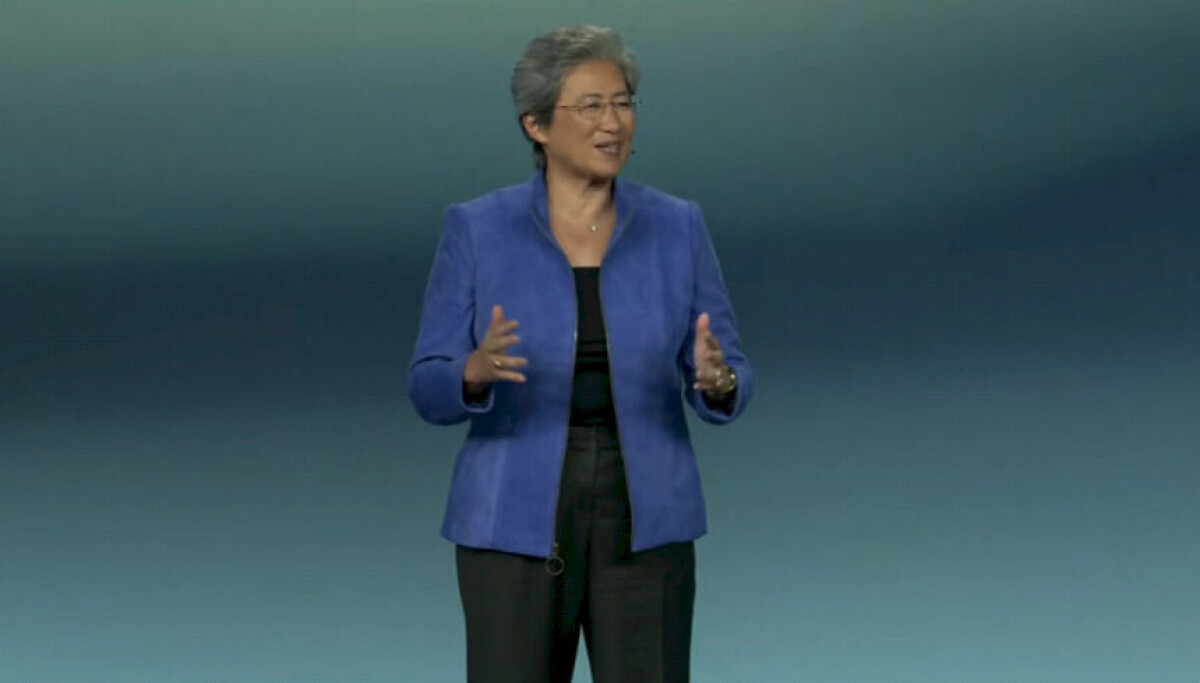
AMD CEO Lisa Su unveiled forecasts at the company's Advancing AI event projecting that the combined AI training and inference market will reach more than $1.4 trillion(約220兆円) by 2030, growing at a 45 percent compound annual growth rate. The outlook reflects a anticipated shift where inference workloads—companies running their own AI models or renting through APIs—increasingly dominate compute spending, expected to move from roughly 50–50 with training to 60 percent inference and 40 percent training this year. Su emphasized that this transition signals AI moving from experimental to production workload status across enterprises and cloud providers, validating massive infrastructure buildouts underway.
Summaries like this, in your inbox every morning.
Sign up free →What happened
At its Advancing AI event, AMD CEO Lisa Su revealed internal forecasts showing AI training and inference combined will reach more than $1.4 trillion(約220兆円) by 2030, growing at a 45 percent compound annual growth rate between 2025 and 2030. Su also noted that in the accelerator market, inference is expected to shift from roughly 50–50 with training last year to 60 percent inference and 40 percent training this year.
Why it matters
The shift toward inference reflects a fundamental change in how AI moves from research labs to production workloads at enterprises and cloud providers. Su argued that the inflection point—when inference demands far exceed training—will validate the hundreds of billions in AI infrastructure investment underway. Token consumption data showed 35 quadrillion tokens per month consumed in February and is projected to reach well into 50 quadrillion tokens per month by late July, signaling sustained demand pressure that justifies AMD's confidence in the market's scale.
What to watch
AMD's roadmap includes the MI455X variant of the Altair MI400 architecture debuting in Helios rackscale server designs later this year, as well as the Venice Epyc 9006 processors also expected later this year. The total compute TAM across datacenter, client, and embedded categories is forecast to grow at around a 40 percent compound annual growth rate between 2025 and 2030 to reach more than $2 trillion(約320兆円), with datacenter commanding an even larger share than last year.
At AMD's annual Advancing AI event in Silicon Valley, CEO Lisa Su presented the company's internal market forecasts and the strategic rationale driving AMD's hardware and software roadmap development. Su opened with a stark observation about compute trends: AI training workloads have increased their compute needs by a factor of 5X every year since 2020, with no signs of slowing. However, the bigger inflection point, according to Su, is the inevitable shift from AI training—today concentrated at a relative handful of large companies—to AI inference, where businesses either rent generative AI models through APIs or purchase AI systems to run their own inference using licensed or open-source models.
To illustrate the scale of current demand, Su cited data from the State of the AI Economy report showing that 35 quadrillion tokens per month were consumed or generated by GenAI models in February. Given the exponential growth curve, she estimated that by late July, consumption would exceed 50 quadrillion tokens per month. This massive and accelerating demand justifies the hundreds of billions in AI infrastructure investment companies are making this year, Su argued, provided the growth curve continues—a concern she acknowledged by invoking the inverse of the Field of Dreams: "You build it, and they don't come." So far, demand has exceeded supply, driving prices higher across all key components—CPUs, GPUs, DRAM memory, flash, switch ASICs, and optical components.
Su disclosed that in the AI accelerator market, the training-to-inference split has already shifted from roughly 50–50 last year to 60 percent inference and 40 percent training this year. She expects this ratio to continue moving in inference's favor, eventually reaching 2:1, 3:1, or even higher multiples. When that tipping point arrives, it will signal that generative AI inference has become a genuine production workload for enterprises as well as hyperscalers and cloud builders—not merely an experiment.
AMD's revised datacenter AI accelerator total addressable market forecast extends through 2030 and projects that AI training and inference combined will generate more than $1.4 trillion(約220兆円) in revenue, growing at a 45 percent compound annual growth rate between 2025 and 2030. Su also broke down the expected datacenter CPU revenue streams into three categories: general-purpose CPUs for back-office applications, databases, web infrastructure, and analytics; CPUs serving as host processors in AI cluster nodes; and CPUs in new agentic AI clusters—sandboxes where models generate code and perform other tasks running Python code alongside GPU or XPU inference engines. This three-bucket breakdown reveals that agentic AI server clusters will drive a resurgence in server CPU spending.
Beyond accelerators and CPUs, Su presented a broader compute TAM across datacenter, client, and embedded categories, forecast to grow at a 40 percent compound annual growth rate from 2025 to 2030 and reach more than $2 trillion(約320兆円). Datacenter compute is expected to command an even larger share of that total than it did last year. Su concluded her keynote by reaffirming AMD's confidence: "We are no longer talking about what might be possible. We are actually seeing how AI can have real and significant impact across every industry and every part of our personal lives." She emphasized AMD's focus on building the technology, roadmaps, and partnerships to enable that impact, framing the current moment as "the next phase of AI."
Looking ahead, AMD plans to introduce the MI455X variant of its Altair MI400 architecture in Helios rackscale server designs later this year, rolling out through OEM and ODM partners. The company is also readying its Venice Epyc 9006 processors for release later this year. These product debuts, combined with the market forecasts, position AMD to capture a growing share of the AI infrastructure buildout as the industry transitions from training-dominated to inference-dominated workloads.
AMD's Advancing AI event marks a major milestone in the company's positioning as a credible alternative to Nvidia in the accelerator space. CEO Lisa Su anchored the announcements in a straightforward economic argument: AI inference workloads are beginning to dominate the market as the industry transitions from a training-focused phase (concentrated at a handful of large labs) to a production-inference phase (distributed across enterprises and cloud providers). The data Su presented—token consumption reaching 35 quadrillion per month in February and projected to exceed 50 quadrillion by late July—demonstrates that demand continues to outstrip supply, supporting the justification for the hundreds of billions in infrastructure spending currently underway.
The shift from 50–50 training-to-inference split last year to 60–40 this year is significant because it validates long-standing industry projections that inference would eventually drive 3X to 4X the compute (and revenues) compared to training. Su's internal forecasts project that AI accelerators and CPUs combined will exceed $1.4 trillion(約220兆円) by 2030, growing at a 45 percent compound annual growth rate through the decade. Notably, the analysis reveals that datacenter compute will be 8.3X larger in aggregate from 2025–2030 than embedded and client compute combined, and that spending on AI GPUs and XPUs is expected to exceed spending on datacenter CPUs by a ratio averaging 6.5X across those years. This underscores the critical role specialized accelerators play in the AI economy AMD is chasing.
AI-summarized, only the topics you pick — one digest a day via Email, Slack, or Discord.
Free · takes 30 seconds · unsubscribe anytime
No discussion yet for this article
Get curated AI news from 200+ sources delivered daily to your inbox. Free to use.
Get Started FreeFree · takes 30 seconds · unsubscribe anytime
