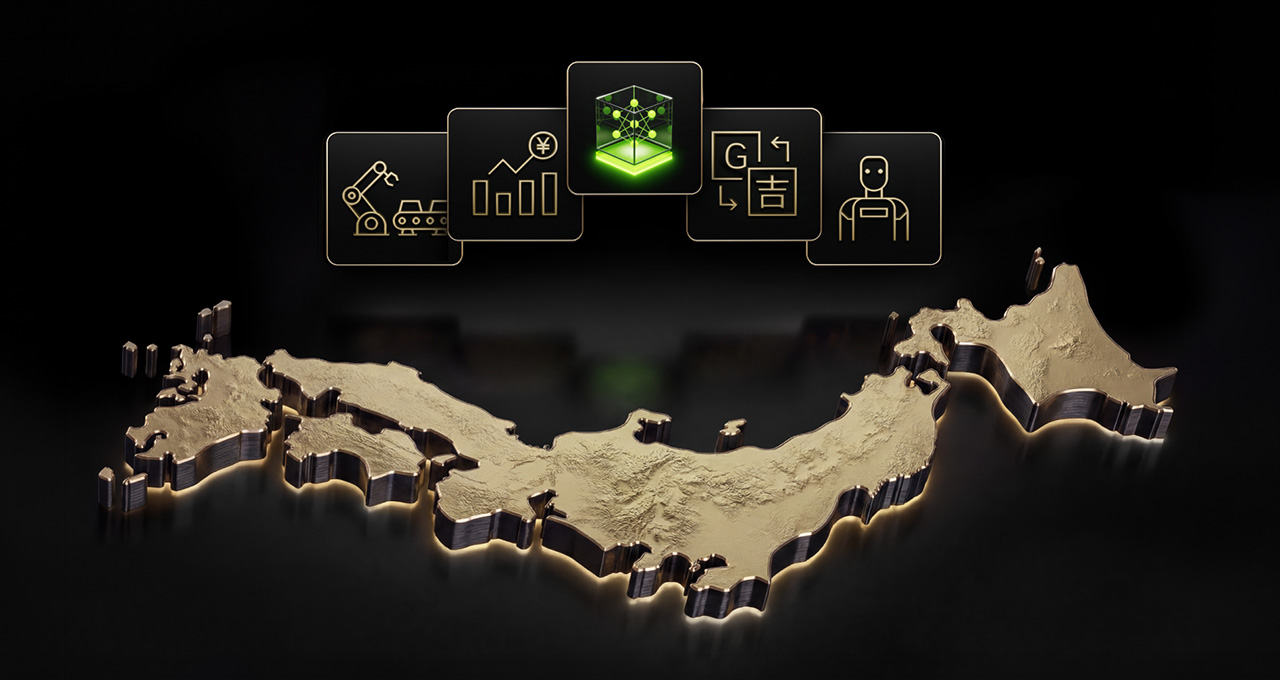
Japanese enterprises and research institutions including Tokyo Tech, SoftBank, Hitachi, and NTT are building industry-specific Japanese-language AI applications and models using NVIDIA's open Nemotron platform.
This addresses Japan's pressing challenges from aging demographics and workforce shifts, enabling organizations to develop AI tailored to domestic industries while maintaining regulatory compliance and data localization control.
The Nemotron models are available through major platforms including Hugging Face and NVIDIA's cloud partners.
何が起きたか
東京科学大学、ソフトバンク、日立製作所、NTT、ENEOSホールディングス、Sakana AIなど日本の主要企業・研究機関が、NVIDIAのオープンモデル「Nemotron」を活用して日本語対応のAIアプリケーションやモデルを構築している。東京科学大学は「Swallow」シリーズの基盤モデルを開発、SB Intuitionsは「Sarashina」シリーズをトレーニング、Stockmarkは日本語文書理解特化型モデルをリリースしている。
なぜ重要か
日本は高齢化や労働力構造の変化という課題に直面しており、国内産業のニーズに適した自律的で制御可能なAI開発の重要性が高まっている。オープンモデルにより、企業や研究機関が規制やデータローカライゼーション要件を満たしながら、自国の言語と産業に特化したAIをカスタマイズ・展開できるようになる。
注目点
NemotronのモデルはHugging Face、ModelScope、OpenRouter、build.nvidia.comで利用可能であり、NVIDIA NIMマイクロサービスとして、またNVIDIAのクラウドパートナーや推論プラットフォーム経由でも利用できる。Sarashina3 miniは日本のデジタル庁により特定のAI活用事例での利用に選定されている。
Ask the AI about this article →
Japan faces acute demographic and labor challenges—aging population and structural workforce changes—that make domestically-tailored AI infrastructure strategically essential. NVIDIA's decision to highlight Japanese adoption of Nemotron reflects broader industry momentum toward open, customizable foundation models that preserve organizational control and data sovereignty. NVIDIA's CEO Jensen Huang frames this in national terms: "every country and company needs to own and manage its own AI infrastructure," and open models enable that independence by letting developers verify, adapt, and protect AI to local needs.
The body shows two parallel tracks of adoption. First, research and infrastructure: Tokyo Tech's Swallow model series explicitly strengthens Japanese-language and reasoning abilities atop retained English/math/coding competence, with commercial applications already in motion (financial translation, asset reports). SB Intuitions' Sarashina—selected by Japan's Digital Agency—signals early-stage public-sector validation. Second, enterprise applications: Avatarin uses Nemotron for enterprise agents with Japanese voice recognition and reasoning; ENEOS applies it to materials discovery workflows combining document search, vision-language understanding, and simulation; Hitachi integrates Nemotron and Cosmos models into multi-agent orchestration for enterprise process transformation; NTT Data extended its tsuzumi2 model's training data using Nemotron-Personas-Japan to improve Q&A accuracy. Sakana AI's Fugu platform dynamically routes each task to the optimal model, balancing accuracy, performance, and cost—a pragmatic approach to heterogeneous model ecosystems.
The technical availability—models on Hugging Face, ModelScope, OpenRouter, build.nvidia.com, and through cloud partners as NIM microservices—removes deployment friction. Transparency (open weights, datasets, recipes) and the NVIDIA NeMo toolkit's customization support address regulatory and localization concerns that would otherwise block adoption in regulated sectors (energy, healthcare, finance). This is not merely product distribution; it is the scaffolding for a defensible, domestically-rooted AI capability.
For example, today's edition would include:
AI-summarized, only the topics you pick — one digest a day via Email, Slack, or Discord.
Free · takes 30 seconds · unsubscribe anytimeWhat is AIToday? →
Ask AI anything about this article. Q&As are published on this page for other readers too.
Visko raised $10 million in pre-seed funding from Llama Ventures and opened public access to its first foundat…

U.S. markets ended August higher, with the S&P 500 up 2.6% and the Nasdaq up 3.9%
Neurovia AI, an Abu Dhabi-based company, is pitching Saudi security agencies software that it says can compres…
AI company Runway has unveiled Solaris, the first model in a new category it calls "Interface World Models." I…

Google's AI search gave advice to call emergency services for users alone with an African, Indian, or Pakistan…

John Deere introduced JD, a conversational AI tool that lets farmers ask open-ended questions about their hist…