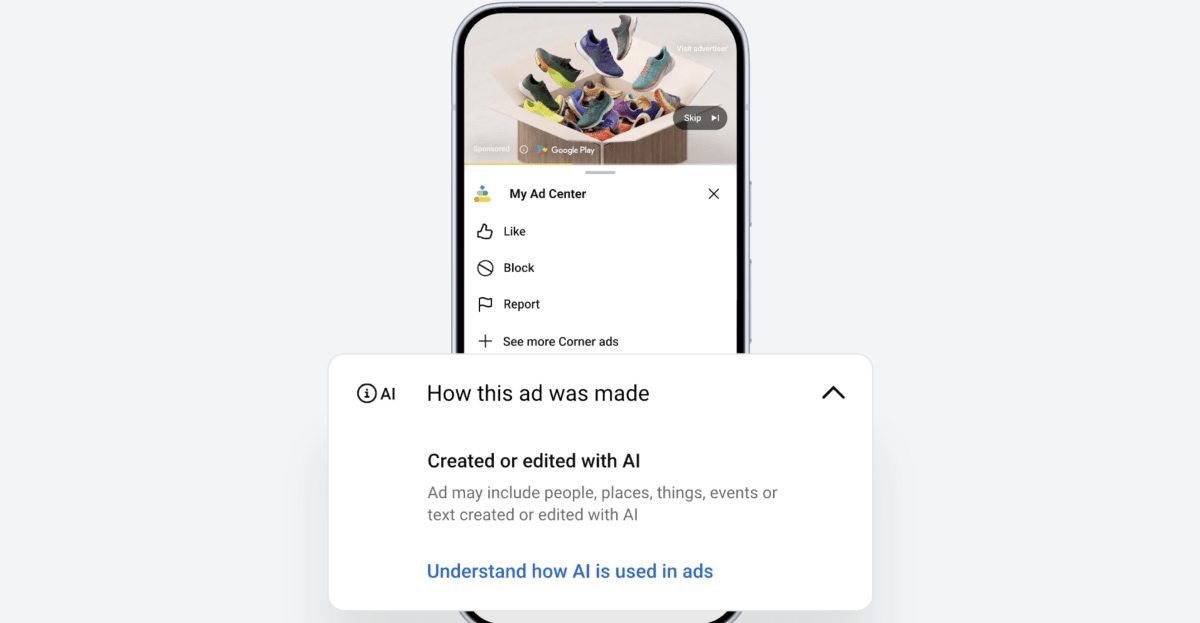
Google now lets users see whether ads on Search, Discover, and YouTube were made or edited with AI, through a new label in its My Ad Center. Ads created with Google's own generative AI tools will be labeled automatically, while those made with AI elsewhere require the advertiser to manually apply the label. This move aligns with Meta's existing disclosure practice and Google's broader push for transparency in synthetic media.
Summaries like this, in your inbox every morning.
Sign up free →What happened
Google launched a new "created or edited with AI" label in its My Ad Center, visible under the "how this ad was made" tab on Google Search, Google Discover, and YouTube. The label will be applied automatically to ads made with Google's own generative AI advertising tools, while ads created with AI elsewhere require manual disclosure. In some regions, the label may also appear directly on the ad itself.
Why it matters
Advertisers and platforms are moving toward transparency about AI-generated or AI-edited creative as regulators and users demand clearer disclosure. Google's step follows Meta's similar "AI info" label and Google's own 2024 disclosure requirement for synthetic or digitally altered political ads. This allows users to see which ads involved AI generation or editing when they tap the info button.
What to watch
Google has also expanded access to SynthID and C2PA content labels, tools designed to help spot deepfake content. The new labeling system is rolling out now, though availability varies by region.
Google's introduction of AI disclosure labels reflects a broader industry shift toward transparency in generative content. Meta has already deployed a similar "AI info" label, and Google itself signaled this direction in 2024 when it introduced disclosures for synthetic or digitally altered content in political ads. The new system acknowledges that users and regulators increasingly want to know when creative assets involve AI generation or editing, even outside the political advertising context.
The dual approach—automatic labeling for Google's own AI tools and manual disclosure for external AI creation—creates an incentive structure: advertisers using Google's native tools get automatic compliance, while those using third-party AI tools must proactively disclose. This may encourage adoption of Google's advertising AI products over competitors. At the same time, Google's expansion of SynthID and C2PA content labels (tools for detecting deepfakes) suggests the company is building a broader suite of content provenance and authenticity signals. Together, these moves position Google as enforcing clarity about AI's role in ad creation, a stance that may become table stakes as regulatory pressure mounts.
No discussion yet for this article
Get curated AI news from 200+ sources delivered daily to your inbox. Free to use.
Get Started FreeFree · takes 30 seconds · unsubscribe anytime
1 minute a day. The AI essentials.
200+ sources · Email / LINE / Slack
