What happened
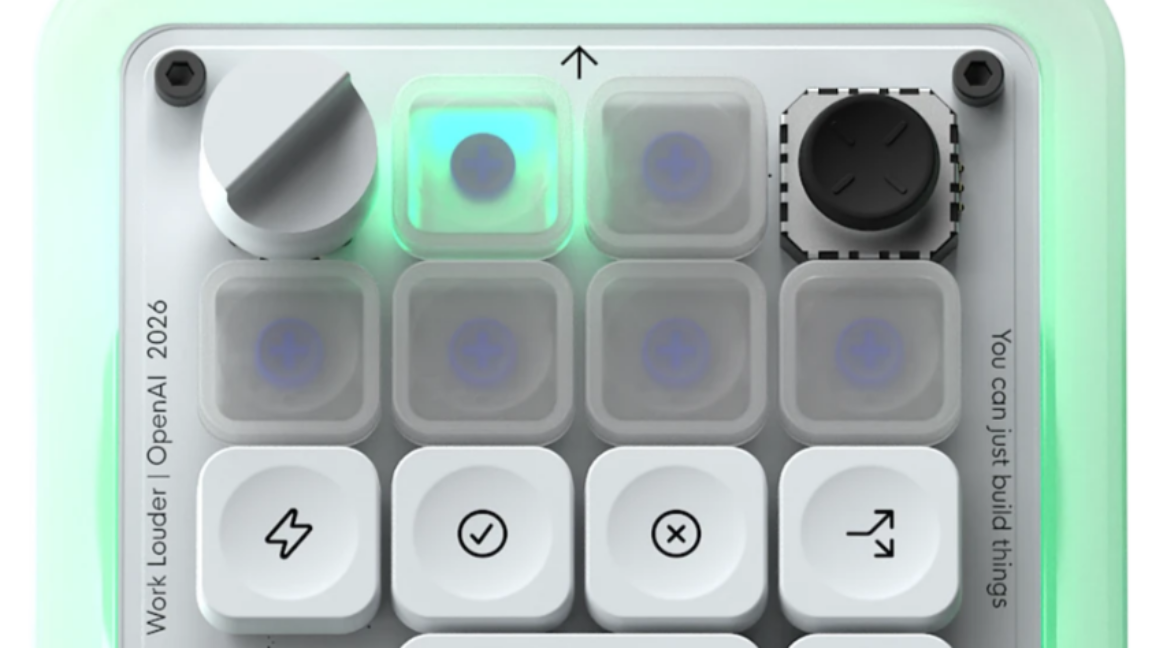
OpenAI launched the Codex Micro, a $230 RGB-lit mini-keyboard made in collaboration with Work Louder. The device features six frosted keys that display color-coded live feedback on up to six Codex threads, cycling from white (idle) to blue (thinking) to green (complete), amber (needs feedback), and red (error).
Why it matters
The keyboard lets users monitor and interact with multiple AI agents at a glance without moving focus away from the desktop—useful for people running Codex agents continuously in the background. This marks OpenAI's first branded hardware device, though it remains a niche tool for desktop-only workflows.
What to watch
The Codex Micro is described as a limited-run collaboration. Below the light-up keys are six programmable buttons that map by default to common Codex tasks (accepting/rejecting changes, branching threads, push-to-talk audio), but can be remapped through software or physically swapped using one of 32 included keycaps. Users can also program and cycle through five additional function sets for general computing shortcuts.
Summaries like this, in your inbox every morning.
The Codex Micro represents OpenAI's first step into branded hardware—a cautious one, focused on a narrow use case rather than a consumer-mass product. By partnering with Work Louder (which already manufactures a visually similar keyboard line), OpenAI avoids the manufacturing complexity of a full in-house device while keeping the focus on Codex-specific features: the six color-coded keys that monitor agent threads without forcing users to switch windows or alt-tab away from their main work.
The device's appeal lies in solving a real friction point for developers and power users running multiple AI agents concurrently on desktop. A glance at the keyboard reveals which tasks are idle, in progress, waiting for human input, or erroring—information that would otherwise require constant window-switching or multi-monitor setups. However, the device is explicitly limited to desktop workflows; the body notes that ChatGPT's mobile app already offers detailed monitoring away from the desk, positioning the Codex Micro as a specialized accessory for stationary agent-monitoring rather than a replacement for mobile interfaces.
The limited-run framing and niche targeting (specialized mini-keyboard for Codex users) suggest OpenAI is testing hardware as a potential revenue stream and user-engagement tool without the risk or commitment of a mass-market consumer device. The pricing ($230) aligns with high-end mechanical keyboards for professionals rather than mass-market peripherals.
Pick your industry and the AI tools you use, and get news related to your work every day.
Free · 30 seconds with Google · unsubscribe anytimeWhat is AIToday? →
Ask AI anything about this article. The AI reads this article, earlier AIToday articles, and Wikipedia, and cites its sources. Q&As are published on this page for other readers too.
Chunghwa Telecom president Rong-shy Lin said the shift from conversational AI to autonomous AI agents is resha…

CoreWeave fell 5% in premarket trading Friday and was on track to finish the week down 15%, after rebounding f…

Apple and Meta said they would jointly release a new open-weight AI model designed to run on high-end Macs, ai…

Investors put $38.5 billion into Asian startups in Q3, per Crunchbase data

A writer and entrepreneur opened his daily to-do list and found 156 items, and concluded that an AI assistant…

A longtime Anthropic investor told Fortune he expects shares priced around $1.8 trillion, below the company's…