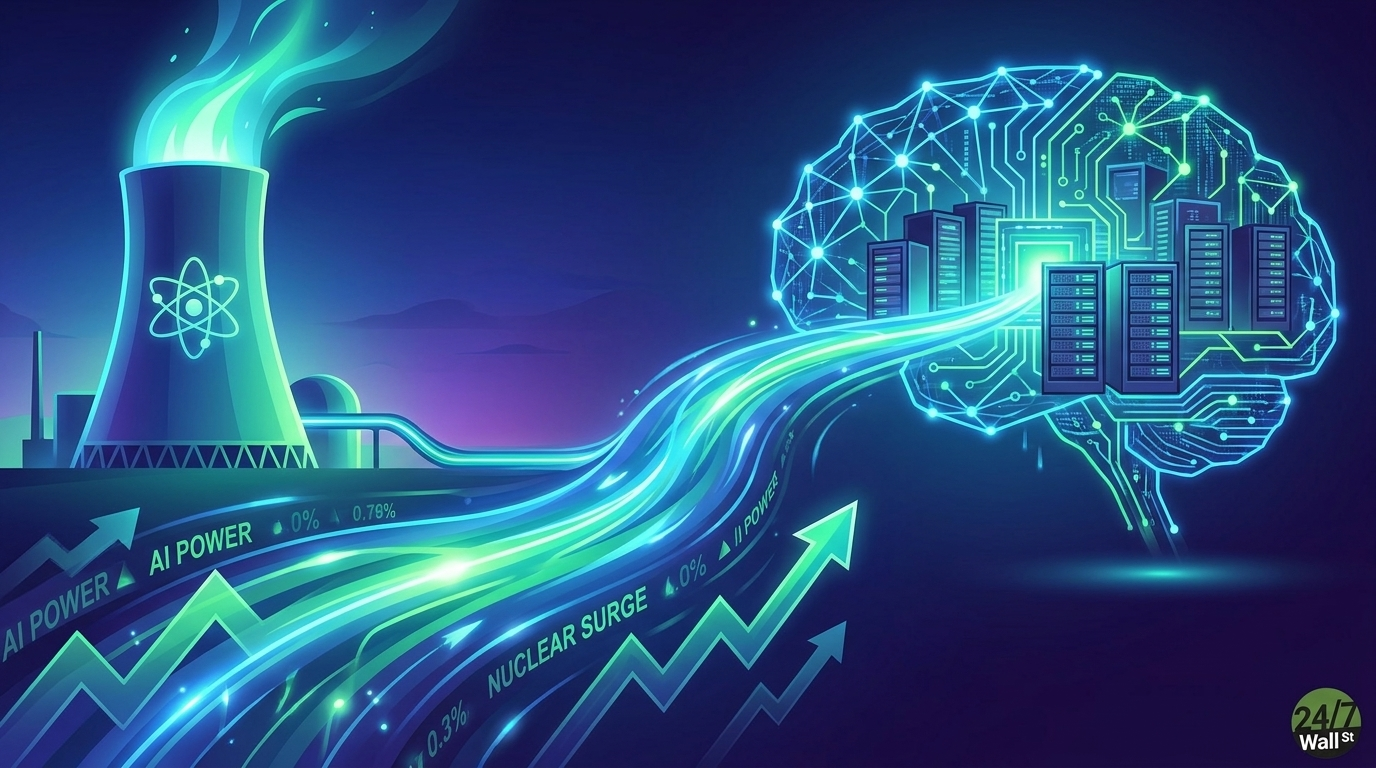
Three major U.S. nuclear power operators are rallying as artificial intelligence data centers drive electricity demand sharply higher. The Department of Energy projects data centers will consume up to 12% of U.S. electrical demand by 2028, and hyperscalers—large cloud providers—are locking in long-term nuclear power contracts.
Constellation Energy has signed 920 MW of 15- to 20-year agreements with investment-grade customers, Vistra has secured backing from NVIDIA and KKR with up to $1.0 billion committed, and NextEra is managing roughly 21 GW of large-load customer interest.
Each company is positioned differently but all benefit from the same underlying shift: AI workloads pulling forward a decade of electricity demand growth.
What happened
Three U.S. nuclear operators—Constellation Energy, Vistra, and NextEra Energy—are benefiting from a surge in power demand from AI workloads. The Department of Energy projects data centers will account for up to 12% of U.S. electrical demand by 2028. Constellation's CEO stated that "projected spending levels for 2026 are nearly 75% higher than last year and continue to be revised upward" from hyperscaler customers.
Why it matters
Nuclear power is emerging as the always-on backbone that cloud providers (hyperscalers) actually want to buy. Constellation has signed 920 MW of long-term nuclear power-purchase agreements (15 to 20 years) with investment-grade customers beginning 2029 to 2032. Vistra is designated as a preferred power provider under a joint venture with NVIDIA, KKR, and Kuwait Investment Authority with an initial commitment of up to $1.0 billion. NextEra has roughly 21 GW of large-load interest from customers, with 12 GW in advanced discussions.
What to watch
Constellation shares closed at $282.50 on August 14 with a forward P/E near 23 and an average Wall Street target of $349.96. Vistra closed at $148.13 with a forward P/E of 16 and an average target of $221.74. NextEra closed at $86.19 with a 2.77% dividend yield. Key upcoming catalysts include PJM's capacity framework finalization, ERCOT queue developments, and NextEra's year-end large-load contract announcement.
Ask the AI about this article →
The convergence of artificial intelligence workloads and nuclear power supply represents a structural shift in how hyperscalers are securing energy. The Department of Energy's projection that data centers will account for up to 12% of U.S. electrical demand by 2028 is the factual anchor—it means roughly a decade of electricity demand growth compressed into the next few years. Constellation's CEO explicitly quantified the spending acceleration: 2026 capex is now nearly 75% higher than 2025 and rising further. This is not speculative; these are committed or near-committed dollars from investment-grade customers.
The three operators tackle the opportunity differently. Constellation is the purest play—the largest U.S. nuclear fleet with long-term PPAs already locked in. Vistra has added a critical advantage via the Helix partnership with NVIDIA and KKR, which signals that a GPU maker is willing to anchor power demand through a single provider and suggests the deal structure (rack-to-grid integration) is how enterprise AI infrastructure will be bought going forward. NextEra is larger and brings a regulated Florida customer base plus the Duane Arnold nuclear restart on track for Q1 2029, but its upside depends on converting its 21 GW of interest into binding contracts—management promised a year-end announcement on that front.
The risks are real but secondary to the demand thesis. Constellation faces a refueling outage dip in Q2 and the expiration of Illinois' ZEC subsidy program in May 2027. Vistra absorbed $472 million in unrealized mark-to-market hedge losses in Q2, a reminder that financial derivatives can obscure cash fundamentals. NextEra must navigate a multi-state merger approval process for Dominion and contend with top-line lumpiness (Q2 revenue missed consensus). None of these risks invalidate the underlying AI-driven power demand trajectory; they simply remind readers that execution risk exists alongside structural opportunity.
For example, today's edition would include:
AI-summarized, only the topics you pick — one digest a day via Email, Slack, or Discord.
Free · takes 30 seconds · unsubscribe anytimeWhat is AIToday? →
Ask AI anything about this article. Q&As are published on this page for other readers too.
BHP, the world's largest mining company by market capitalization, has deployed AI across its operations
Team Liquid announced a new five-year extension of its long-running collaboration with Dell Technologies' Alie…
A University of Mississippi study published in Journal of Interactive Advertising found that AI ads succeed wh…

Goldman Sachs Research says AI supply and demand won't balance until the first half of 2028
Lam Research broke ground yesterday on a new lab in Tualatin, Oregon

Visa, Mastercard, and Fiserv joined the Agentic Payments Alliance (APA), a 26-company coalition led by stablec…