U.S. hyperscalers' massive AI investments will boost Japan's semiconductor exports by roughly 17% and related industries' capital spending by about 9%, adding about ¥2.2 trillion annually. However, the real GDP impact is estimated at only 0.1–0.2%, well below Japan's potential growth rate, meaning the global AI boom is unlikely to overheat Japan's domestic economy even as stock gains in semiconductor and AI shares lift household wealth.
Summaries like this, in your inbox every morning.
Sign up free →What happened
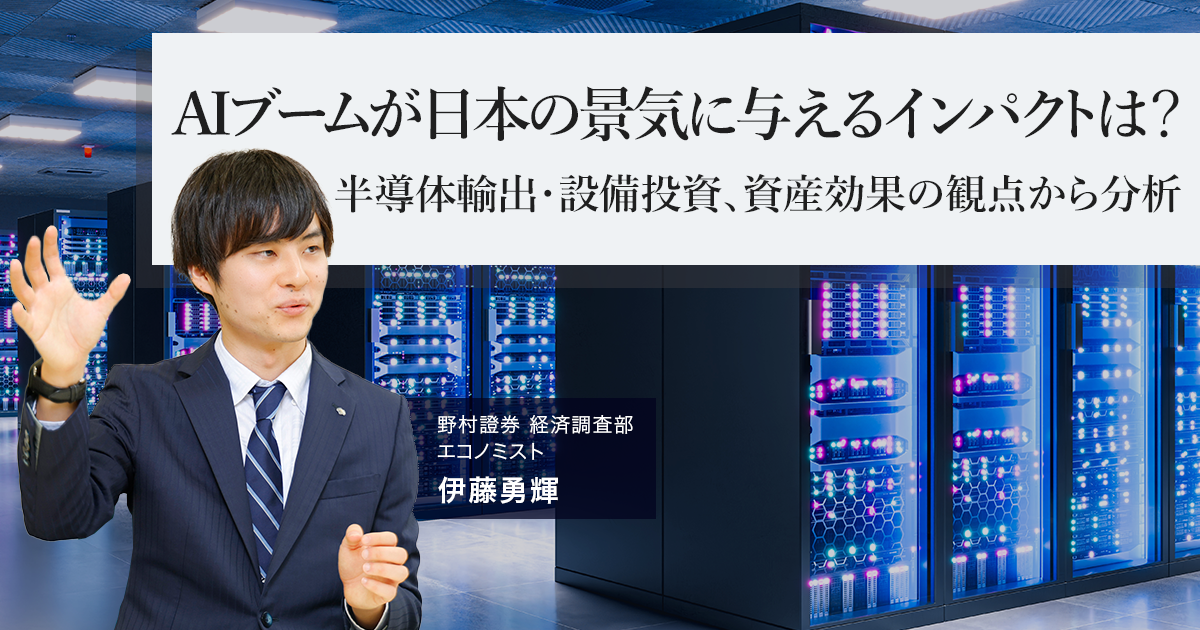
Nomura Securities economist Itō Yūki analyzed how the global AI boom—driven by six major U.S. hyperscalers (Amazon, Alphabet, Nvidia, Oracle, Microsoft, Meta)—affects Japan's economy. Their capital expenditure is projected to grow 92% (in yen) in 2026, which would boost Japanese semiconductor-related exports by approximately 17% and related industries' capital investment by about 9%, adding roughly ¥2.2 trillion annually to the economy.
Why it matters
Despite the AI boom's scale in the U.S., its real GDP impact on Japan is estimated at only 0.1–0.2%, well below Japan's potential growth rate of 0.6–0.7% (Bank of Japan estimate). Even accounting for government investment in physical AI (¥10.5 trillion through 2040, or roughly ¥0.8 trillion annually), the effect remains limited. However, stock price gains in semiconductor and AI shares could boost household wealth and consumption through asset effects, though this alone is unlikely to overheat the domestic economy.
What to watch
The Philadelphia Semiconductor Index (SOX) has risen sharply in recent months, and Japanese semiconductor and AI stocks are driving Japan's stock gains. Household holdings of risky assets (stocks and investment trusts) are increasing, with property income (dividend gains) rising in disposable income. The Bank of Japan mentioned AI-related demand in its April outlook and discussed regional AI demand dynamics at its July 9 branch managers' meeting, indicating close monitoring—though current conditions do not warrant interest-rate hikes.
The global AI boom, anchored in U.S. hyperscalers' record capital spending plans, creates two transmission channels to Japan's economy: first, increased demand for semiconductor-related products and manufacturing equipment exports; second, domestic capital investment in production capacity. The body shows that U.S. hyperscaler capex and Japanese semiconductor export volumes move in tandem, lending credibility to the forecast that a 92% increase in U.S. investment would drive Japanese exports up 17%. This export gain then stimulates domestic capital investment in related manufacturing sectors by roughly 9%.
However, the cumulative effect—roughly ¥2.2 trillion in new annual activity—amounts to only 0.1–0.2% of real GDP growth when memory price inflation is stripped out. This sits well below Japan's structural growth potential. The government's own AI strategy, budgeting ¥10.5 trillion through 2040 for physical AI applications, translates to only ¥0.8 trillion per year, or about 0.1% of nominal GDP. Even combined, direct investment channels cannot ignite a domestic boom.
The article does identify a secondary channel: asset price gains. As semiconductor and AI stocks surge (the Philadelphia SOX index has climbed sharply in recent months), household wealth in equities and investment trusts rises, boosting reported property income and disposable income. This "wealth effect" could encourage consumption, but the body's conclusion is that even this offset cannot push Japan's economy into overheating. The tension between soaring stock valuations and modest real economic impact reflects, the economist notes, the fact that corporate earnings—especially for Japanese firms listed on the Nikkei—flow partly to overseas operations and foreign GDP, not solely to domestic growth.
No comments yet. Be the first to share your thoughts!
Log in to join the discussion


Get curated AI news from 200+ sources delivered daily to your inbox. Free to use.
Get Started FreeFree · takes 30 seconds · unsubscribe anytime
1 minute a day. The AI essentials.
200+ sources · Email / LINE / Slack
