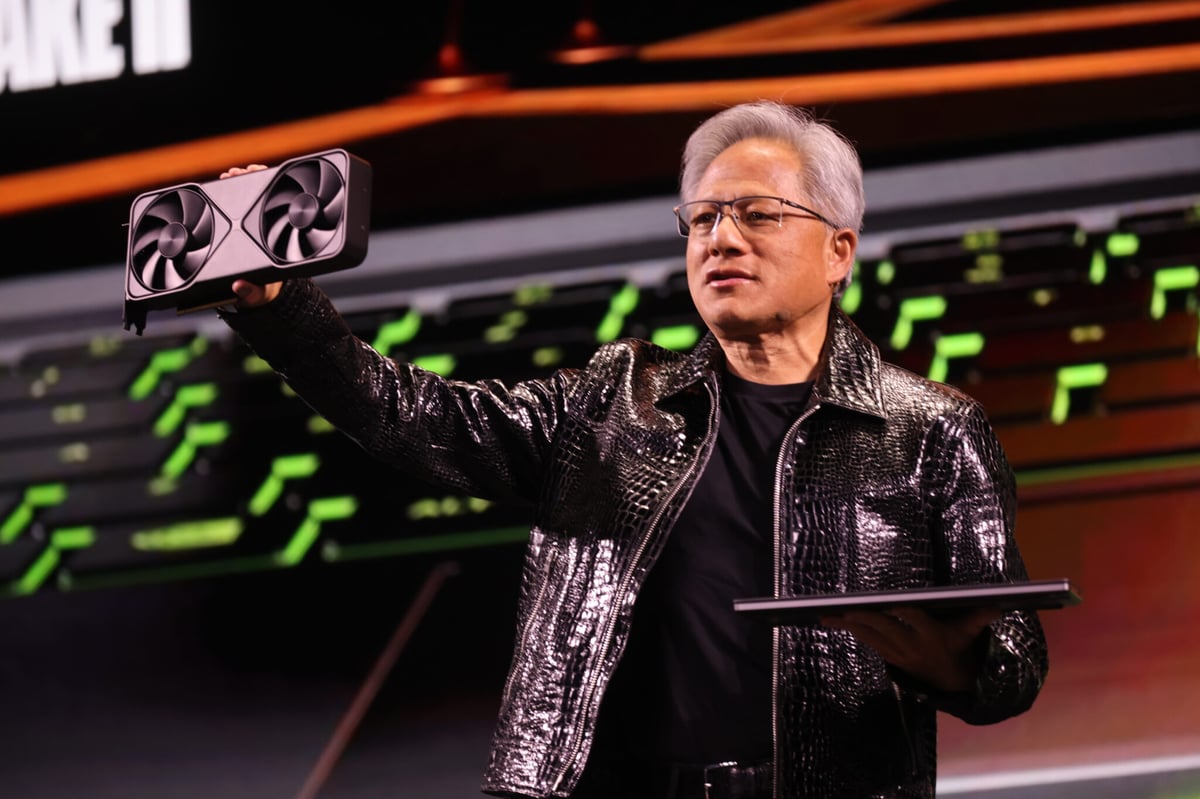
Nvidia CEO Jensen Huang confirmed that the Vera Rubin processor systems are already in mass production, dismissing recent reports of delays caused by thermal, memory qualification, and manufacturing issues. The company expects Vera Rubin to drive $1 trillion(約160兆円) in combined revenue with Blackwell processors in 2026 and 2027, double its prior forecast, and analysts believe the product can help Nvidia maintain its leadership in the competitive AI inference market.
Summaries like this, in your inbox every morning.
Sign up free →What happened
Nvidia CEO Jensen Huang denied reports from KeyBanc Capital Markets and SemiAnalysis that thermal issues, high-bandwidth memory qualification problems, and manufacturing issues with networking components could delay the Vera Rubin systems launch. Huang stated that Vera Rubin is already in production with "giant amounts of production incoming."
Why it matters
Vera Rubin is a critical driver of Nvidia's growth strategy. The company is anticipating $1 trillion(約160兆円) in revenue from Vera Rubin and Blackwell processors combined in 2026 and 2027—double the $500 billion(約80兆円) it expected from these architectures in 2025 and 2026. Vera Rubin can significantly reduce AI inference costs, helping Nvidia maintain its dominance in the AI inference market despite rising competition.
What to watch
Wall Street's 12-month median price target for Nvidia is $300, implying a potential 45% gain. However, analysts project Nvidia's earnings-per-share growth will accelerate to 88% in fiscal 2027 (versus 60% last year), and if the stock trades at 25.5 times earnings by fiscal 2029 with earnings per share at $16.06, the stock could reach $409—double its current price.
Recent reports from KeyBanc Capital Markets analyst John Vinh and research firm SemiAnalysis suggested that Nvidia's next-generation Vera Rubin processors and chip systems could face significant delays due to three technical hurdles: thermal issues, problems with the qualification of high-bandwidth memory (HBM), and manufacturing problems with networking components. For investors, any delay to Vera Rubin was alarming given that the company has flagged it as one of the most important product releases in its history.
However, Nvidia CEO Jensen Huang moved quickly to quash these concerns. In comments reported by Bloomberg, Huang stated that the delay reports are "not true" and emphasized that "Vera Rubin is already in production. Giant amounts of production incoming." This assertion carries significant weight because Nvidia is betting heavily on Vera Rubin to drive growth in the next two years. The company expects to generate $1 trillion(約160兆円) in combined revenue from Vera Rubin and Blackwell processors in 2026 and 2027—a doubling of its prior forecast of $500 billion(約80兆円) from these two architectures in 2025 and 2026.
The strategic rationale for this aggressive revenue projection centers on Vera Rubin's ability to substantially reduce artificial intelligence inference costs, the computational step where an AI model produces answers after being trained. Nvidia already dominates the AI inference market despite mounting competition, and Vera Rubin is positioned to further cement that leadership by making AI inference more economical for customers. Wall Street has reacted positively to Nvidia's prospects: 62 of the 66 analysts covering the stock rate it as a buy, with a 12-month median price target of $300, implying a 45% gain from current levels. Moreover, earnings-per-share growth is projected to accelerate to 88% in fiscal 2027, well above the 60% growth Nvidia achieved in the prior year. If Nvidia trades at 25.5 times earnings by fiscal 2029 with earnings per share reaching $16.06, the stock could trade at $409—double its current price—suggesting the Vera Rubin rollout remains key to the company's valuation story.
Vera Rubin represents a pivotal moment for Nvidia's growth trajectory. The company's decision to double its 2026–2027 revenue forecast from these chip architectures—from $500 billion(約80兆円) to $1 trillion(約160兆円)—underscores how central this product is to Nvidia's strategic plans. By dismissing the delay reports and affirming that mass production is already underway, CEO Huang is signaling confidence that the company can meet extraordinarily high demand despite the technical challenges (thermal issues, memory qualification, and networking component manufacturing) that analysts had flagged.
The strategic importance of Vera Rubin lies in its ability to reduce AI inference costs significantly. As AI inference becomes a larger cost component for data centers and cloud providers, a processor that cuts those expenses while maintaining Nvidia's market dominance could create a substantial competitive moat. Wall Street's bullish stance—with 62 of 66 analysts rating the stock a buy and a median price target of $300 (implying 45% upside)—reflects confidence that Vera Rubin will sustain the company's historical growth rate. If earnings-per-share growth accelerates to 88% in fiscal 2027, as forecasters expect, Huang's production claims suggest Nvidia is well-positioned to deliver on that promise.
AI-summarized, only the topics you pick — one digest a day via Email, Slack, or Discord.
Free · takes 30 seconds · unsubscribe anytime
No discussion yet for this article
Get curated AI news from 200+ sources delivered daily to your inbox. Free to use.
Get Started FreeFree · takes 30 seconds · unsubscribe anytime
1 minute a day. The AI essentials.
200+ sources · Email / LINE / Slack
