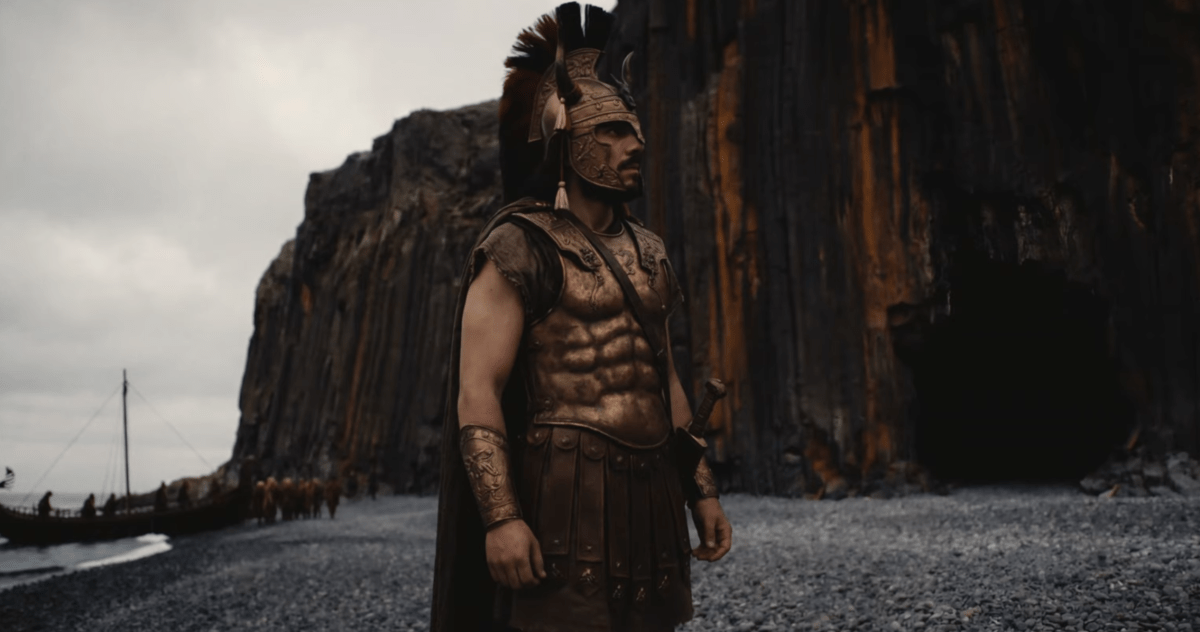
Fountain 0 announced Odysseus: The Fall, an AI-generated film reimagining of The Odyssey, timed to capitalize on the release of Christopher Nolan's $250 million(約400億円) Odyssey adaptation. Produced on a "mid-five figures" budget using AI video tools, the film exemplifies a growing trend of AI-generated entertainment positioned as direct-to-video knockoffs rather than serious artistic works, with the studio framing it partly as a showcase for its AI production capabilities rather than a standalone film experience.
Summaries like this, in your inbox every morning.
Sign up free →What happened
Film studio Fountain 0 announced Odysseus: The Fall, an AI-generated reimagining of The Odyssey directed by Ash Koosha, set to be available for digital rent or purchase later this summer. The movie was produced on a "mid-five figures" budget using Kling's AI video generator and Google's Nano Banana, a fraction of the $250 million(約400億円) Christopher Nolan spent on his own Odyssey adaptation.
Why it matters
Fountain 0 is explicitly positioning the film to capitalize on buzz around Nolan's project—which is tracking $80–$100 million(約160億円) in its opening—and to market its AI production workflow to viewers interested in AI rather than traditional filmmaking. Executive chairman Tom Rogers told Variety the company hopes the release will convince people to compare it with Nolan's film and see "the state of the art in AI filmmaking today," but the company's strategy reads more as advertisement than artistic endeavor.
What to watch
Odysseus: The Fall is available for digital rental or purchase later this summer. The trailer reveals the movie's reliance on AI aesthetics—short shots with "over-glossy" visuals and uncanny character movements—and Koosha voices the entire cast, including an Odysseus modeled after his own likeness. Particle6 has also announced plans for a feature-length movie starring an avatar.
This weekend, Christopher Nolan's Odyssey adaptation will open in theaters, tracking $80–$100 million(約160億円) in its opening days and generating substantial cultural momentum around a high-profile reimagining of Homer's classic. On Tuesday, film studio Fountain 0 announced it would attempt to ride that wave with Odysseus: The Fall, an AI-generated film of its own, directed by Ash Koosha and set for digital rental or purchase later this summer.
The production pipeline reveals the economics of AI filmmaking. Koosha wrote, directed, and edited the film with a budget in the "mid-five figures"—a fraction of the $250 million(約400億円) Nolan invested in his adaptation. Fountain 0 used Kling's AI video generator and Google's Nano Banana to create the visuals. The film marks Koosha's second collaboration with the studio; his previous project, Dreams of Violets, an AI-generated docudrama about civil unrest in Iran between late 2025 and early 2026, cost only $2,000 to produce. For Odysseus: The Fall, Koosha modeled the title character after his own likeness and voiced the entire cast himself, with his brother Pooya assisting on much of the work.
The trailer makes the reliance on AI generation immediately obvious. Every shot is short, with an "over-glossy aesthetic" characteristic of AI-generated imagery, and the characters move with an "uncanny stiffness" that betrays their artificial origin. Yet Fountain 0 frames this not as a limitation but as the company's genuine artistic achievement. Executive chairman Tom Rogers told Variety that the film is aimed at audiences who "might not like going to the movie theaters, but have a real interest in AI and what's going on." More pointedly, Rogers suggested that when the film releases, it will serve as "a catalyst" for comparisons between "the highest state of human filmmaking achievement" (Nolan's work, which Rogers expects reviews will praise) and "the top state of the art in AI filmmaking today" (Fountain 0's own output). This framing positions Odysseus: The Fall less as a creative interpretation of The Odyssey than as an elaborate advertisement for the studio's production workflow.
The strategy echoes the direct-to-video knockoff model of earlier decades—a low-budget imitation designed to capture commercial attention from a major release without investing genuine creative labor. Rogers's claims of artistic legitimacy are hard to square with the reality: Dreams of Violets, despite a possible argument that it raised awareness of Iran's human rights history, plays as "a collection of prompted clips." Odysseus: The Fall appears designed primarily as an AI-hype stunt, joining other recent attempts by firms like ElevenLabs (which released an Odyssey audiobook narrated by an AI-generated facsimile of Michael Caine) and Particle6 (which has promoted an "AI actress" named Tilly Norwood and announced plans for a feature-length movie starring an avatar) to manufacture relevance through novelty rather than artistic merit.
What these companies seem to overlook is the core driver of ticket sales and cultural discourse: the emotional resonance and collaborative human craftsmanship that traditional filmmaking embodies. Nolan's Odyssey has generated both effusive praise and hateful backlash—powerful reactions that reflect the film's ability to elicit genuine emotion and spark conversation. The tech boosters behind Fountain 0, Particle6, and similar ventures have yet to release a film or series that generates comparable excitement. Until they do, stunts like Odysseus: The Fall—riding the coattails of genuine artistic achievement—are all they have to offer.
Fountain 0's announcement of Odysseus: The Fall arrives at a carefully calculated moment: Christopher Nolan's Odyssey adaptation is tracking $80–$100 million(約160億円) in its opening weekend, generating significant cultural buzz around a high-profile reimagining of Homer's classic. By releasing an AI version of the same source material, Fountain 0 is attempting to leverage that attention—not to offer a genuine alternative interpretation, but to advertise its AI-driven production capabilities. Executive chairman Tom Rogers made this explicit in his Variety comments, positioning the film as a point of comparison between "the highest state of human filmmaking achievement" and the "top state of the art in AI filmmaking today." This framing reveals the true business model: the film is less a creative work than a marketing vehicle for the studio's workflow.
The production budget disparity underscores the appeal of AI generation for studios willing to sacrifice artistic depth. At "mid-five figures" compared to Nolan's $250 million(約400億円), the cost structure mirrors the economics of direct-to-video knockoffs that thrived in previous decades—low-budget imitations designed to capitalize on the commercial momentum of major releases without investing in genuine filmmaking craft. Fountain 0's earlier project, Dreams of Violets, cost only $2,000 to produce, suggesting a pattern: rapid-turnaround AI-generated content with minimal human creative labor beyond initial prompting and direction.
The visual evidence in the trailer—short shots, over-glossy aesthetics, uncanny character movement—confirms that the technology cannot yet match the precision, emotional resonance, or collaborative artistry that drives audience engagement with films like Nolan's. The article notes that both Fountain 0 and Particle6 seem to believe they can "troll their way into relevance," but their strategy appears to misread what audiences actually value: the emotional impact and human craftsmanship embodied in traditional filmmaking, not the novelty of AI generation itself.
No discussion yet for this article
Get curated AI news from 200+ sources delivered daily to your inbox. Free to use.
Get Started FreeFree · takes 30 seconds · unsubscribe anytime
1 minute a day. The AI essentials.
200+ sources · Email / LINE / Slack

