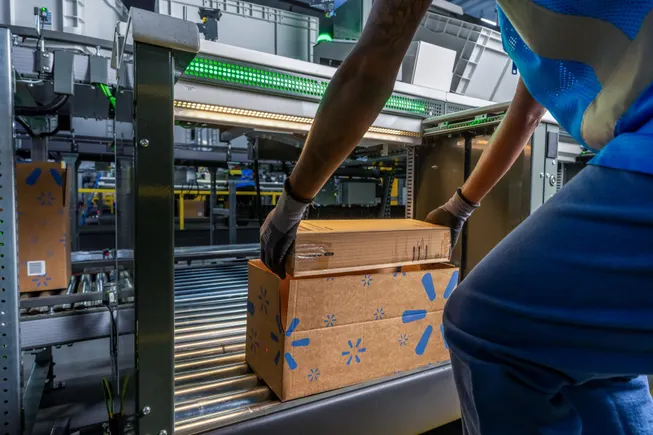
Walmart is embedding AI agents and digital twin simulations into its supply chain operations to navigate 2026's tariff and geopolitical turbulence. Instead of reacting to disruptions after they occur, the company can now model how its network responds to facility closures, weather events, or sudden demand swings—allowing associates to implement recommendations faster. This shift reflects the broader evolution of supply chain technology from statistical models to large language models to AI agents.
Summaries like this, in your inbox every morning.
Sign up free →What happened
Walmart's supply chain technology team is using AI agents and digital twin technology to manage inventory, transportation, and fulfillment across its network. The company partners with OpenAI and Google to offer role-specific AI certifications through its employee platform Squiggly, and data science teams build custom AI tools tailored to business needs.
Why it matters
Supply chain leaders face growing complexity from tariffs, geopolitical disruptions, and extreme weather in 2026. By simulating how its logistics network responds to facility closures, transportation delays, or sudden demand shifts, Walmart can anticipate problems and respond faster—reducing the manual guesswork that has traditionally defined supply chain management.
What to watch
Walmart's supply chain technology team now oversees AI-driven decisions across nodes (where products are received, processed, stored, or shipped), fulfillment engines, and inbound/outbound transportation. Same-day delivery is becoming standard; Sam's Club launched a one-hour delivery option in April.
Walmart's supply chain technology organization is deepening its reliance on AI and simulation to manage one of retail's most complex operational challenges. According to Indira Uppuluri, SVP of supply chain technology, her teams already had access to large language models and open source models popular among enterprises, but the breadth and depth of data available now—coupled with machine learning—provides stronger signals for decision-making in an increasingly turbulent landscape.
The company's supply chain technology team is responsible for a vast set of moving parts: managing nodes (facilities where products are received, processed, stored, or shipped), running the fulfillment engine that sources inventory and sets delivery standards, and overseeing inbound, outbound, and middle-mile transportation technology. Same-day delivery has become a competitive necessity; Walmart-owned Sam's Club debuted a one-hour delivery option in April. To optimize this complexity, Walmart deploys AI agents and models that give associates a holistic view of how the entire company's resources are being leveraged, rather than forcing them to optimize each node individually. Uppuluri identified three balancing factors: assortment, speed, and cost.
Central to Walmart's 2026 strategy is digital twin technology—virtual replicas of the company's logistics network used to simulate how goods move under stress. If a fire closes a facility, if transportation is delayed, or if customer demand suddenly shifts, the system can model the network's response and surface recommended actions for associates to implement. This approach is a direct response to the challenge supply chain leaders face: much of their work involves preparing for and reacting to unpredictable events—weather, geopolitical conflict, tariffs—that create barriers to product movement. Sometimes these events can be anticipated; often they cannot. Digital twins compress the response cycle by allowing teams to test and validate decisions before deploying them live.
Walmart's commitment to AI extends to workforce enablement. The company partners with OpenAI and Google on role-specific AI certifications offered through Squiggly, an employee-facing platform that also encourages associates to build their own custom tools. Data science and optimization teams within the supply chain organization build bespoke AI tools to meet specific business needs. As Uppuluri reflected, the supply chain industry has evolved continuously—from stochastic models to large language models to AI agents and agentic workflows—and the models backing supply chain operations will continue to evolve in tandem with the business itself.
Walmart's supply chain technology organization has moved beyond predictive models to a more dynamic, real-time approach powered by AI agents and digital simulation. The shift reflects a broader industry evolution: as Indira Uppuluri, SVP of supply chain technology, noted, the industry has progressed from stochastic models to large language models and now to agentic AI systems. What has changed is not just the type of AI available, but the scale and specificity of insight. Weather patterns and customer buying history, combined with machine learning, now generate stronger signals than before—giving supply chain teams visibility into how the entire network operates as a single system rather than isolated nodes. This is particularly critical in 2026, a year marked by tariff-driven and geopolitical-fueled turbulence that has made supply chain planning more unpredictable and urgent.
The introduction of digital twin technology addresses one of supply chain management's core challenges: the inability to anticipate and prepare for unexpected disruptions. Rather than only reacting after a fire, facility closure, or transportation delay occurs, Walmart's teams can now simulate these scenarios and test responses in a virtual environment. This reduces decision latency and improves confidence in recommendations associates implement. The company's partnership with OpenAI and Google on AI certifications, combined with investment in custom tools built by data science teams, suggests Walmart is not treating AI as a plug-and-play solution but as a foundation for sustained capability building across 2 million employees.
No comments yet. Be the first to share your thoughts!
Log in to join the discussion

Get curated AI news from 200+ sources delivered daily to your inbox. Free to use.
Get Started FreeFree · takes 30 seconds · unsubscribe anytime
1 minute a day. The AI essentials.
200+ sources · Email / LINE / Slack
